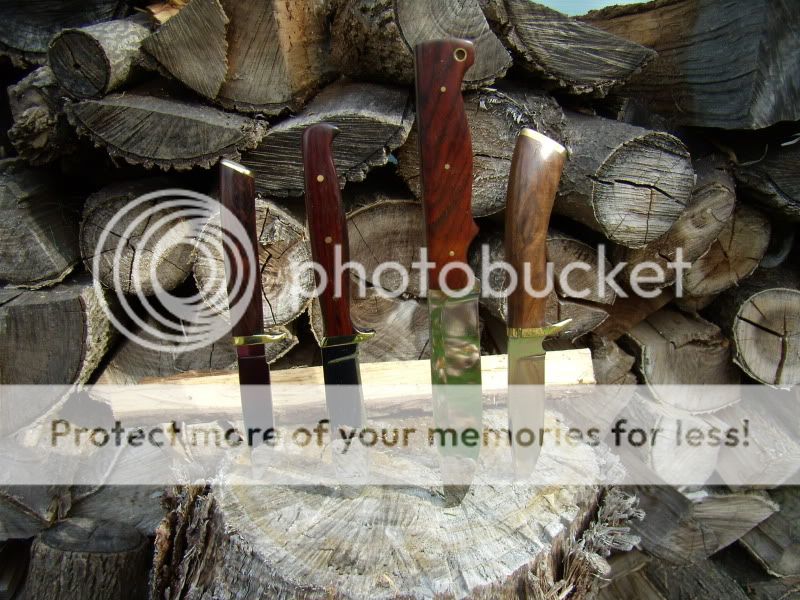
Finish for Black Walnut?

Joined
Jan 30, 2009
Messages
580
Hello - I am wondering on how best to finish some figured black walnut scales ((Natural /not stabilized)). I have glued up and ready for shaping / finishing? Would love to hear some methods and even better if you have pics - thanks in advance!
Cheers,
Kris
 
All of these have tungoil finish on them. The one on the right is walnut, two in the middle are cocobolo, and the one on the left is king wood.

Mike

PA260071.jpg
 
Hey Kris -- I've stashed a few links to threads that might help. -- Phil

Step by Step Guide to finishing Burl & Figured Wood Handles
Pasted from <http://www.bladeforums.com/forums/showthread.php?t=688972>

Finishing wood handles...
Pasted from <http://www.bladeforums.com/forums/showthread.php?t=688561>

Recommendation? Black walnut (finishing)
Pasted from <http://www.bladeforums.com/forums/showthread.php?t=695035>


How do you finish wood handles?
Pasted from <http://www.bladeforums.com/forums/showthread.php?t=773240>
 
I am not a knife maker but a gunstock maker. Here's my way of doing things. The ancient military way of treating gunstocks was to submerge them in linseed oil for about 24 hours. Guess it worked for most military rifles for a couple centuries. Now I dislike linseed oil because it is not very effective against moisture intrusion and the old standby for finishing wood was to apply a coat a day for a week-a coat a week for a month-a coat a month for a year-and a coat a year forever. I prefer Tru-Oil or Pro Custom Oil which are both 5x as effective against moisture intrusion and easier to use. Be sure your wood is locally dry (about 12% nationwide but more on the NW coast and maybe 5-7% in desert areas). Apply finish under the scale. After finish sanding, apply the finish and let dry (4-24 hours depending upon local humidity). Now remove all the finish with 0000 steel wool. First it will get dull then a bit brighter as first you dull the finish then remove it. At this point you are left with "finish IN wood" as opposed to "finish ON wood". Do you want to fill the pores? Classy guys always do! So apply a coat THICKLY and let PARTIALLY dry...then smear the sticky mess to fill the pores. Now let dry and remove the finish as before. If all pores are not filled...repeat. Now you have a choice. Do you want finish IN or ON wood? Once the pores are filled, you have finish IN wood. You can apply wax. But you may wish to build up the finish. You do this by applying finish thinly and lightly applying steel wood to just dull the surface and take little tits or heavy areas off. When you like it-quit. Some then cheat and spray with Deft which is a harder finish. Lots of other ways and finishes, but the fanciest Italian shotguns use this method (minus the Deft). A gunstock takes about an hour of steel wooling between finishes but the small area of a knife is very quick.
 
Thanks for this thread. I was taught by a gunstock maker as well and what PeterB wrote up is almost exactly how I do it too. You want the finish in the wood!! Trust us. I like Pro-Custom oil, as I think it dries a little quicker and harder than Tru-oil. Also it stores much, much longer in the can. The only thing I do differently is I wet-sand with 400 grit sandpaper not 0000 steel wool in the beginning stages. And, I'll have to try the Deft topper - that's a new one for me.

Thanks,
-M
 
I also mix the very first coat with paint thinner to get it to penetrate a bit deeper. Please fill the pores with finish as described. If you use a filler or stain/filler, it detracts from the beauty of the wood. I find that Pro-Custom Oil gives a bit more realistic color than Tru-Oil which darkens a bit. In either case, I fill the cans with marbles to bring the liquid to the surface. You want to eliminate air in the can which causes the hardeners to react within the can, reducing life. One can is good for a lot of knives. Tru-Oil is Birchwood Casey available at about any sporting goods. Pro-Custom Oil is available from Brownells. I am making 1911 grips now and using from my supply of gunstock blanks and turned stocks which I discovered had flaws when turned. These give me LOTS of 1911 grip material and salvage beautiful wood which would not have made gunstocks. So far, the best stabilizers I have found is K&G in Arizona.
 
Back
Top