
-
The BladeForums.com 2024 Traditional Knife is available! Price is $250 ea (shipped within CONUS).
Order here: https://www.bladeforums.com/help/2024-traditional/
You are using an out of date browser. It may not display this or other websites correctly.
You should upgrade or use an alternative browser.
You should upgrade or use an alternative browser.
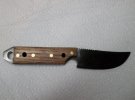
finished my first
- Thread starter redd1981
- Start date


I have to say thanks to you guys for pointing me in the right direction and I made alot of mistakes and learned from everyone of them.
Thanks..... already quite a few hours into the next


- Joined
- Sep 3, 2010
- Messages
- 2,460
I hope you don't consider this making fun, but I am observing.
1. you suffer from the dreaded blocky handle syndrome. embrace the curve. they are more comfortable.
2. you seem to suffer from a disease that I have quite badly. You feel the drive to just be done, and then work on improving your next knife. While I understand this, I will encourage you to pay attention to detail. I am working on knives 6 and 7 right now, and I have a lot of knives that I would love to go back and redo becuase I left some imperfections on them. they work well, but they are not as nice as I would like. Attention to detail is a skill that needs to be developed for pride in your work to develop. Both are every important.
Again, I am not criticizing you. I am just looking at your work and giving you advice based on my experiences. Feel free to ignore me.
1. you suffer from the dreaded blocky handle syndrome. embrace the curve. they are more comfortable.
2. you seem to suffer from a disease that I have quite badly. You feel the drive to just be done, and then work on improving your next knife. While I understand this, I will encourage you to pay attention to detail. I am working on knives 6 and 7 right now, and I have a lot of knives that I would love to go back and redo becuase I left some imperfections on them. they work well, but they are not as nice as I would like. Attention to detail is a skill that needs to be developed for pride in your work to develop. Both are every important.
Again, I am not criticizing you. I am just looking at your work and giving you advice based on my experiences. Feel free to ignore me.

Stacy E. Apelt - Bladesmith
ilmarinen - MODERATOR
Moderator
Knifemaker / Craftsman / Service Provider
- Joined
- Aug 20, 2004
- Messages
- 38,480
+1 for what Geek advised.
Take your time and regularly take a break. When you come back, look over the knife for areas that need more work.
As far as advise on this and future knives, I have one major concern:
You have a very deep finger choil and a rivet directly above it in the thinnest area of the knife. If the knife gets any major twist or lateral stress , it will break there.
You would be best to use two or three rivets, placing the forward one on the center-line of the handle, and just above the point where the handle meets the choil. The rearward rivet should be placed at a point that optically matches the spacing of the forward rivet. If using a center rivet, it should be placed equidistant between these two. Using Corby bolts will assure a strong handle and no need for more than three rivets ( two Corby bolts will do just fine).
Take your time and regularly take a break. When you come back, look over the knife for areas that need more work.
As far as advise on this and future knives, I have one major concern:
You have a very deep finger choil and a rivet directly above it in the thinnest area of the knife. If the knife gets any major twist or lateral stress , it will break there.
You would be best to use two or three rivets, placing the forward one on the center-line of the handle, and just above the point where the handle meets the choil. The rearward rivet should be placed at a point that optically matches the spacing of the forward rivet. If using a center rivet, it should be placed equidistant between these two. Using Corby bolts will assure a strong handle and no need for more than three rivets ( two Corby bolts will do just fine).
Attachments
Last edited:

- Joined
- Feb 5, 2010
- Messages
- 3,911
The very first thing I noticed was a very deep gouge in the forward part of the blade. Then I noticed the scratches along the edge, and what look like file gouge serrations on the edge itself. Also, it looks like you left the blade VERY thick, with the exception of the quarter inch or so right at the edge. Since we only see one side of the knife, I can't comment on what the other side tells us.
I'll add my +1 to Steve's comments. Take your time. The act of making the knives is fun, not a chore. Enjoy it. Even the hard work parts, like filing and sanding, are enjoyable as you watch the material become what you envision. If a big scratch or gouge isn't part of what you envisioned, keep filing or sanding until it's gone. If in your minds eye you see bevels that go well up the side of the blade, keep filing or sanding until they are as you envisioned them. When you get tired, stop for a bit, but don't stop altogether until you are really satisfied. If you notice that you sanded or filed too long in one spot and now you have a valley or a ridge, keep working until the blade is even and beautiful in your eyes.
Don't be afraid of the hard work. It ill make hard muscles that do the work more easily next time.
I'll add my +1 to Steve's comments. Take your time. The act of making the knives is fun, not a chore. Enjoy it. Even the hard work parts, like filing and sanding, are enjoyable as you watch the material become what you envision. If a big scratch or gouge isn't part of what you envisioned, keep filing or sanding until it's gone. If in your minds eye you see bevels that go well up the side of the blade, keep filing or sanding until they are as you envisioned them. When you get tired, stop for a bit, but don't stop altogether until you are really satisfied. If you notice that you sanded or filed too long in one spot and now you have a valley or a ridge, keep working until the blade is even and beautiful in your eyes.
Don't be afraid of the hard work. It ill make hard muscles that do the work more easily next time.


- Joined
- Feb 17, 2007
- Messages
- 3,375
Its great for a first knife. Keep it forever. The thrill of making it over comes your desire for perfection. Study some knives you really like and then slow down a bit and enjoy the process. Take the time to make the blade taper more and the edge will thin out better as you do it. Make sure all the deep marks and scratches are gone before you harden it. leave it dull and work on the handle. Hold and feel it in your hand keep working it till it feels good. Every knife is a learning experience and you will gain on each.
The first one is always special. You have every right to be proud of it.
The first one is always special. You have every right to be proud of it.
Congratulations! It's the best knife you EVER made!!! Stop now and save your self a lot of money.
I LIKE your knife because it is the ideal first knife. Others have pointed out what they perceive as flaws. I'm here to tell you what you did right. You've got wood on the handle, a pointy end, and a cutting edge, and you didn't leave the mill scale on the sides like I did for a couple of my knives.
It looks like you're attacking the blocky handle syndrome with your second knife design. Those curves look down-right sensuous!
Good Job! Welcome to the mad-house. Will we get to see your second one too?
- Paul Meske
I LIKE your knife because it is the ideal first knife. Others have pointed out what they perceive as flaws. I'm here to tell you what you did right. You've got wood on the handle, a pointy end, and a cutting edge, and you didn't leave the mill scale on the sides like I did for a couple of my knives.
It looks like you're attacking the blocky handle syndrome with your second knife design. Those curves look down-right sensuous!
Good Job! Welcome to the mad-house. Will we get to see your second one too?
- Paul Meske
I think you did a great job for a first knife. As others have said, the time it takes to finish a project to a higher standard can be frustrating, but the end result will be well worth it. That's something my father pointed out to me on my first woodworking project when I was in the 8th grade. At the time I thought he was being a jerk, but it turned out to be some of the best advice he ever gave me. If you take a look at your handles in the first and second photos, you will notice that the sanding scratches are pretty noticeable. Take a little more time to work them out with progressively finer grades of sandpaper. Although you will sand across the grain at times, do most of your sanding, and all of it with the finest grades of sandpaper, with the grain.
Congratulations on your first knife.
Congratulations on your first knife.

WOW!!!! thank you guys so much for all the replies, once again it really means alot.
yes the thrill of finishing my first way overtook a need for perfection. As for the all the gouges and scratches.... one of the major lessons I learned is to STOP SHORT with all the filing and finish with sandpaper If I were to sand all those out at this point there would be next to nothing left of it lol. Sometimes the hard way is the best and only way to learn a lesson (for me anyway)
Thanks again.
yes the thrill of finishing my first way overtook a need for perfection. As for the all the gouges and scratches.... one of the major lessons I learned is to STOP SHORT with all the filing and finish with sandpaper If I were to sand all those out at this point there would be next to nothing left of it lol. Sometimes the hard way is the best and only way to learn a lesson (for me anyway)
Thanks again.
Brian.Evans
Registered Member
- Joined
- Aug 20, 2011
- Messages
- 3,267
I don't know much about knives, but I will pass on a maxim I think about when I make my razor scales:
Every step must be treated as your masterpiece for the finished piece to become your masterpiece.
It helps me slow down and realize that every step is important.
Every step must be treated as your masterpiece for the finished piece to become your masterpiece.
It helps me slow down and realize that every step is important.