Finished up 2 more

RyanW

Moderator
Joined
Jul 17, 2009
Messages
3,327
As the title states I finished up 2 more knives...

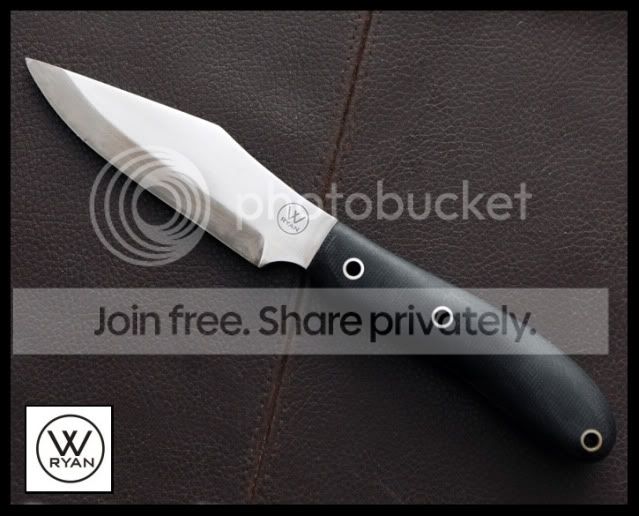
This is my 3rd Scandi grind, I am calling it "ScanTac" I wanted to combine Bush and Tactical.

OAL: 8.75"
Blade (Tip to Plunge): 4"
Steel: O1 (3/16" x 1.5")
Scales: Canvas Micarta
Pins: (3) 1/4" Stainless Steel Tubing
Grind: Scandi
ScanTac.jpg


A friend and I sat down and drew this one up. He is in SWAT and wanted a fighter for his left Thigh. This is the Proto-type, his will have Black Handle Material, and a Kydex Sheath

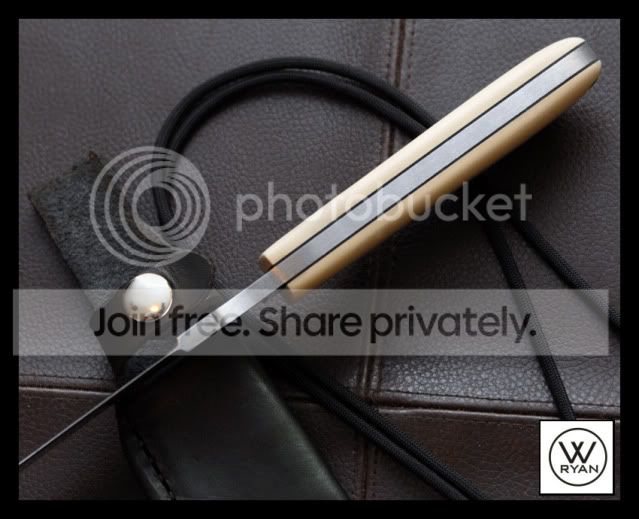
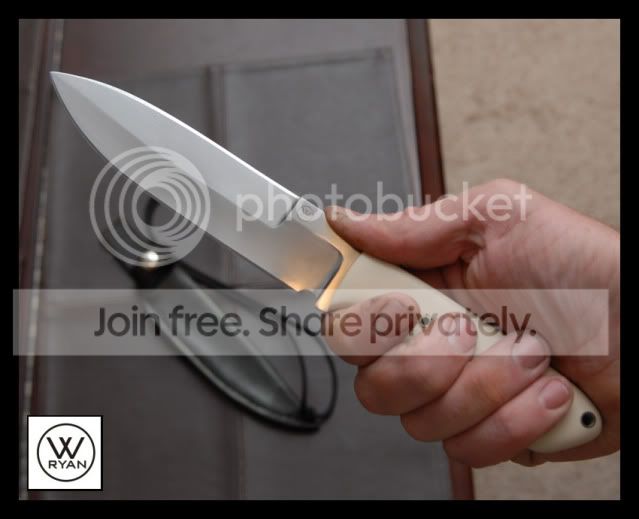
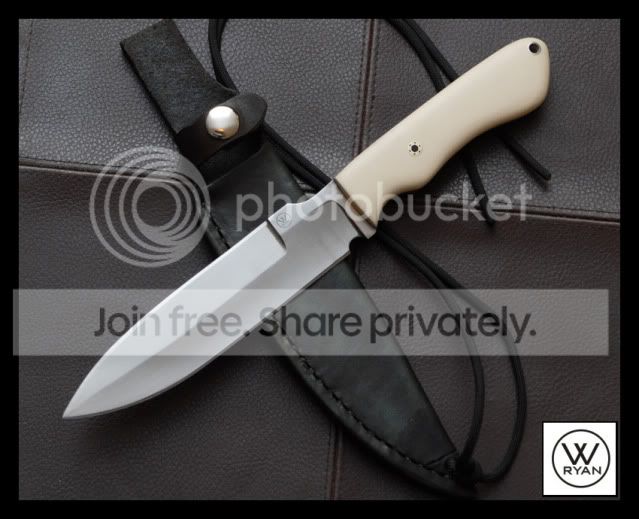
OAL: 11"
Blade: 6"
Steel: O1 (1/4" x 1.5")
Scales: Antique "Ivory" Micarta
Pins: 1/4" Mosaic & 1/4" SS Tubing
Grind: Hollow (Primary) Flat (Spine Edge) *** see question Below
Sheath: Leather
*** I will be doing both as Flat Grinds on His blade (Input appreciated on this issue)
IvoryFighter.jpg

IvoryFighterSpine.jpg

IvoryFighterHand.jpg


Thanks for looking
 
They are both great looking knives. I really like the second one, but would probably put flat grinds on both edges (in stead of the hollow grind at the bottom). Just my $0.02.
 
Here goes :D:foot:

Not sure about the ScanTac. It seems to me that the functions/features don't compliment each other as well as they might. Just looking at the use of the Scandi grind on that thickness of stock.

Scandi grinds, coming from the bush knife, are usually associated with wood carving; they usually have a fine edge and their self-guiding action helps to smoothly run off long wood shavings. One of their down-sides is that the fine edge, if fine enough to carve well, is vulnerable to damage and that any resultant rolling or chipping takes a lot of effort to sharpen out as the whole 3/8ths bevel has to be worked down flat. Using a Scandi as a pry tool (tactical prying?) is liable to cause that kind of damage and working out a big ding in the field is a pain. Another downside is that the rapid transition from edge to full stock thickness reduces their slicing ability when compared to higher grinds (assuming same stock and similar edge geometry). If there is a need to hammer the blade into wood, for instance, Scandi grinds really do start to wedge quickly, it can take a lot of effort to get them to bite deeply.

Clearly there is a lot of mileage in knives that are fitted for both tactical situations and bush work, but I reckon that the flat and sabre grinds offer more functionality and versatility. The BRKT Bravo1 series, the Fallkniven F1 and the ESEE 3 and 4 all come to mind.

But hey, one only discovers things by experimenting! :D If you find that it works for you, great!

All the best

Chris
 
Maybe someone could define what a scandi grind is please. I believe it is short for "Scandinavian". How does it differ from other grinds? Where did it come from and what are the benefits and down-sides to it?

And while we're at it, what does the word "tactical" mean when applied to a knife? Is it a shape, a grind, a length, a color, a metal, a particular intention? If I paint a knife black does it become tactical? In not, why not? What are the traits that set a tactical knife apart from other knives?

LonePine
AKA Paul Meske
 
I believe a Scandi grind is a V grind that only goes up part way of the blade. There are no bevels from the end of the grind line to the spine. Kind of like a chisel grind, only on both sides of the blade, down to a 0 degree edge.

Am I correct?
 
Thanks for the replies thus far...
lonepine... GrizzleyBear is correct Scandi is Short for Scandinavian. No secondary bevel. Angle is usually 12.5 Degrees, the idea is that you can lay the bevel flat on a Stone and move back an forth without worrying about getting the angle right, which makes field sharpening simple (But requires a bit of work) As far as the term "Tactiacl" goes, it is a word that I throw around a bit I guess. My definition is "easy to move quickly for slicing and a pointy end for stabbing"... When I think Tactical I think of fighters made to cut flesh. The Second Knife I posted is all Tactical in my mind.

Claycomb, I was not a big fan of Scandi grinds in the past (no experience with them really). I have been carrying and using a few by various makers over the last 3 months and have found them very useful in the wilds. you are correct about their slicing ability, they don't work well on paper, cucumbers or tomato's but if you are shaving fatwood or even batoning they act like a wedge that splits dry wood quite well. I have found that if you just adjust the angle that you hold the blade you can take small bites or angle into the material to take bigger bites. I mostly work with 1/4" Steel so this being 3/16" feels pretty thin to me. I have been using a few Mora's and they are made with very thin steel, I have some 3/32" that I will be working with in the near future that I feel will give this design a little more agility. This knife feels great in my hand and is quickly becoming a favorite.

As far as damage to the blade, I think the Scandi grind would perform much like a Convex or Flat Grind. Damage on a Convex would be a challenge to fix in the field. Fixing the scandi just takes a bit more elbow grease.

As scandi grinds go, they are a pain (to a newbie like myself) to get right. if you don't get the angle (Approx 12 Degrees) right the entire length of the blade on both sides they are a nightmare to sharpen.

Anyway, I was seeking input on the Ivory Fighter. Flat Grind vs. Hollow Grind was really what I was interested in hearing opinions about... Thanks Tedinatl!
 
Back
Top