Finishing Walnut

Joined
Apr 30, 2018
Messages
2
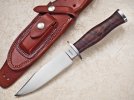
So recently I started making my first knife as a shop project in school. I was wondering what the best way to finish with walnut? any help and advice is appreciated.
 
If you want to go all out, sand to 600, spread thin CA glue over the walnut then sand off any that remains on the surface. Polish to 1000 then buff with tripoli and white diamond. Finish with a layer of carnauba.

Walnut can be prone to slight grain tear out. Thin CA will solve this.

If the knife is for display and not heavy use, you can look to apply a number of products that will protect/look great. All of these products will eventually wear/chip away with heavy use, so in that case I recommend the CA/polish route.
 
I sand to 400 grit and put on a thick coat of Birchwood Casey wood sealer and filller. I set over a portable heater and it dries in around an hour. Sand flush at 400 grit again, 80% of pores are filled. Now you can do another coat of the sealer or wetsand with tru oil. Sand to final grit and tru oil till wood wont take anymore. Let dry a day or two and buff with wax. I hand buff with paste wax. This is just whats worked best for me from experience. I finish sand at 800 or 1500 grit depending on figure.
-Trey
 
I'm finishing up some walnut so this is very timely. I'm curious if you do anything to make the color really pop. Mine seems kinda of drab or dull with little color change.
 
Walnut is the wood I most like a built up finish on.

Sand to a very good 400 grit and wipe down with a tack cloth
Apply the finish of choice ( tung, Watco, linseed, Birchwood-Casey finish, etc.).
Wait 10-15 minutes and wipe off the excess.
Let dry overnight and sand with 400 grit to remove the excess dried finish.
Re-apply finish ... wipe/dry/ sand ....repeat about 6-10 times.
If it hasn't fully dried overnight, wait another day ( or two) between coats. Two weeks isn't a long time to attain a show winning handle.

The trick is to sand off all the finish over the wood ... and leave the finish that is in the wood. Done right some walnut can have the most amazing 3-D look yoiu ever saw. This procedure is really good with Claro, and crotch walnut.
 
Not a knife handle, but I’ve been refinishing this antique table for the past 6 weeks. Sanded to 800 grit, light damping, let dry, shear fuzz off with xxxx steel wool. Repeat the light damping and shearing until no more fuzz is raised. This picture is the 10th coat of Watco Danish oil just before I wiped it off.

ABAFB60A-A5CC-4911-9C43-73CC9E807E97 by Wjkrywko, on Flickr

This was the previous coat buffed:

450DFA38-0FBA-4DC9-A65F-7062BD3DDB70 by Wjkrywko, on Flickr

CF8461E9-0DA3-46D8-8E1B-BF0C5D25BDA8 by Wjkrywko, on Flickr

Here’s the “before” images: There was no saving the original 120 year old finish.

9F414FD3-B582-4D91-8BF0-F8FE41057DA1 by Wjkrywko, on Flickr

10B6120E-86FF-4263-9981-350A1307EECA by Wjkrywko, on Flickr
 
Last edited:
If you don't need an extraordinarily tough finish, but want truly spectacular results, a french polish over BLO is probably the most glossy and deep finish. It generally brings out the greatest chatoyance. I wouldn't recommend it for anything that you are going to get alcohol on, and for a knife handle, it will show signs of wear, but it is a finish that instrument makers have been using for centuries, and it wears gracefully.

Danish oils and the like also tend to wear well if applied properly. I would avoid anything water based (at least that I have used), because, while these finishes may be hard and resilient, they tend to chip/flake/peel when they do start to fail.

To achieve a glass finish, use increasingly fine grits (600-800 max for some oil based varnishes, lower for others) between coats and thinner coats near the end. I like wet sanding the final coat with a thinned varnish (whatever you were using) with 2k grit, and wiping off any remaining varnish afterwords. That should be glass by it self, but a slow speed buff with very fine compound may make a noticeable difference in some finishes.

I will say that a full CA finish can also give glass like results and with a high quality CA can be very tough. But I will caution that if the knife is going to be regularly exposed to water, you may get some crazing in the finish, especially when built to any significant thickness. That being said, it is a finish I have used on a bunch of razor handles, and as long as you ensure that there is no ingress point for the water, use a water resistant CA, and wipe the handle after exposure to water, you should not see any problems.

 
Back
Top