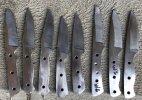
First Bevels Ground!

Joined
Sep 27, 2014
Messages
1,108
I completed grinding the bevels on my first blades today. I still need to take them up to 400 grit.
These are all ground to 60 grit at 5 degrees using a bubble jig except the one on the right that is ground to 4 degrees and 400 grit.

I got wild on the second and fifth blades(counting from left). They were actually ones I was doing near the end. Both times I was a couple passes from being done and then tried to press hard a get done in one pass and things went wrong. I figure I will leave them for now and get them heat treated and then grind those two to 4 degree angles and it will clean up the mistakes.

I have some layout dye and will put some on and then sand up to 400 and send them off.

I want to thank everyone that has been chiming in on my other threads and answering my million questions. You have given me confidence to try this out, to be relatively successful and to screw up too!

These have turned out better than I expected so far.
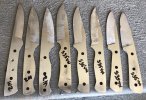
IMG_1437.jpg
 
How do you think you've done so far? That is the most important view of all.

Regards, Fred
 
If those are the first blades you have ground then that is photographic proof the bubble jig works :thumbsup:
I got a cheap set of letter stamps from harbor freight to stamp the type of steel in blades
 
If those are the first blades you have ground then that is photographic proof the bubble jig works :thumbsup:
I got a cheap set of letter stamps from harbor freight to stamp the type of steel in blades
Those are my first bevels ever ground. I think the bubble jig was amazing. It really made finding the right angle and holding it consistently easy. In the end I haven't wrecked any blade and the final results will be quite good...way better than I expected to come up with. One thing the bubble jig showed me was how much more shallow the angle I needed to grind with was. I would have been chasing around with waay to sharp an angle without it. It also made me way more able to be consistent and make multiple passes the same.

Fred.Rowe Fred.Rowe on one hand I think these are wonderful and way better than I expected them to be. I'm very pleased. I will make some pretty nice knives out of these. On the other hand, those two that went wrong and I got wild on bug me because I got impatient. Simple mistakes made because I lost perspective. On the other hand again, I know that I didn't go so far wrong that I can't make a bit of an adjustment and still have a very nice knife.

Stacy E. Apelt - Bladesmith Stacy E. Apelt - Bladesmith Those white metal marking pens. Where do you purchase those? Like, I see this https://www.tenaquip.com/product/ni...EwfKcOjlwv3o0XbC5nCTwDQ1_0xSaLgRoCIfwQAvD_BwE

But should I be able to find them in a hardware store? I see a paint pen by Sharpie that works on metal but I think it is just a paint pen and doesn't have the titanium di-oxide. I would rather buy one from a local store than wait a week on line.
 
Great job. You'll be hooked now. I like the profile of the 5th and 6th knives. I also love the s35vn.

Have you considered incorporating Spanish notches? Some people don't like them but I do. They do make sharpening a bit easier. However, as these are your first blades, these notches can easily disappear while chasing grinds.
 
Great job. You'll be hooked now. I like the profile of the 5th and 6th knives. I also love the s35vn.

Have you considered incorporating Spanish notches? Some people don't like them but I do. They do make sharpening a bit easier. However, as these are your first blades, these notches can easily disappear while chasing grinds.

The original design for these two had a spanish notch (didn't know the name for it til now). I didn't know how to do them or when. I was thinking of using my chainsaw file to make them. I also have a wheel that is small enough. I suppose they should have done been done prior to bevels...but I could do them now right?

I actually only had one knife where I went too far with the bevels and had to "shorten" the height of the blade. And that was only a couple mm shorter. The bubble jig made it quite easy to keep my angles proper and just stop when I got to the right thickness of edge. Everything stayed centred and true.
 
I notice that the heat treat places say I need to deburr my blades. Just run along the edge at the end when I am sanding bevels at 400 grit?
 
The original design for these two had a spanish notch (didn't know the name for it til now). I didn't know how to do them or when. I was thinking of using my chainsaw file to make them. I also have a wheel that is small enough. I suppose they should have done been done prior to bevels...but I could do them now right?

I actually only had one knife where I went too far with the bevels and had to "shorten" the height of the blade. And that was only a couple mm shorter. The bubble jig made it quite easy to keep my angles proper and just stop when I got to the right thickness of edge. Everything stayed centred and true.
Round file will work well. You can also pre drill a hole before profiling but you have to be carefull when drilling.
 
Randy, put those blades that you said, Ah :(:poop:... into a white plastic bucket that you will keep under your work bench,,Later as you gain more time on the grinder, those blades you think you screwed up, Will revel another pattern to you and become some of your best! With a little help from you!—————-For de burring before ht, I use a worn 220 belt and round any edges just slightly . Hard right angles and burrs can cause stress risers and crack your blades in HT or later...
 
Randy, put those blades that you said, Ah :(:poop:... into a white plastic bucket that you will keep under your work bench,,Later as you gain more time on the grinder, those blades you think you screwed up, Will revel another pattern to you and become some of your best! With a little help from you!—————-For de burring before ht, I use a worn 220 belt and round any edges just slightly . Hard right angles and burrs can cause stress risers and crack your blades in HT or later...
Thanks,
Do I need to round the edge of the holes I drilled too?

Also, where I began the plunge is quite square into the blade at the moment. I remember seeing a video of someone rounding the plunge out a bit. I think they got the edge of their j flex belt off the edge of their platen a bit and then rounded it out. Do I need to do that before sending for heat treat?

Thanks.
 
Yes chamfer those holes, you can find an 82 degree (the most common size) counterbore at any hardware store. A one flute one ordered online will be better, I need to think of the brand name of the good ones...

You can roll any belt over the platen for plunges, I like to do it at 80-120 grit then just polish with other belts.
 
Why do I need to get these blades up to 400 grit prior to heat treat when I will drop back to 220 post heat treat and then go up to 600? Why don't people leave them at 220?
 
Why do I need to get these blades up to 400 grit prior to heat treat when I will drop back to 220 post heat treat and then go up to 600? Why don't people leave them at 220?
You don't really have to take any of the recommendations offered by makers that answered your questions. If you feel other makers are giving you Bogus direction you can do it your way and find out if any of the information was good or bad. Since these are your first blades you have no experience with post heat treat finish. Most often the blades come back with a frosted
finish and you can call that good or drop back a few grit sizes to polish it up.

ETA: its easier to clean up/ touch up a blade at 400 post heat treat than one at 220 grit.
 
Last edited:
You don't really have to take any of the recommendations offered by makers that answered your questions. If you feel other makers are giving you Bogus direction you can do it your way and find out if any of the information was good or bad. Since these are your first blades you have no experience with post heat treat finish. Most often the blades come back with a frosted
finish and you can call that good or drop back a few grit sizes to polish it up.

ETA: its easier to clean up/ touch up a blade at 400 post heat treat than one at 220 grit.

I was just worried that the rougher spots might be a problem during ht like burs or sharp corners can be. There are a two tiny spots on one blade (1/8" round) where I can see 220 scratches but they are in places where I really need to go back and make a pass or two with 120 or 60 to move the bevel up an 1/8" to get rid of them properly. I didn't want to do that now. I think with that blade I will ht and then grind the bevel to 4 degrees and that will take care of the scratches.

I know I don't have to do what you guys say, but alsoI watch some newbies ask questions and then proceed to argue or ignore the advice they have been given..."how do I make a knife from railway spike?"...sort of stuff. I figure I can cut out a ton of mistakes and problems if I listen to the experienced makers. I realize some things are personal preference like starting bevels with 36 or 60 grit or using a bubble jig or learning to free hand. I already took the bubble jig off when I was sanding at 220 and 400 and just went with feel of the flat on the blades. Other things are a must do, like rounding edges prior to heat treat or setting the ricasso I think.

Thank you again to everyone who chimed in with my million questions this last week on a few threads. You helped me produce some pretty nice blades for my first try. I am over the moon. They are sanded to 400 grit and will head off to ht in the next day or two.IMG_1439.jpg
 
Not every question you can ask will be answered until you have actually completed a few knives...Many things are common sense and others you have to experience first hand by trial and error. I can explain how to drink a beer and what the buzz feels like from a 12 pack but you can't fully appreciate it until you've done it yourself.

There are a number of designs that I grind bevels on After Heat Treat no Pre heat treat grinding at all...That comes with experience.
 
Back
Top