First big blade/Tanto W2

Joined
Apr 14, 2006
Messages
252
Ok guys i have a few questions. I am attempting a large blade for the first time. The blade length is 10 inches and 4 on the handle end for a total of 14 inches. At the moment its 1 1/2 inches wide and 1/4 inch thick. I have done a large amount of research on more traditonal tantos and still have some questions. Right now the blade has been rough forged and is being thermal cycled.

I'll be quenching in parks 50 with a clayed spine and most of the blade. Do i need to forge in the curve on a blade this size, or whats going to happen when i quench? Aust temp will be 1450.

Most of the pics i have seen of tantos only really show the side profiles and not the spine or edge to well. Once i get it ground and profiled what would be the reccomended spine thickness? i was thinking 3/16 to 1/4? Also would a full flat grind work as some i have seen appear to be that style while others have a small bevel half way up the blade. And for the edge is there a secondary bevel right at the bottom or does the blade itself supposed to be ground to the edge? i hope that made sense.

I have pretty good control of my hamon abilty and placement. The thermal treatment atm is as follows. Forged blade out, normalize 1600, 1500, 1450, and oil quench at 1400 with a anneal for 1 hr at 1300 immeditaly following the 1400 quench. I will harden at 1450 which this recipe has given me nice hamons with Don's W2 in the past.

Any input would be great, i hope to post some pics of the process soon.
 
Last edited:
I recently made my first Tanto with a 7" blade and went through much of these same questions.
Here's mine.. http://www.bladeforums.com/forums/showthread.php/844824

As far as the curve or "sori", many tantos have little to no curve, at least in the reference materials I have, but like you I was looking for some curvature. I forged my blade straight and did a combination water/ Parks50 quench. The water quench for 3 seconds pulled a beautiful graceful curve into the blade and then straight into the Parks50 for the remainder of the quench. It was my fear of the "ping" that got me doing the hybrid quench.
My point being, that with the clay coat and the water quench, just like in longer blades, the blade is forged straight.

I can't seem to remember the spine thickness at the munemachi but I think 3/16" is pretty good. I think 1/4" would be a bit heavy for this length of blade.

Traditionally the grind is a convex straight to the edge without a secondary bevel. The amount of "meat" in the convex grind, the "niku" varies and I would suspect that with a tanto it would be quite minimal. So you could flat grind most of the way and then convex the final shape into the edge.

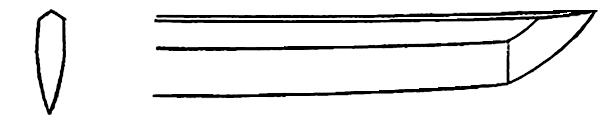
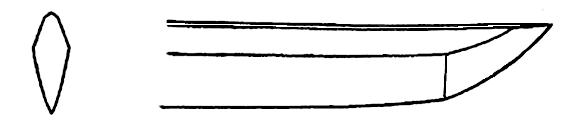
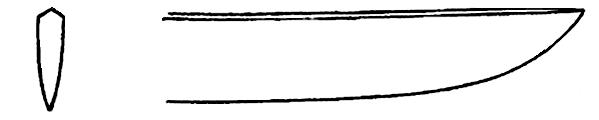
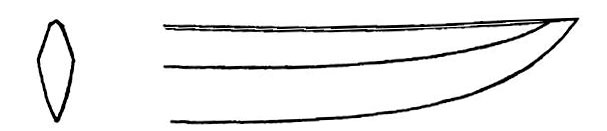
Here's a quick view of some blade profiles. I went with the hira-zukuri as is common in tantos.

SHINOGI-ZUKURI
The most general style for TACHI/KATANA and WAKIZASHI (long swords). (=> kissaki types in shinogi-zukuri style)

1) The ridge line (shinogi) is in normal height.
imageLNC.JPG

2) The ridge line is higher.
imageF67.JPG


HIRA-ZUKURI - The most general style for TANTO.
image2A2.JPG


SHOBU-ZUKURI - It is like SHINOGI-ZUKURI, but without YOKOTE line.
image739.JPG


Here's another good reference for blade styles and hamon styles.

http://home.earthlink.net/~steinrl/terms/terms.htm
 
The site that SBranson posted is a really good primer on japanese blade geometry, and should get you through the basic parts of your design phase. I don't think 1/4" thick is too much for a tanto at all. In my own research on tantos I have discovered that the design is far more variable than I had previously thought. Traditionally, they came in all shapes and sizes. Masamune, for example, was known for making very wide, thin tantos, whereas there were others that were made from the base of a broken katana and therefore very thick. Some had a partial back edge (kissaki moroha zukuri) and others were fully double edged (moroha zukuri).
You really have a lot to play with if you're looking for a traditional shape, and obviously a little more to play with if you're going for a non-traditional shape.
I'm looking forward to seeing how this turns out.

- Chris
 
Sbanderson that blade looks very nice i hope mine is half as nice. And the link you posted put toghter alot of words i was having trouble trying to figure out. I dont think i can brave a water quench at this time as i broke this blade down from don's 2 inch w2 which took sometime, mostly by hand.
 
I did a little looking around about the thickness and I retract my comment earlier. It appears that there is no rule and that Tantos did tend to vary much more than other blades. I would think 1/4" would be great particularly if you have a shinogi-ji.

If you aren't doing a water quench then you might want to follow this thread about oil quenching and curvature.

http://www.bladeforums.com/forums/showthread.php/854563

The clay will add another dimension but it's still worth considering that the oil may not produce the sori you're after and you may be better off forging in some curvature.
 
Last edited:
Yeah i was reading that topic before you happened to post it. Not sure how i feel about it as ill have a alot of other variables then he did. Out of all the other blades i have done with w2 i have neither expercienced any type of curving up or down that i can remember, i could be wrong though. I did add about 1/16 of curve at the deepest part of the curve on top. I guess we will know in a few days. I'll see if i can get a pic up of the blade as profiled. I also took some width off of it due to 1/12 not looking quite right.
 
For what it's worth, I've never noticed curving in parks50, just in water quenches, so you're probably pretty safe assuming that your blade will be stable.
 
Hello Dakota 11
I've done 8-10 blades that were W1 or W2 with claycoats into Parks 50 and I always get some negative curve. So I tend to forge or grind a good bit more curve than I actually want. I'd like to give you a hard fast rule but it all depends on the blades cross section, thickness, clay thickness and location and probably a million other variables. Good luck and hope to see a cool hamon pic soon.

Matt
 
Back
Top