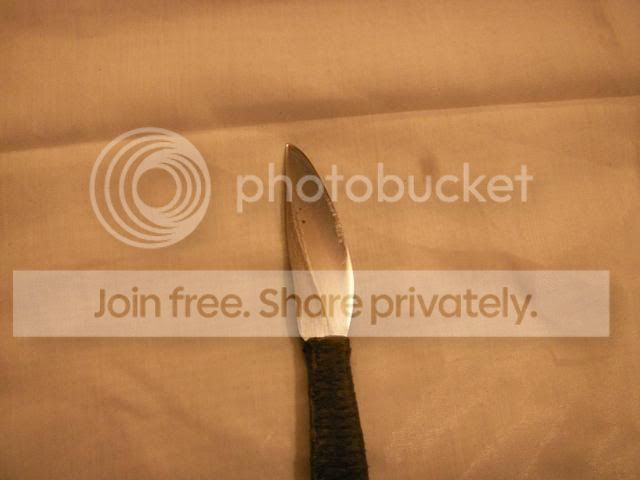
First blade forging,please critique

Joined
Nov 7, 2004
Messages
86
UPDATE-Knife now completed.Pics in response bottom of page
First try at forging anything really.I have some questions and would welcome honest evaluation.Blade was forged to shape and just abit of cleanup on a disc sander.It has not been hardened.

003-3.jpg

005-4.jpg


I attempted to forge in the bevels but it seems that it came out mainly on the one side.I tried to work both sides evenly:confused:

There is some inclusion? on the beveled side 1/3rd of the way down the handle.Is that scale that was hammered in?

On the flatter side there are 2 hammer marks shaped like a heart from hitting too hard.Once youve got a blade pretty much in the shape and thickness you want,the bevels set and you make too hard of a blow is there a way to finnese it out without changing what youv'e already done?

I'm actually quite happy with the shape,feels really good in the hand and even the one sided bevel though unintentional works for me on this knife.
 
Last edited:
Looks like pounded in scale (at least to me).

To create the bevel are you lifting the spine a bit and lining the edge with the edge of the anvil (to protect the anvil from direct blows), using lighter blows and a hammer with a well rounded face? Flipping sides after a few blows?

A flatter is unlikely to help a deep mishit unless there is still enough metal to move around.
 
I did line up to the edge of the anvil and alternate sides but did't lift the spine.I'll try that next time.I take it I was basically undoing on the back side what had been done every time I flipped it?I only have a Peddinghaus crosspeen, no flatter.Would I switch to the flatter after the general shape is done or after the bevels are in just for light cleanup to get everything straight.I want to be able to get as close to finished out of the forge as possible
 
Last edited:
That inclusion looks like a cold shut to me. When you were reducing the size a piece folded over and you hammered it down. It is were the two pieces came together. I would advise you taking it a bit slower and just try to get a clean profile first. This will help you learn a little better hammer control. You do not need a real big hammer a 2.5 lb is plenty. It is kind of hard to see exactly what you were doing with this one. Do not give up and give it another shot. Try drawing a blade shape then forge it. Make sure you lift the spine when hammering the bevels. It will come eventually.
 
Hammer control is what you need to practice. The blade looks like it was also forged too cold. When the metal is at proper forging temps, it moves rather easily. You didn't say what the metal was or how you were heating it ( both should always be stated), but between 2100F and 1600F is the normal forging range for most blade steels. If you are having to hit it hard to move the metal, it most likely is too cool. If the metal is not red ,don't hit it at all.

First forge in the profile, then the bevels.To help with forging the bevels, after the profile is right, curve the blade down like a banana. The curve will lift up to a straight spine as you move the metal in the bevels to taper them down to the edge.

If at all possible ,go see a smith with some experience to watch him and have him teach you some techniques. Filling out your profile will help a lot,too.
 
Steel was a piece of a large architectual bolt that came out of and old brick building.Heat was via Lively charcoal forge.I have a video from Hoods Woods that has Tai Goo and Tim Lively as well as Tim's video.Guess i'll have to watch them again:p.It was a bright red/orange heat,too cold?maybe I hammered too long and it cooled too much. How many heats on average does it take to complete an average 6in. knife?I'm glad I posted,now I know what I need to work on.The profile is what I wanted.Sort of a half leaf shape with lots of belly and long handle.Assuming the cold shut is not too deep(doesn't appear to be) could I grind it out and go ahead with completing this blade or has it been ruined by forging cold?
 
Since the cold shut is in the handle it probably will not harm anything. Grinding is the only way to remove them and it may be deeper than you think. Keep the steel hot. If you forge too long and thus too cold you can crack the blade and then you are done. Now your steel selection, have you tried hardening any? You may find it will not harden. This is why we recommend using known material, especially when starting out. The number of heats it takes to forge a knife depends greatly upon your skill level. As you improve they will be reduced. Do not worry as much about that right now, just concentrate on your technique.
 
.Heat was via Lively charcoal forge.I have a video from Hoods Woods that has Tai Goo and Tim Lively as well as Tim's video.Guess i'll have to watch them again:p.

Hey, that's the same video that got me going on bladesmithing!

Something I discovered that can help in the 'heat of the moment' is drawing your desired profile shape right on your anvil with soap stone or sharpie marker. This gives you a pattern you can lay your hot blade right on to check how close you're getting. Good Luck! Looking forward to watching the progress.


-Haley
 
Handle was flat ground,removed all defects.Abit of filing and sanding on the blade.Triple quenched and tempered.Still a few scratches to get out and i'm not happy with my attempt at a epoxy impregnated cord wrap handle but not too shabby :confused:
 
It resembles a knife and probally cuts well too. Keep it up, they will get better and better.
 
Back
Top