
First Chef, please critique!

Joined
Jan 9, 2019
Messages
103
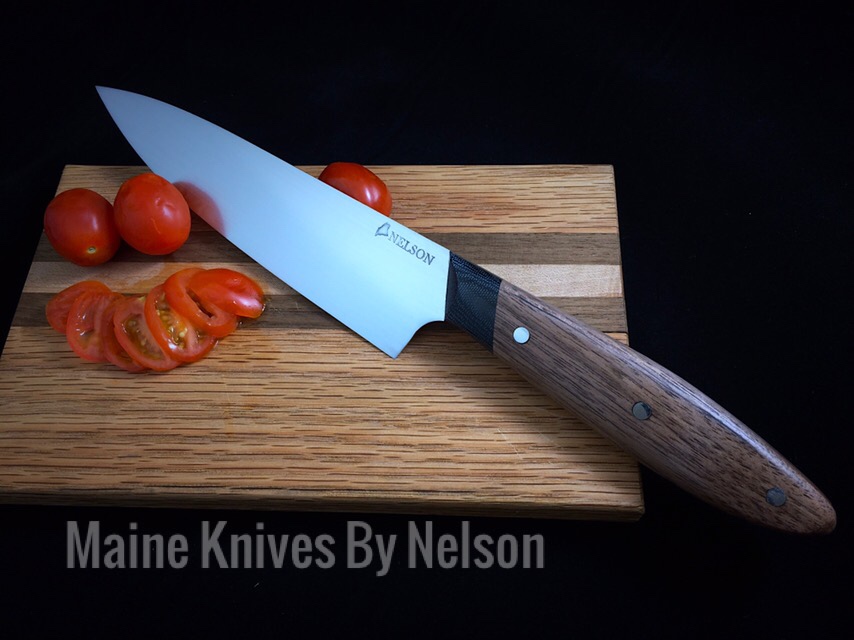
This is the first chef Ive made, I have made a few paring knives in the past though. I mostly do a lot of hunting/bushcraft knives. After doing a lot of research this is the design I came up with which I'm hoping is realistic. Only thing I noticed is I may need to widen the height of the blade as when the heel is on the cutting board my fingers barely contact the board also. The steel is .0875" S35VN with a dry ice bath at 61HRC, walnut scales stainless pins and canvas micarta bolster with hidden pin , plungeless ground, slight distal taper, mildly rounded the edges on the spine. I also (not sure what its called if anything) concaved the front of the scales on a contact wheel for finger grooves for a pinch grip.

 
Beautiful knife. Great looking lines and very well finished. s35vn will make an awesome kitchen knife.

As soon as I looked, I wondered about knuckle clearance given the belly in the handle. You don't have to make the blade higher to get more knuckle clearance. You can angle the edge from the heel to the tip so that when the knife is placed on the cutting board the handle will be angled up slightly but this will alter your wrist angle. Or you can make the flat near the heel shorter but that would turn the knife from a chopper to a rocker. These are user preference things that not many users think about. If you like a pinch grip the design looks great with the long flat.

One of the first kitchen knives I made I gave to a chef to try out. His one comment was that long flats make a knife hard to sharpen without creating a hollow over time.
 
Execution is superb! The only issue I see is the one that you are already working on (clearance).
 
This is the first chef Ive made, I have made a few paring knives in the past though. I mostly do a lot of hunting/bushcraft knives. After doing a lot of research this is the design I came up with which I'm hoping is realistic. Only thing I noticed is I may need to widen the height of the blade as when the heel is on the cutting board my fingers barely contact the board also. The steel is .0875" S35VN with a dry ice bath at 61HRC, walnut scales stainless pins and canvas micarta bolster with hidden pin , plungeless ground, slight distal taper, mildly rounded the edges on the spine. I also (not sure what its called if anything) concaved the front of the scales on a contact wheel for finger grooves for a pinch grip.


looks nice, what's the blade length? looks to be about 6-7"

My critique is I think the handle pins diameter is a bit large and my eyes keep getting drawn to the 3 pins ...

I think knuckle clearance is made to be more important than it is IMO,
you can also bring the cutting board closer to the edge and your hand/knuckles are not over the cutting board area.
However much of this depends on the length of the blade and whether you prefer to use the tip or the heel for most cutting.
Many line knives or petty style have low heel heights.

T768OrV.jpg


"... that long flats make a knife hard to sharpen without creating a hollow over time.

Can you explain this further, long flats meaning the bevels? create a hollow where?

thanks
Harbeer
 
Thanks for the great feedback!

looks nice, what's the blade length? looks to be about 6-7"

My critique is I think the handle pins diameter is a bit large and my eyes keep getting drawn to the 3 pins ...

I think knuckle clearance is made to be more important than it is IMO,
you can also bring the cutting board closer to the edge and your hand/knuckles are not over the cutting board area.
However much of this depends on the length of the blade and whether you prefer to use the tip or the heel for most cutting.
Many line knives or petty style have low heel heights.

T768OrV.jpg


Can you explain this further, long flats meaning the bevels? create a hollow where?

thanks
Harbeer


Blade length is 6", I agree with the pins drawing the eye. after looking at it and a few other blades I made with smaller handles I believe I need to look into 1/8" pins or something that blends in more. Currently I am using 3/16"
Beautiful knife. Great looking lines and very well finished. s35vn will make an awesome kitchen knife.

As soon as I looked, I wondered about knuckle clearance given the belly in the handle. You don't have to make the blade higher to get more knuckle clearance. You can angle the edge from the heel to the tip so that when the knife is placed on the cutting board the handle will be angled up slightly but this will alter your wrist angle. Or you can make the flat near the heel shorter but that would turn the knife from a chopper to a rocker. These are user preference things that not many users think about. If you like a pinch grip the design looks great with the long flat.

One of the first kitchen knives I made I gave to a chef to try out. His one comment was that long flats make a knife hard to sharpen without creating a hollow over time.
Great tip about the angle change from the heel! I'll have to modify a little for my next blank and see how I like it.
 
Can you explain this further, long flats meaning the bevels? create a hollow where?

thanks
Harbeer
often chefs steel the blade or have poor sharpening and end up not sharpening the heel the same as the flat cause of the steeeling action causing a "hole" in the blade (the flat no longer makes full contact with the board and then does not make a full cut ) note keep an eye out on the 2" mark as that too can make a "hole" in the edge
 
Looks nice. What you have made is called a petty, short for petite chef knife. A chef knife is bigger than about 8 inch blade length. Most chefs knives are from 8-10 inches and some go as big as 12 inches.

Hoss
Great to know thanks!
 
I agree with the others on knuckle clearance. When I made my first chef knife, I thought the handle angle looked odd. I made some dropped handles, but as I made more, the first thing I notice is whether the handle drops or not. Second is the belly profile. Your belly profile looks pretty good, but I use slight belly with shorter full flat sections. I tend to use less belly than most other knives I see, but that is a personal preference thing. Great knife for this point in the journey!

BABDE84A-1D4E-43E5-B96B-C57CFE227DEA by Wjkrywko, on Flickr
 
often chefs steel the blade or have poor sharpening and end up not sharpening the heel the same as the flat cause of the steeeling action causing a "hole" in the blade (the flat no longer makes full contact with the board and then does not make a full cut ) note keep an eye out on the 2" mark as that too can make a "hole" in the edge
Well explained. I knew I didn't do a good job expressing what I was thinking.

My first nikiri, I tried to have a long flat edge and it quickly exposed my lack of grinding skills and I had a very difficult times keeping the edge so that it would lay flat to the cutting board. The 2" bump was brutal. Even the slightest curve helps.

What thickness do you have at the spine? One thing I struggle with is that my knives are thin and light. When people pick them up, they are almost always like the "weight" of the heavy bolstered knives because they associate a heavy knife with a quality knife and a light knife with a cheap one. Probably because they are familiar with Germans.

I struggle with "what I like may not be what the public likes".
 
Well explained. I knew I didn't do a good job expressing what I was thinking.

My first nikiri, I tried to have a long flat edge and it quickly exposed my lack of grinding skills and I had a very difficult times keeping the edge so that it would lay flat to the cutting board. The 2" bump was brutal. Even the slightest curve helps.

What thickness do you have at the spine? One thing I struggle with is that my knives are thin and light. When people pick them up, they are almost always like the "weight" of the heavy bolstered knives because they associate a heavy knife with a quality knife and a light knife with a cheap one. Probably because they are familiar with Germans.

I struggle with "what I like may not be what the public likes".
The spine thickness is about 0.0875. Also a distal taper which starts about 3” from the tip up the spine.
 
often chefs steel the blade or have poor sharpening and end up not sharpening the heel the same as the flat cause of the steeeling action causing a "hole" in the blade (the flat no longer makes full contact with the board and then does not make a full cut ) note keep an eye out on the 2" mark as that too can make a "hole" in the edge
Poor steeling technique does cause the dig out just in front of the heel of the blade... Also that’s where most people do the majority of the chopping so over time you can get a a slight curve in there. I sharpen knives for people that have never used a steel or sharpen and those can have that same issue..
 
Well explained. I knew I didn't do a good job expressing what I was thinking.

My first nikiri, I tried to have a long flat edge and it quickly exposed my lack of grinding skills and I had a very difficult times keeping the edge so that it would lay flat to the cutting board. The 2" bump was brutal. Even the slightest curve helps.

What thickness do you have at the spine? One thing I struggle with is that my knives are thin and light. When people pick them up, they are almost always like the "weight" of the heavy bolstered knives because they associate a heavy knife with a quality knife and a light knife with a cheap one. Probably because they are familiar with Germans.

I struggle with "what I like may not be what the public likes".

Our job as craftsmen is to educate our customers. I have a few loaners out there for people to try before they buy. It’s almost universal that people prefer wa handles, non dropped handles, and 3/32” or thinner once they try them. Offset grind is preferred by 2/3 to 3/4 once they try them. I get people to imagine rocking to get the belly profile. Most go for less, not more.
 
Nice customer preference info Warren. What does the term "offset grind" mean. Centerline of the blade verses centerline of the handle??

regards,
dms
 
for people that like a bit more heft to the blade i dont distal taper as much (spine thickness is .113) most the time when i go over a custom kitchen knife order i blow there mind with options. let them soak some of it in then start asking the questions of how much care they want to give the blade and then styl and the cutting action the like to use most i can then start narrowing down what they are looking for in a blade. as to stock pieces for shows or for me to send to retail i make them as an avg of the most liked. no lasers less its a nakiri or slicer
 
Nice customer preference info Warren. What does the term "offset grind" mean. Centerline of the blade verses centerline of the handle??

regards,
dms

I do quite a few d-grinds. The edge is offset 70/30 to one side, with a ffg on the 30 side. I do either a convex or “chisel grind” on the 70 side. The 30 side is the non dominant hand, which tends to hold the food.

I’ll do a drawing of this grind tomorrow probably.
 
Last edited:
for people that like a bit more heft to the blade i dont distal taper as much (spine thickness is .113) most the time when i go over a custom kitchen knife order i blow there mind with options. let them soak some of it in then start asking the questions of how much care they want to give the blade and then styl and the cutting action the like to use most i can then start narrowing down what they are looking for in a blade. as to stock pieces for shows or for me to send to retail i make them as an avg of the most liked. no lasers less its a nakiri or slicer

It’s important to ask how they cut, and what they cut, then translate that into geometry. I think we are talking about the same thing, but using slightly different language.
 
Back
Top