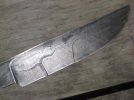
First cracked blade. :(

Joined
Oct 29, 2006
Messages
2,912
D@mn.. 5 hours of forging, grinding clay coating and "ping" "ping"

The blade cracked twice, really bad.
My fault I know as I'm sure I botched the quench.

Started with a W1 drill rod. I know I ground the blade a little thin for a brine quench but still had about a 1/16" at the edge.
Heated to non mag, then got it a little brighter. Held it there for about 10 mins. then quenched into brine. I was going to do the "interrupted" quench but held it in too long.
The plan was about a count of 3 then into warm oil. Well I think maybe I did a generous 3 count then "ping", so I left it in knowing it was a goner, and the second ping.

I've looked for advice on the length of time before the "interruption" but can't find anything specific.

I'm going to try again, hopefully this time with a little more info..:o

Thanks
 
That sucks, buddy! Looks like a nice piece of steel, I've only heat treated 7 blades of my own and am always so scared to hear my first ping... I have only quenched in oil, too scared to try brine.
 
Hey Stuart, sorry about that buddy. My heart goes out to you. Really nice looking blade before the cracks.
 
Length of time to ping ? That you have to find by trial and error. You should have timed it to the ping and subtracted a few seconds.
 
Well that sucks balls Stuart!!! :grumpy:

I've heard that sound many, many times. It's why I went to Park 50 and didn't look back (I know that's not really an option now). That sound was greatly reduced after building my salt bath and having super tight temp control, but it still happened a lot. I also feel that if you're quenching in water, you need to austenitize about 50F degrees cooler than if going into oil.

Leon and Hiroko Kapp (authors of The Craft of the Japanese Sword) told me that Yoshindo has about a 70% success rate and that that is VERY GOOD. If a guy that has swordsmithing in his blood that deep, breaks 3 out of 10 blades, then it doesn't give us mere mortals much of a chance! ;) *lol/crying*

The brine quenches that did work for me, went like this

- In 1-2-3

- Out 1-2

- In 1-2-3

- Out 1-2


- In 1-2-3-4-5-6....till cool enough to grab lightly and then RUN to the tempering oven.

I'm talking about literal counting ONE-TWO-THREE.... And don't throw any "mississippi's" in there!!!!


Hopefully Bill Burke sees this thread because that wild man still does all kinds of water quenching! :)
 
Under the heading of "It could be worse".... you mentioned that you had a few hours invested... consider how much more frustrating this would have been if those hours had been weeks of hand filing.

Sorry, I know there isn't much comfort there. But whenever I see one of these stories (which ALWAYS seem to involve water/brine quench) I say to myself "how would I have felt if this had happened to the leaf knife I spent weeks working on before HT?" That would have been MOST discouraging. Not sure how I would have receovered from that blow.

- Greg
 
I feel your pain! At least you didn't get the blade down to 400 grit before you could see the cracks, happened a couple times with me.

Listen to Nick and get the Parks 50. It will make your life much easier.

Aint knife making FUN! :)
 
Looks like he was quenching in brine. How did you hold it there?? Did you have a thermocouple? Just a few degrees can cause problems. Also W-1 is a low allow steel, just a higher tolerance 1095. You really do not need the long hold but if done properly it will not hurt.
 
Thanks for the co-miserations. :p:(:D

No thermocouple, just a forge and a magnet and my eyes. :p

I think the first ping would've been at about 4 secs. I wish I had Nick's advice before this.
The reason I went for this long was that I have tried a couple brine to oil quenches before and only holding in the brine for about 1-2 secs then straight into warm canola until activity stopped. I wasn't thrilled at the edge holding I was getting so I thought just a little longer then into warm oil. (btw, the brine was warmed to 120-130 on my meat thermometer :p)

As far as Parks 50.. well I just got my 5 gal. pail in last night but the stuff is like gold so I was afraid to use it. Stupid maybe but I wanted to get a good tank set up before I used it. It cost me almost $250!!! to get it into Canada but I figure it's a good investment.

Also I chose brine because I wanted some real crazy hamon activity as this was for my brother down in Texas.

Now I'm determined to make it work so I think I will try Nick's method and if that fails then I will go to Parks 50 and not look back. :p
 
Well at the risk of personnel retribution on here!!!

When I first started using clay and water I broke almost every blade that I did. But being too stupid to give up and succumb to the norm(parks 50) I kept at it. I did get better and was only breaking about two thirds of my blades. Then I went to Japan and watched as some of the best sword/knife makers in the world quenched blades IN WATER. I watched in amazement as orange hot knives were plunged into warm water and swirled around as if the smith were stirring a pot of soup, and i never seen one cracked blade. Sword smiths went from the fire right into cold water and held the screaming blade there until it was cool and again no cracks.
So When I returned Home I started breaking knives again. I broke knives if I austenitzed in a digitally controlled oven and I broke knives if I heated them in salts and I broke knives if I heated them in the forge. I went back to my old ways of interrupting my quench and didn't break as many but still most of them broke. I bought parks 50 and didn't break blades but the hamons where not what I wanted usually ending up very close to the edge. I reflected on what I saw in Japan and what finally dawned on me was that the edge was the only part of the knife that was above critical temp was the edge. I made more knives and put clay on them and heated in the forge with the windows covered and the lights out. checked the edge with a magnet and when it was nonmagnetic went back into the forge long enought o make sure my heat was even and then as fast as I could from the forge into the slack tub and held it there teeth gritted waiting fo the crack. the blade quit screaming What no ping!! over to the grinder for a quick look HOLY SHIT I got a STIFFY. this is cool. do five more as quick as I can slather on the clay and into the forge while it is still wet. heat into the water great I think I'm coming. OK time to do a sword I cant get it into the frorge so I will use my 48 inch paragon. heat into the water __________ping_________________ping ___PING pingpingpingpingping ping. It cracked almost every half inch for the entire length of the blade. SHIT. Now what the F*&^%. Oh dumb as the whole blade was at temp. duhh.
Anyway the purpose of this long drawn out story is to try and convey to you the bullshit that I put myself through and to let you know that I've done this enough to have some small idea of what I'm talking about and not just relaying information that I have heard or read somewhere.

So what I have learned. put a very thin wash of clay over the entire blade. put the clay on the back no more than 1/8th of an inch thick. while letting the edge soak at temp is importtant keeping the spine below critical is equally so, so you have to keep putting the blade in and out of the fire. THE MOST IMPORTANT THING IS TO NOT OVER HEAT THE BLADE. even the upper end of the austenitizing range is too hot for a water/brine quench with some steels. if the clay pops of the blade when heating it you didn't have the blade clean enough before putting on the clay dosen't matter if the clay is wet or dry. it is also more prone to cracking and a shitty looking hamon if the clay comes off. Nothing special needs to be done with the water as far as heating or cleaning if your heat and clay is right. I have done twenty five blade now into plain water with no cracks to preasent of course now the next ten will break since I have written all this down.

Good luck
 
Thanks Bill! :)

It's easy to get 5th hand information but it's worth what you pay for it.

Your real world experience is worth a hell of a lot of blood, sweat, and TEARS!!!

Thanks for helping my buddy Stuart out! :)
 
Thanks Bill! :)

It's easy to get 5th hand information but it's worth what you pay for it.

Your real world experience is worth a hell of a lot of blood, sweat, and TEARS!!!

Thanks for helping my buddy Stuart out! :)

No problem Nick. I hope it helps.
 
Hey.. I thought I responded to this. Thanks very much Bill. It helps tremendously in that it's a fantastic story and an inspiring one, but also the control of temperature.
I use my forge for heat treating as mine is the style with the burners on the top, I have to keep moving the blade through a direct flame for heating. So rather than do the muffle tube I had thought to do, I think I will stick with this and change my approach. I will try with heating edge up, working the edge of the blade to non-magnetic and not concerning myself so much with the rest.
What I had been doing was putting it in the forge on it's side and flipping it over, running it under the flame. (I also leave the rear door open so as to not overheat the tip)
My thought was that I could best control the heat at the edge by heating the middle of the blade and having the heat radiate to the edge rather than hit the thinner edge directly and risk overheating.
I think now that that approach was not necessarily wrong, but not the best approach for this style of heat treat. I will try edge up and focus on the edge only. I suspect I will have much better results.
I hope anyway.

Ironically, this is what I had been doing with my avatar knife in 52100 and the oxy/acet. torch.
In the W1 case I just assumed that the clay would take care of the cooling, but not thinking that I should really not have the spine above non-mag.

Thanks!!!
 
Back
Top