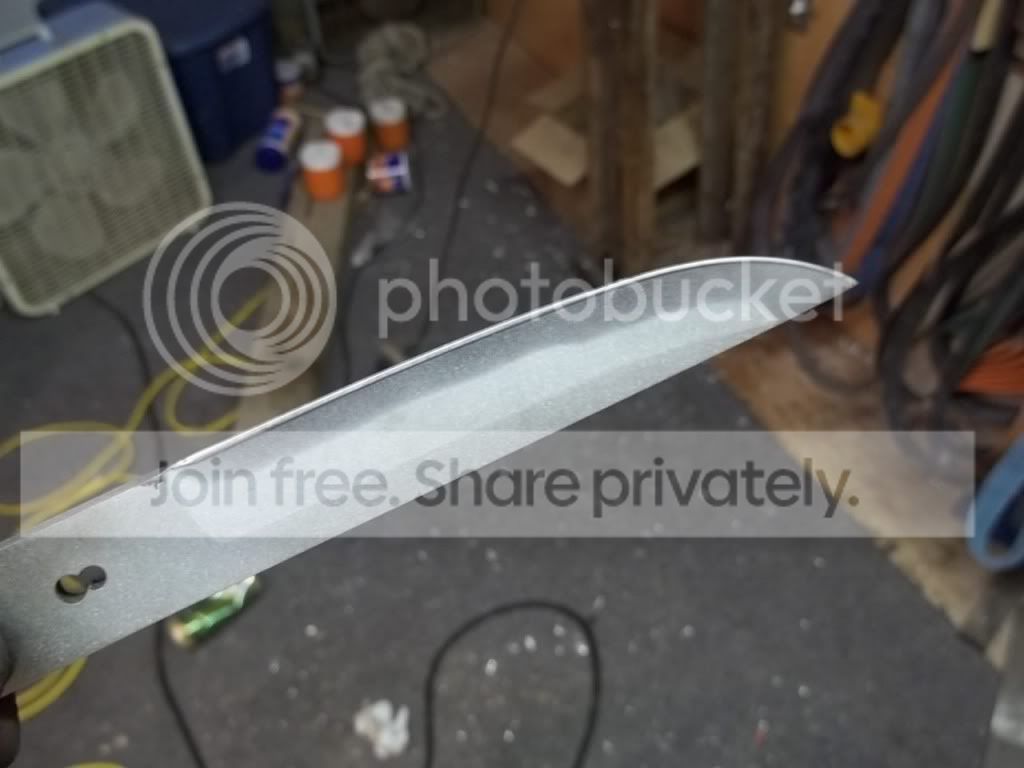
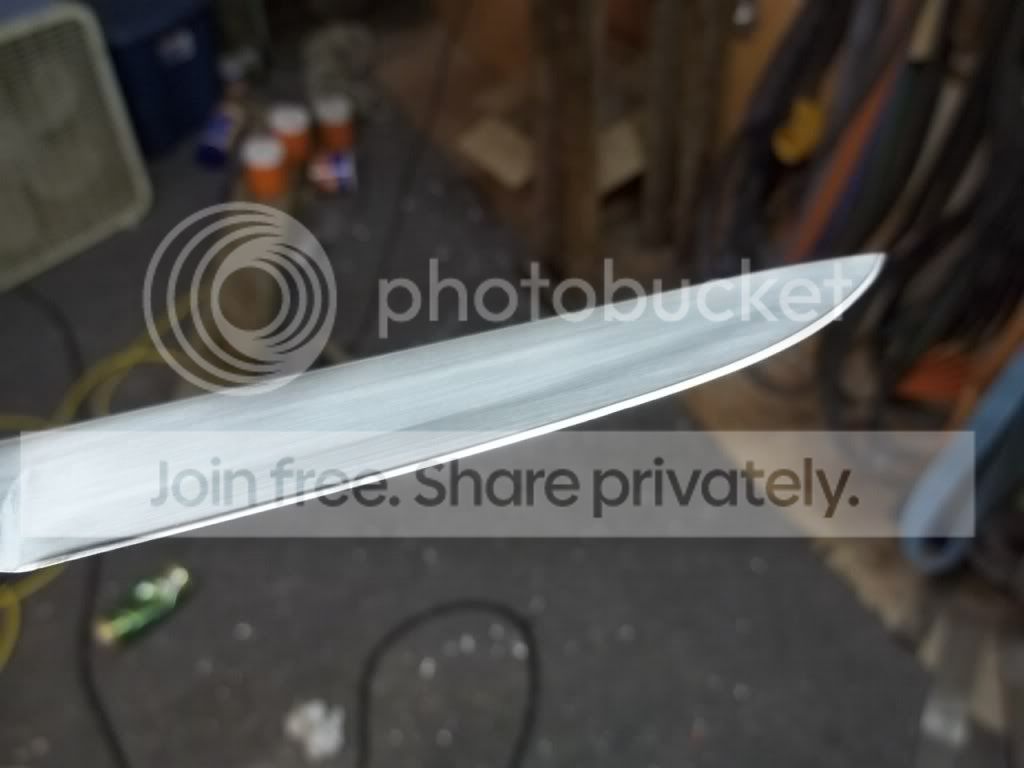
first hamon

Joined
Apr 22, 2004
Messages
878
This could be addictive...

So I got my first hamon this morning, verified during a quick sandblast session, a little closer to the edge than I wanted but totally serviceable, less activity than I wanted but not bad for a first attempt.

I'd like to better understand what makes the hamon more visible without etchant. Etching actually obliterated my favorite part of the hamon, that lighter colored band separating the martensite from the pearlite or mixed structure.

Why is it that rubbing with certain abrasives removes everything?

btw I am definitely not willing to go through a large number of stones... yet, just trying to get that sguiggly band of white back and make it more visible.
 
Surely you have finished to a higher degree than that quick sandblast this morning. I'd recommend at least a 600 grit hand rub. What steel are you using? A nice sanded finish can yield a white line fairly easily in W1 with a mild ferric etch followed by oxide removal.

I think some abrasives take everything off because they are sharp and aggressive, milder abrasives may affect the soft back or hamon line more than the hard edge. Finer abrasives or scrubby non-abrasives like non-abrasive scotchbrite or even a nylon bristle brush may help you to take off oxides with out erasing your line. Some metal polishes work well for this, Flitz is popular. I've tried Turtle brand white polishing compound, it works ok but leaves a kind of heavy film on the steel that can be annoying.
 
I'll usually take the blade up to about 1200 grit, then etch in ferric chloride. Afterwards, I generally use Flitz to remove the oxide. Flitz will not erase the hamon.
 
I used a file in an oil quench. Belt sanding to 120 made the hamon show, but then it disappeared until I got to 1000x hand sanding, though not very defined unless you catch the light just right. Peek metal polish obliterated it... vinegar made it sort of show but the look I wanted isn't there.

6 micron diamond paste made it disappear too, though I met a guy at Blade who had fantastic hamon using diamond paste.

So I'll try some finer sandpaper if I can get to town tomorrow... ferric chloride is not available retail here

100_0089.jpg


100_0090.jpg
 
Looks decent. I remember when I got bit by the hamon bug. Lost many hours chasing hamons with 6000 grit. :) It's a mojo thing. When you got it you got it and when you dont, you dont.
 
go to 1000 grit, etch in heated lemon juice rub with soaked cotton ball, then flitz, then go again.... agree with mitchell,,,,flitz will not take the hamon off.... leaves it white...

you can use vinegar in the natural lemon juice to quicken the etch if you cannot get ferr chloride
 
Six micron is 3000 grit.

When dealing with a hamon question, you need to give the details about steel type, HT, and how the blade was coated.

There is no quick and easy way to get a hamon to "POP". It takes careful attention to the line and its characteristics. Using any mechanical sanding, or just sanding everything, will only show a small part of what is there. Sandblasting sounds like a bad idea to me. You will have to sand past all the micro-pits created to get the surface right...and will be sanding away some of the hamon details at the same time.
Look up a few sites on Shiagi Togi and on hybrid polish. The hybrid system is much easier, and on knife blades is the most common procedure.

Also, different methods work for different hamons. There is no "One Shot" procedure that works every time. Having several polishes and using your discretion as to which will work on a certain hamon is a function of time and experience. I would suggest that you start with red oxide (rouge) and green oxide ( green chrome) in the beginning. Flitz is an excellent compound to use for hybrid polishing.The surface preparation building up to the final polish is also very important. I should be done by hand and lubricated with soapy water or WD-40 beyond 400 grit. I would go to at least 2000 and 6000-8000 is even better.

The etchants used are very weak, and usually rubbed in with a cotton pad/ball and your fingers. It may take 10 minutes of rubbing to get the wispy lines to show......assuming they are there. Diluting muriatic acid 100:1 is a common hamon etchant, as is lemon juice and white vinegar. Those two can be used straight, or diluted 2:1 to make a slower etch. Diluted FC is used to darken the blade and to show where the hamon features are. I doubt that you can't buy FC in Canada. Most likely you just don't know where to get it. You can even buy the dry powder on Ebay, and mix up your own liquid stock.If it is truely unobtainable, you can make your own FC easily.A earch should find you lots of info on making your own. It only requires steel wool and either muriatic acid.

Most people can get a hamon of sorts, and it may show an undulating line on the blade. But, to get the wispy details and subtle effects, it takes a bit of coaxing in the final polishing. Also, don't expect a hamon to look like it is painted on in white paint. It should be subtle and require turning the blade to see some of the features.

A polish techniques that can develop a hamon:[/COLOR

Sand by hand evenly and slowly. Using water stones is a great system, but requires a lot of skill. Good quality sandpaper, a bowl of clean water with a few drops of dish soap and a 1/2 Tsp of washing soda ( to retard rusting), a clean and comfortable place to sit, backing sticks/blocks to hold the sandpaper on, and lots of elbow grease are the main ingredients.

Sand evenly and in the direction of the hamon (lengthwise, not crosswise) and go up the grits to 600-800. Give the blade a quick etch in 10:1 FC or full strength white vinegar. This will help you see where the features are. You should see the main line, and hopefully any secondary lines and some wisps ( if they are there).

Continue sanding the blade at 1000 grit, rubbing a bit harder above and below the hamon line than directly on it. At 1000grit ,the features should start to show. Rub the hamon line with a weak etchant. Use a bit of thumb pressure and go in tiny circles. Look for lines and wisps that are showing now that you did not see before.
Continue polishing to 2000 grit. Depending on the surface desired you can quit here or go up finer. Etch the line to see what has shown up at the end of each grit . You may think you are removing the hamon as you polish, because the surface just gets shinier, and thus the hamon disappears. The etch will show what is there, and the details will be enhanced in the next step.

Now that the blade surface is prepared, it is time to "develop" the hamon. All the features that are present are locked in the steel, and are waiting to be made more visible. This will be done by oxidizing, and changing the surface of the steel in different ways. A word about the work area...CLEAN. Let me give you that woird again - CLEAN.
Any grit sitting around from previous sanding will come out and haunt you. Clean everything up well, wash all tools and blocks, wipe off the table and chair arms. and make sure the blade is C_L_E_A_N.

On a very simple hamon ,with little or no detail beyond the line, you might just carefully work the surface between the edge and the hamon to make it frostier than the shiny bevel above. This is not the same thing as the fake hamon on many cheap blades that is sand blasted on.

You will carefully work an abrasive compound (the paste from a tiny flat stone in shiagi togi), to dull the shine on the surface. On a hybrid polish,use a fingertip to rub a fine grit abrasive that will leave the surface less reflective. This can be anything from finely ground scale collected of the anvil in forging, Nagura stone "mud" paste, fine valve grinding compound, or 4-6 micron diamond paste. The fine grit in the compound will leave a smooth but slightly frost surface. Carefully follow the hamon and do not go above it. This looks good and sometimes is all you can do with a very simple hamon.Some folks quite here.
If you don't like the completely "white" surface to the edge, use some Flitz or rouge and careful polish below the hamon. Wash everything and give the blade another etch. Now use just a tad of Flitz, and re-polish the blade, staying off the hamon as much as possible.

For a hamon with lots of activity, the process goes the same up to when you switched to the abrasive compound. Instead of making a frosted surface, you will try and coax the hamon out by polishing the three surfaces with different materials. The surfaces are :
The area above the hamon

The hamon
The surface from the edge to the hamon

Each surface should be polished in a way to enhance the hamon. The way to decide is far beyond this ( already long) post. Try several polishes and etchants, and observe what the steel looks like after the polish. red oxide leaves a darker look, green brighter,acid etchants white, FC dark. At each step ,you often have to re-etch and then rub off the oxides with a fine compound ,like Flitz. One standard ( well, there are no standards) look is a shiny edge, a white hamon, and a darker bevel.....or the reverse of that.

You may need to employ strategies to keep from polishing areas that you don't want to change. Applying white nail polish over the hamon area after you get it just the perfect frosty look, can allow you to polish above and below without worry of ruining the last 4 hours of work. Remove the nail polish with acetone when you are done.The same method can be used to protect the shiny and darkened bevel from damage while re-working the hamon and lower surface.

A piece of cardboard or plastic held by your right hand at the boundary of the hamon will keep the compound you are using with your left hand (to make the hamon white ) from dulling the brightly polished bevel. After the hamon is worked, the same procedure ( new piece of cardboard/plastic) can protect the hamon while you polish the edge.

OK, enough. The only way to decipher this ramble is to go and try some of it to a blade.

 
Last edited:
thanks all, yes ferric chloride is available just not at a local radio shack like I usually see recommended... and our knife show is FRIDAY and for some reason I decide to try a hamon when I should be going over my new blades looking for scratches..

so what I'm seeing here is that there can be serious work in getting to the subtlety, but heavy etching can give me some definition quickly...

I didn't realize there would be quite so much detail in finishing... I guess I was hoping to sand the whole blade "just so" and have the hamon show and not have to treat the zones separately.

Thanks again!
 
... I guess I was hoping to sand the whole blade "just so" and have the hamon show and not have to treat the zones separately.

Yes, you can do that....it just won't be as impressive. Many just sand and etch, then give a little buff with Flitz....and quit there. Others go a bit farther. Each has its realm.
 
Six micron is only about 800 grit, you want a finer finish than that.I think he was using it to develop the contrast. Read on.

When dealing with a hamon question, you need to give the details about steel type, HT, and how the blade was coated.

There is no quick and easy way to get a hamon to "POP". It takes careful attention to the line and its characteristics. Using any mechanical sanding, or just sanding everything, will only show a small part of what is there. Sandblasting sounds like a bad idea to me. You will have to sand past all the micro-pits created to get the surface right...and will be sanding away some of the hamon details at the same time.
Look up a few sites on Shiagi Togi and on hybrid polish. The hybrid system is much easier, and on knife blades is the most common procedure.

Also, different methods work for different hamons. There is no "One Shot" procedure that works every time. Having several polishes and using your discretion as to which will work on a certain hamon is a function of time and experience. I would suggest that you start with red oxide (rouge) and green oxide ( green chrome) in the beginning. Flitz is an excellent compound to use for hybrid polishing.The surface preparation building up to the final polish is also very important. I should be done by hand and lubricated with soapy water or WD-40 beyond 400 grit. I would go to at least 2000 and 6000-8000 is even better.

The etchants used are very weak, and usually rubbed in with a cotton pad/ball and your fingers. It may take 10 minutes of rubbing to get the wispy lines to show......assuming they are there. Diluting muriatic acid 100:1 is a common hamon etchant, as is lemon juice and white vinegar. Those two can be used straight, or diluted 2:1 to make a slower etch. Diluted FC is used to darken the blade and to show where the hamon features are. I doubt that you can't buy FC in Canada. Most likely you just don't know where to get it. You can even buy the dry powder on Ebay, and mix up your own liquid stock.If it is truely unobtainable, you can make your own FC easily.A earch should find you lots of info on making your own. It only requires steel wool and either muriatic acid.

Most people can get a hamon of sorts, and it may show an undulating line on the blade. But, to get the wispy details and subtle effects, it takes a bit of coaxing in the final polishing. Also, don't expect a hamon to look like it is painted on in white paint. It should be subtle and require turning the blade to see some of the features.

A polish techniques that can develop a hamon:[/COLOR

Sand by hand evenly and slowly. Using water stones is a great system, but requires a lot of skill. Good quality sandpaper, a bowl of clean water with a few drops of dish soap and a 1/2 Tsp of washing soda ( to retard rusting), a clean and comfortable place to sit, backing sticks/blocks to hold the sandpaper on, and lots of elbow grease are the main ingredients.

Sand evenly and in the direction of the hamon (lengthwise, not crosswise) and go up the grits to 600-800. Give the blade a quick etch in 10:1 FC or full strength white vinegar. This will help you see where the features are. You should see the main line, and hopefully any secondary lines and some wisps ( if they are there).

Continue sanding the blade at 1000 grit, rubbing a bit harder above and below the hamon line than directly on it. At 1000grit ,the features should start to show. Rub the hamon line with a weak etchant. Use a bit of thumb pressure and go in tiny circles. Look for lines and wisps that are showing now that you did not see before.
Continue polishing to 2000 grit. Depending on the surface desired you can quit here or go up finer. Etch the line to see what has shown up at the end of each grit . You may think you are removing the hamon as you polish, because the surface just gets shinier, and thus the hamon disappears. The etch will show what is there, and the details will be enhanced in the next step.

Now that the blade surface is prepared, it is time to "develop" the hamon. All the features that are present are locked in the steel, and are waiting to be made more visible. This will be done by oxidizing, and changing the surface of the steel in different ways. A word about the work area...CLEAN. Let me give you that woird again - CLEAN.
Any grit sitting around from previous sanding will come out and haunt you. Clean everything up well, wash all tools and blocks, wipe off the table and chair arms. and make sure the blade is C_L_E_A_N.

On a very simple hamon ,with little or no detail beyond the line, you might just carefully work the surface between the edge and the hamon to make it frostier than the shiny bevel above. This is not the same thing as the fake hamon on many cheap blades that is sand blasted on.
You will carefully work an abrasive compound (the paste from a tiny flat stone in shiagi togi), to dull the shine on the surface. On a hybrid polish,use a fingertip to rub a fine grit abrasive that will leave the surface less reflective. This can be anything from finely ground scale collected of the anvil in forging, Nagura stone "mud" paste, fine valve grinding compound, or 4-6 micron diamond paste. The fine grit in the compound will leave a smooth but slightly frost surface. Carefully follow the hamon and do not go above it. This looks good and sometimes is all you can do with a very simple hamon.Some folks quite here.
If you don't like the completely "white" surface to the edge, use some Flitz or rouge and careful polish below the hamon. Wash everything and give the blade another etch. Now use just a tad of Flitz, and re-polish the blade, staying off the hamon as much as possible.

For a hamon with lots of activity, the process goes the same up to when you switched to the abrasive compound. Instead of making a frosted surface, you will try and coax the hamon out by polishing the three surfaces with different materials. The surfaces are :
The area above the hamon
The hamon
The surface from the edge to the hamon

Each surface should be polished in a way to enhance the hamon. The way to decide is far beyond this ( already long) post. Try several polishes and etchants, and observe what the steel looks like after the polish. red oxide leaves a darker look, green brighter,acid etchants white, FC dark. At each step ,you often have to re-etch and then rub off the oxides with a fine compound ,like Flitz. One standard ( well, there are no standards) look is a shiny edge, a white hamon, and a darker bevel.....or the reverse of that.

You may need to employ strategies to keep from polishing areas that you don't want to change. Applying white nail polish over the hamon area after you get it just the perfect frosty look, can allow you to polish above and below without worry of ruining the last 4 hours of work. Remove the nail polish with acetone when you are done.The same method can be used to protect the shiny and darkened bevel from damage while re-working the hamon and lower surface.
A piece of cardboard or plastic held by your right hand at the boundary of the hamon will keep the compound you are using with your left hand (to make the hamon white ) from dulling the brightly polished bevel. After the hamon is worked, the same procedure ( new piece of cardboard/plastic) can protect the hamon while you polish the edge.

OK, enough. The only way to decipher this ramble is to go and try some of it to a blade.


Copyed and saved so I can refer back to it. Thank you Stacy
 
Sorry, I glanced at the wrong chart. 6u is an F800 belt, which is around 3000 mesh.
 
i copied that too... when all my orders are done I can get into this in more detail.
 
what is Flitz as we dont have it in autstralia and im looking to find something else to use
 
Flitz, Simichrome, Mother's.....any one of the paste type metal polishes will probably work. Go to a gun shop, hardware store, or auto store and ask where the metal polishes are. They will have several types. I can't imagine Flitz is not available in Australia....... It is -
http://www.flitz.com/t-storefinder.aspx

Flitz is great on getting a final dark luster on non-hamon knife blades,too.
http://www.flitz-polish.com/index.php?page=Product.Product&externalId=541


Ebay always has it. Here is one with free shipping. http://compare.ebay.com/like/190541291297?ltyp=AllFixedPriceItemTypes&var=sbar
 
Awesome information Stacy!!! Do you mind if I copy and save that for future reference?
 
Back
Top