
First heat treat!

Joined
Jan 2, 2010
Messages
337
I have been putting my shop together for about the last 1 1/2 years and have finally made it to my first heat treat.

Actually I have only ground 3 blades so far. The first one I didn't want to screw up with my first attempt at a heat treat so that one is next. This one is currently in the kitchen oven for its first temper. I wanted to test a piece of unground steel out to see if I could get it to harden properly. That turned into just profiling it, then grinding just a little of a bevel, then what the heck i'll just make another knife.

All I have used so far is some 1080 from Kelly Cupples. The heat treated one is 1/8" thick with a less than full flat grind, ground on a 2hp GIB with variable speed. I have an Evenheat with a perfect fire controller. I made a little baffle of stainless foil around my rack in the kiln because of the discussion of not having recessed coils. I set the oven for 1475. After it was heated up I put the blade in for approx 8 min. Then into some McMaster-Carr 11 sec oil heated to 130 degrees. Everything went as smooth as I could have imagined. Very little smoke, no flare up, blade came out with little to no scale, no warpage or cracks (WOOHOO!) which was my biggest worry. Now it is in the kitchen oven for a 2 hour temper at 425.

I have not done a file test yet. I'm a little worried that it didn't get up to temp after being in there for 8 min. I only took about 7-10 minutes from post quench the oven because I cleaned it up a little and washed the oil off. If anyone has ANY feedback I would love to hear it. Or any future suggestions as well.

Here are some pictures. First is the quenched one, then the other ground ones and some other profiles
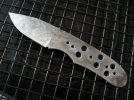
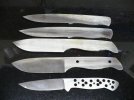
P1030198.jpg
Knives smaller.jpg
 
Oh, forgot to ask in the initial post if there was someone who might be willing to test the hardness for me if I pay shipping both ways????
 
You are fine with a 1/8" blade in a pre-heated oven for 8 minutes.

For reference, the time at soak starts when the blade reaches the target temp....not when it enters the oven.
You set the timer when the controller rebounds to the target temp.

The reason even 1080-1084 blades should have at least a 5-10 minute soak is to allow time to equalize with the oven. Once at temperature they can be quenched because there are no alloy ingredients or excess carbon to deal with.

All HT ovens should be allowed enough time to come up to temperature and fully equalize the chamber before adding the blade. This often takes 30 minutes or more. Give it time to equalize, don't rush this step.
I read posts like, " MY 5000W Home built HT oven reaches 1500°F in five minutes....", and cringe, because there are so many red flags in that statement. The read-out reaching 1500°F and the oven chamber being stabilized/soaked at 1500°F are two very different things. A blade placed in a cool oven that is heated that rapidly may reach temperatures over 1800°F before the oven is stabilized at an even 1500°F. It may go into the quench after dropping back to 1500°F, but the grain growth could be horrible.


It is a good idea to watch the temperature read-out and get a feel for how long your oven takes to rebound from opening and adding a blade. Once you have a feel for how long it takes you oven to return to the target temp, you can factor that into the soak time needed.

It is a good practice to soak all blades a minimum of 10 minutes once placed in the oven. This will account for the temperature drop, the blade equalization, and the alloy content going into solution. Slow ovens may need more time.

The higher the alloy content, the longer the soak time needed.
Simple 10XX steels should soak 10 minutes.
Higher alloy carbon steels, like O-1, A-2, 52100, W-2, 5160, 9260, etc. should soak for 10-20 minutes.
Simple stainless steels soak about 30 minutes, and complex stainless steels 30-45 minutes.
 
Thanks for the reply Stacy. I had a general concept of what you suggested. The oven is 220v. I let it get up to 1475 let it sit for a few min then added my blade. It dropped to 1400 then back up to 1475 within a min or so. I started my time after that minute so around 9 min total kiln time.

I think I will let it equalize a little longer on the next run and let it sit for another min or 2. The reason for my concern that it may not have gotten up to temp was the lack of excitement when quenching. No flare up, not a ton of smoke, really nothing to speak of. It took about 5 sec to open the door grab the blade with pliers, turn it over, pivot and submerge. Tip first, agitate in a cutting motion, for about 15 sec. When it came out I could handle it barehand almost immediately. I was surprised at the lack of oxidation/scale.

After the first temper it was mostly a blue and purple color. I decided to lightly grind the bevel to clean steel. After the second 2 hr temper at 425 the blade had lightened a little and the bevel was a nice light brown/ straw color. A file will not totally skate but it def doesn't bite like annealed. I cleaned up the rest of the knife with a 220 grit belt slowly and dunking often. It grinds a little different but not what I was expecting from a fully hardened blade. At this point I don't have a reference point to compare.

Any thoughts?
 
No excitement during quenching is a good thing,controlled temps with good oil and a full quench you will very seldom get a flare up and not much smoke.
Stan
 
I agree with Stan.
When demonstrating a quench from the forge, the blade is almost always too hot, and there is lots of smoke and such. When quenching from the oven, there is little excitement. Also, many people pull the blade out of the oil too soon, and there is lots of smoke and flames from the hot metal. This is especially predominant when the blade is held in tongs while heating in the forge. The hot tongs will make the oil smoke and flare up a lot more than a pair of tongs that were only use to pick up the blade and quench it.
 
I think I will HT the other 2 I have tomorrow and then have someone test the hardness on them. Any volunteers? I would be eternally greatful and willing to include fair compensation.
 
By the sounds of it, you should be fine. At a 425 temper, i would say expect 57-58RC hardness. I would think you should be fine :)
 
A boring quench is a good quench... just as the other guys said. Stacy summed up my thoughts on preheating the oven and I can ABSOLUTELY confirm the temperature spike now. I dropped four tabs of Tempilstix (1500F, 1600F, 1700F, 1800F) and ran my oven at full ramp to 1500F. All four tabs were melted!!!
 
Last edited:
we use a temp controlled forge and muffle to heat treat with..Ive learned it takes more than 35 minutes for the forge to even out enough to heat treat in..
 
Back
Top