- Joined
- Apr 27, 2009
- Messages
- 991



The BladeForums.com 2024 Traditional Knife is available! Price is $250 ea (shipped within CONUS).
Order here: https://www.bladeforums.com/help/2024-traditional/


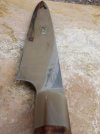
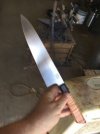
One problem that many have with kitchen knives, including very skilled and experienced knife makers. is that the tend to apply the designs and techniques used to produce other types of knives to kitchen knives and often, that just doesn't work. You sometimes end up with "kitchen" knives that more resemble something that Jim Bowie would have had with him at the sand bar. One thing that i notice is the a lot of us have been told that the point of a knife should be in line with the center of front of the handle or perhaps the "axis of thrust" based on the handle shape if it is curvy. In the case of a chef knife, I would argue that the point should be in line with the center of the blade at the heel and no higher. Once you get that, you decide what shape you want to use, be it say a fairly symmetrical long spear shape with nice sexy curves like say a Kramer, a more flat belly shape like a typical Gyuto or an old Sabatier or even one with the tip maybe a tiny bit higher like the typical old school Henckels.

I took that one down to about .005 for the most part and .007-.008 at the heel. I leave the heel with a little more beef on my knives, but I have to double check when I sharpen to make sure the heel gets done like the rest of the edge.
My budget has not allowed me to buy high end kitchen knifes so I'm trying to base the design from pics.
It is a good book. I took some good advice from it. Thanks H!Murray Carter has a knife design book with kitchen knife patterns available for your use. That might be a worthy investment for you.
regards
For the blades where I did an S grind, I used a rather tall convex for the edge, like 3/8 high. The S grind ended up being a double flat grind, first one taking the entire bevel from spine thickness down to like 1mm at the edge and the second coming under that with the hollow starting right under the "shinogi" formed where the second flat meets first flat and the convex edge starting right below the bottom of the hollow. The sequence was first flat, second flat, rough convex of the edge, hollow, blend and do initial hand sanding of everything with EDM stones and paper, set the edge and clean up with paper, final hand sand everything nice and slick, then final sharpening.How does it feel in your hand? do you have grip choices when you use it? how is the balance? how does it work for you when slicing or dicing in the kitchen? how does the handle FEEL, heck with wa or western or eastern. If you work at it, the handle will seem to disappear in your hand. The joy of making a kitchen knife is making one that works well for YOU, heck with 'it looks too pointy' or 'point is in wrong direction'.
if it is a kitchen knife used on proper cutting board I prefer the edge .0025 or less over the whole blade. what is the thickness 1/4" and 1/2" above the edge? for a good kitchen slicer I like it to be 0.020" at 1/4" and 0.030" at 1/2" for best performance. I also prefer hardness to be at least Rc62, Rc64-65 is even better.