First Kitchen knife - UPDATE: Fragged

Joined
Apr 14, 2011
Messages
168
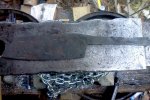
Well guys, I finally got up the confidence to try forging out some kitchen blades. I figured I'd try a santoku to start off. I just finished the HT and am getting ready to finish my grinding. It's very thin at the moment, hence the somewhat premature HT -- I was concerned that doing any grinding other than rough profiling before hardening would be asking for warp problems with my primitive HT setup. I have some thoughts on where to go from here, but I'm hoping for some input from you all to tell me if I'm on the right track or not.

First, it's Aldo's 1084, forged to present thickness with only a little grinding to clean up the profile. Did 3 normalizing cycles, starting around 1600 and dropping to around 1450 on the last cycle. Then heated to around 1200, air cool to 900ish, quench (additional grain refinement, as I understand it). Afterward, the standard 1084 backyard HT -- Austenitize @ 1500, quench into canola, tempered 2 x 2 hour cycles @ 425F. Blade stayed true and straight after the quench, right through the tempering.
IMG_20111115_073550.jpg

Spine comes in at .093 as-forged, edge is 0.051". The blade edge comes in at 7". I'm thinking of doing a Wa-type handle, so the tang will need to be ground and cut down to accommodate that.

So, here's the plan of attack (subject to change, naturally), and where I need the most input from you more experienced fellows:

  • Clean up the profile
  • Scale removal, assuming I don't go kuro-uchi style with it
  • Grind down the tang, drill a couple small holes
  • Grind in bevels (probably a slight convex grind, about 1/3 of the way up from the edge, to aid with food release)
  • Attach handle (ambonaya burl block)
  • Shape handle
  • Finish work
  • Sharpen
  • Chop stuff and test edge retention

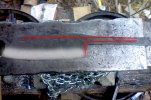
This is roughly the trimming I'm thinking of doing -- Red lines for profile cleanup, white for where the bevels will be ground in. The profile will be more rounded... my Photoshop drawing skills leave much to be desired. :thumbdn:
IMG_20111115_073550 copy.jpg

What changes would you guys recommend? Any issues I'm missing here? What do you think so far? I'm at a stage where I can still make a lot of changes, so I'm open to whatever you all might have to say. I started making knives with the intention of eventually making kitchen knives, but I have much more experience with using them than trying to design and make them.

Thanks for reading and I'm looking forward to your suggestions. :)
 
Last edited:
i made a knife almost just like that but after doing rough grind i went to heat treat and it warped like you wouldnt believe! i am not sure if to thin, had a lot of stress or what but it was to warped to save even after several attemps to straighten. so i put it int he vice and broke it at full hardness to see how the grain size turned out, not too bad. so i took the part with tang still on it and made a simple handle and gave it to a buddy that does wood carving , we will see how it holds a edge and full hardness
 
Yeah, that's why I heat treated almost straight out of the forge. I knew it was thin and that was going to be an issue. So, I cold worked most of the remaining hammer marks out, then thermal cycling, then HT, then cleaned up the profile. I managed to avoid the warp that way. I figured since there was no grinding done and I had relieved as much stress and refined the grains as much as I could without a HT furnace, that if it did warp it would be minimal and could be straightened during tempering.

I'm still toying around with handle options, but I think this will be a pretty decent knife. I soaked it in vinegar for about the last 6 hours to help get the forge scale off and it worked like a charm.
 
looks liek a good start
so far as testign no need to do the chopping
also you will not need that much belly on a veg "chopper" i leave most of the edge dead flat for more contact on the cutting board
 
looks liek a good start
so far as testign no need to do the chopping
also you will not need that much belly on a veg "chopper" i leave most of the edge dead flat for more contact on the cutting board

I was wondering about the belly on it... you confirmed what I was thinking. Now that I've gotten all the heavy scale off, I'm going to clean up the profile and tang. I didn't mean "chopping" as far as abusing it in the yard or anything... more like putting it through a workout on the board with various types of veg.

Also, I've been following your work on KKF and here on BF; I really admire your work. Thanks for chiming in.
 
Looks good so far. You made as good choice to grind the bevels after HT.
The red lines are good, but I would keep a bit of that 45 degree transition from the tang bottom to the blade to allow for some extra strength. The edge should be nearly straight up to the last 2" from the tip.
I would just flat grind and sand it .
make an octagonal handle and you will have a nice knife.

Here is a short tutorial on building one:

For those wishing to try this style -
Fit a 1/2" to 3/4" ebony block to the tang as close as possible. The tang should taper evenly toward the blade in both thickness and width. Use the same techniques as doing a metal guard....small holes, saw/drill out the excess wood, file to a close fit. A good trick is to taper the slot from the backside of the ebony block. It only needs to be a flush fit on the front, the back can have a lot of room. File from the back while looking from the front. Once the ebony fits snug, drill the main handle block to fit the tang. This doesn't need to be a perfect fit, as it will be enclosed. Sand the mating surfaces, as well as the front of the ebony piece, and check that the handle and bolster blocks fit right. Mix up some epoxy and tint it black. Fill the tang hole on the big block, and cover the mating surfaces with epoxy. Put some epoxy on the tang,too. Slip the bolster block on, and then the main handle block. Slide them up until, the bolster wedges on the tang. Clamp snugly , wipe off any excess epoxy from the tang, and let cure. After the handle is fully cured, sand to a square, aligning with the blade. Make the handle taper slightly from the butt. Now carefully sand the corners to make an octagon. I like the corners a tad smaller that the side flats.
An ebony butt cap that matches the bolster can be put on, too.
 
Stacy, THANK YOU! Really though, I'm beginning to wonder if you have ESP. Haha. I was just digging around looking for where you had posted this tutorial; I knew I had recently seen it or something similar in another thread.

I'm going to try your octagonal handle tutorial and grinding suggestion. I'll update once I have made some progress. :)

As far as the grind goes, my concern is that I won't be able to get the marks from my hammer peen out without thinning the blade down too much. (Hence my initial thought of leaving it with a kuro-uchi finish... It seems more intentional than a flat ground blade with peen marks.) Time will tell, I suppose. Worst case, it'll be thin -- Aldo's 1084 has held up remarkably well in some other very thin applications I've played with. I won't say that I think my HT setup is "optimal" by any means, but I think I've done a decent enough job for the blade to perform essentially as intended.

Any thoughts on the ideal final spine and edge thicknesses on a knife like this? I would measure my Wusthoff, but I don't think that's necessarily the best example.

One other [long, drawn out] question... between the ebony "ferrule" and the main handle block, I've seen a number of other smiths put either a metal (copper, etc) or G10 (etc) spacer... Am I wrong to assume some small holes should be drilled in the spacer and maybe a small hollow put in the wood where the pieces are fitted together to allow the epoxy somewhere to go/create a stronger bond? Or is there some other method of fitting those pieces together that would be preferable? Also, suggestions for what type of spacer material would be best?
 
Last edited:
mine start at the handle around .100 thick and distal taper to maybe half that at the tip end also you can grind the edge to under .007 no problem before sharpening (maybe even thinner )
 
I'm with Lloyd... .060" is just right for me.

If putting a spacer between the bolster and the handle, cut the spacer slot nice and loose, and glue the spacer to the bolster. Then assemble the bolster/spacer to the handle as one piece.
 
Wowza, those are some thin laser slicers guys! I'll do my best! Thanks for the input. I'll probably grind it in the morning.
 
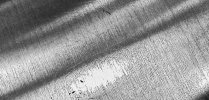
Ok, so I took Stacy's recommendation and flat ground the blade... Everything was looking good, so far. Then I looked closer. The blade is ground up to a 220 grit belt and I'm now noticing a strange pattern all over the blade. I can't tell if they're small cracks or what. I flexed the blade -- no breakage or anything that would lead me to believe that the blade is likely to break.

Here's a picture. I did the best I could, but it's very difficult to see. I've changed it to black and white and upped the contrast so it will be easier to identify. The grind lines are pretty pronounced because of the editing... much less so to the naked eye. Look for the odd pattern going across them.

IMG_20111117_015807 copy.jpg

If you look by the brightest point of the picture, you'll see what I'm talking about.

Are these cracks, a pattern created during the quench, what? And should I toss this thing and start over, or press on?

Added: If it makes any difference, the blade has been ground down an additional 0.030 to a spine thickness of 0.060 roughly. Doubt that's important, but figured I'd include that little tidbit anyway.
 
I see what you are talking about. I would say that is an artifact of hammer blows made at too low temperature. It looks like microcracking around the hammer mark that is still shiny in th photo. Clean it up a bit more, and then give it a quick dip in FC. See what the surface looks like. If it looks OK, go ahead and finish it. If the blade has lots of these cracks, best to quit here.

Page will chime in shortly, as metal flaw inspection is his forte.
 
Thanks, Stacy. Unfortunately this defect is fairly prevalent over the majority of the surface, not just by the hammer mark. I'll take it to 400 and see if it's still showing up. My gut tells me this blade is toast.

Maybe I'll name this pattern dumb-ass-cus and say it's my own proprietary texture. Haha. I'll hold out hope for now.
 
My first guess is that you are still in the scale layer, that would explain the overall prevalence of the pattern, it looks like the surface microfissure pattern of deep scale that has been allowed to form through cold (sub forging temp range) forging. Try taking off another .025" per side, take it down to 800 grit in the same spot you photographed, photograph it, give it a light etch either in dilute ferric chloride, vinegar, or sodium bisulfate (I personally like 2% Nital for steel but if you are not experienced dealing with full strength Nitric I would not advise this being your first experience with it) and photograph it again. My hope is that this is just a surface scale condition taht you have just not gotten to the bottom of. If the pattern is unchanged then you have issues, I am hoping that you can get under it, the etch will help you to see what is going on as etches show grain boundaries and stresses

-Page
 
Last edited:
My first guess is that you are still in the scale layer, that would explain the overall prevalence of the pattern, it looks like the surface microfissure pattern of deep scale that has been allowed to form through cold (sub forging temp range) forging. Try taking off another .025" per side, take it down to 800 grit in the same spot you photographed, photograph it, give it a light etch either in dilute ferric chloride, vinegar, or sodium bisulfate (I personally like 2% Nital for steel but if you are not experienced dealing with full strength Nitric I would not advise this being your first experience with it) and photograph it again. My hope is that this is just a surface scale condition taht you have just not gotten to the bottom of. If the pattern is unchanged then you have issues, I am hoping that you can get under it, the etch will help you to see what is going on as etches show grain boundaries and stresses

-Page

Well Page and Stacy, I took your advice and ground it a bit thinner and etched with vinegar. Turns out they are indeed cracks. So, since the blade was pretty well ruined anyway, I decided to abuse it a bit and then break it open to look at the grains.

Good news is, it held an edge remarkably well... And it definitely wasn't doing kitchen tasks. Granted, I did do some slicing and mincing of various veg in the kitchen just to feel whether I liked the geometry -- which I did. It was a very efficient slicer and the lightly convexed area helped with food release.

I then proceeded to chop through a couple of 2x4's... I put the edge on with an EP and set it at 12* per side. It held that edge without deformation right up until it cracked top to bottom (because of the mini-cracks in it to begin with). Even after the blade failed, it was still shaving sharp (got through 1 and 3/4 of the way through the second 2x4.)

So, I don't feel this was a total failure. The geometry felt good for normal kitchen tasks and sliced like crazy. The edge held very well, so the HT couldn't be too far off considering the primitive nature of the equipment used. Overall, I'm happy with the learning experience and walked away understanding the good and bad of this blade well enough to make another one even better.

Oh, and when I snapped it open, the grains were very tight... no noticeable growth, to my eye, and looked very uniform under magnification. I don't have proper equipment to do an analysis, but what I see seems to mean I'm at least on the right path. Hopefully an HT oven will be in my future after the new year.

I've already started forging another, longer kitchen knife -- and yes, I'm keeping it hotter and making sure not to forge it below the recommended range. I'm also normalizing every so often and annealed (warmed vermiculite) when I was done working on it this morning. I'm still planning to do the octagonal handle, etc. This one, however, I will be leaving a little thicker for HT, then grinding it down to roughly the same thickness of this last one in the interest of getting through any residual scale and making sure all hammer marks are gone before hand sanding. Hopefully this one works out better and I get to finish it all the way. I'd really like to have it done by Thanksgiving, but I'm not sure that's in the cards. Wish me luck!

Thank you very kindly for your help!
 
Good plan.

I usually start with stock twice the planned blade thickness,..... so I start with .125" and end up with a .060" blade (at the spine).

Forge between 1600 and 2100F and don't try to pound the steel too hard. At the end of a forging session, I would not anneal the blade. Just cycle it down.
Heat to about 1600 and let cool to black - quench
heat to 1500F and let cool to black - quench
Heat to just barely non-magnetic and let cool to black - quench
heat to just below the non-mag point, about 1200F , and cool to black - quench
Heat to the same point and let cool in the air until it can be hand held.
Set aside until the next forging session.

When the blade is finished with forging and ready for grinding, do a spheroidal anneal, and then go to the grinder.
 
I was really hoping that we were just seeing "alligatoring" scale, sorry that was not the case. One of my students had a blade crack like that ( he would always try to get the steel to move when it was black) and it kinda came back and bit him about 6 years ago. Learning to forge is a process that inevitably will have some failures, the best thing to do is learn from them and move forward. Good luck, and strike while the iron (steel) is HOT!

-Page
 
Back
Top