
First post, first knife and a huge thank you

Joined
Apr 9, 2019
Messages
28
Just wanted to give a big thank you to everyone on the forum. I have been reading/searching the boards almost obsessively for all the tips and tricks I could find for the past 2 months or so.

I finally finished up my first knife out of 1084.
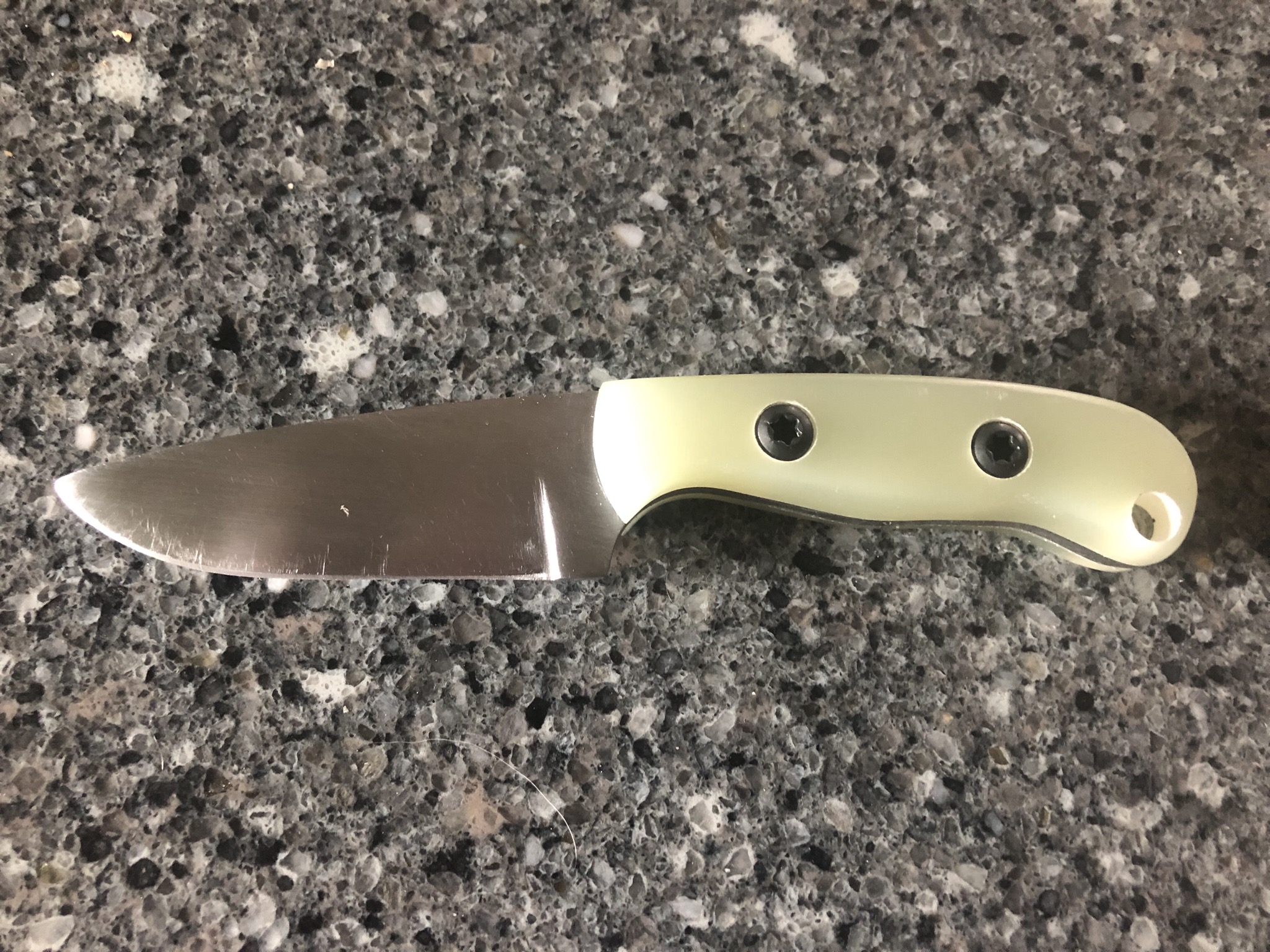
YqMQjgS.jpg


Any constructive criticism would be welcome.

The process got a bit frustrating at times, but I definitely learned a ton. Can’t wait to get started on my next one.

Thank you very much to everyone who posts here. I don’t think I would have finished it without this forum as a resource.
 
Great first knife. You avoided a lot of the first knife design flaws and ended up with a nice, functional design. Only thing I’d say is to spend more time finishing the blade. It still has a good bit of scratches and some grind marks at the plunge. Also try to keep the tip pointy as it seems to have gotten rounded a little. Nice job overall!
 
Welcome Steve.

Not bad at all! That is a great first knife.

I can't tell in the protos, but don't make the top/bottom of the handle too squared off. Round the top over onto the sides and do the same from the bottom.
You also should slightly chamfer the thong hole … or put a tube through it.
 
Finishing the blade was were a good portion of the frustration came from. I was going for a satin type finish. After I got the blade looking how I wanted I would end up with more scratches after sharpening, then try to fix those and dull the edge again. I went back and forth like that several times. I think that’s what happened to the point.

How would you recommend chamfering the hole? I spent so much time working how to best make the scales removable that I kinda lost sight of the overall shape of it.

Thank you both for your input!
 
A very solid first effort, well done.
A lot can be done with files and sand paper. What equipment did you use to heat treat your blade?
 
Thank you.

For the heat treat I heated it to non-magnetic with a propane torch, held it there for about two minutes and quenched in canola oil. I think my oil was a bit too hot, probably around 180 or so when I quenched. I underestimated how long it would take the torch to heat it up. Tempering was done in the oven at 400 for two 1 hour cycles.

Not the best or most accurate method, but my understanding is that it will produce decent results with 1084. The next knife I do will more than likely be sent out for heat treating.
 
Camfur thong hole with a larger drill bit. Do not go past the shoulder. When sharpening, do not go off the end of the stone,or the side, stop the stroke before you do
A common mistake, it's not hard to look at a knife an tell this has happened. When removing scratches, make sure all are gone before starting fine grit. If you see any after starting the finer grit, go back to the lower one. That will show up.!!! An most of all , Thank you for your service to our great country!!!!!! An welcome to the forum. Wayne
 
Finishing the blade was were a good portion of the frustration came from. I was going for a satin type finish. After I got the blade looking how I wanted I would end up with more scratches after sharpening, then try to fix those and dull the edge again. I went back and forth like that several times. I think that’s what happened to the point.

How would you recommend chamfering the hole? I spent so much time working how to best make the scales removable that I kinda lost sight of the overall shape of it.

Thank you both for your input!

The blade finish is always a pain but gets easier as you go. I use a hard rubber backer on my sanding block and WD-40. Some folks use windex which I like at higher grits. Watch Nick Wheelers hand sanding videos. They are very informative and filled with great tips. A great hand rubbed finish takes some skill but most of all it takes patience. It’s a marathon and you just gotta keep going. Get all your scratches out before moving on. Don’t get too obsessed with trying to go all the way to 1000 grit at first. A well done 220 grit finish looks better than a poorly done 1000 grit finish. Did you bevel the front of the scales? I guess it’s a glare or something so it’s hard to see. Also, you can get a chamfering bit for your drill/drill press or get a hand held one. I use something like these. https://www.google.com/search?q=cha...53#imgrc=gmXd4zape-wTwM&imgdii=1fozz2zJmsARPM
 
Looks good Steve, and welcome! If you're interested in getting into forging blades, I'd suggest checking out the NWBA, and try to get to the monthly open forges and the annual conferences down in Longview. There are a number of great bladesmiths that show up and all are very generous with advice.
Another great way to speed up the process is to look into taking a class, one of the best instructors lives Yelm.
Have fun.
 
Great job, and for a first knife! Any countersink will work to chamfer the lanyard hole. My first guess when I saw the pic was that the scratches happened during sharpening, which is something that will be easier to avoid with more practice and experience in hand sharpening. A good way to help protect the blade's finish when applying the edge is to use something like a strip of painters tape or frog tape to cover each side of the blade with and then use the edge of something to score the tape along the edges/corners of the spine and edge so that the excess will easily be able tear off, then the tape will cleanly match the shape of the blade.

I would do the first number of strokes on the stone with the edge trailing so the tape that's covering where the edge is being applied will abrade off as opposed to being pushed back up by the stone. Once that small section of tape has been removed then you can switch push strokes if that's what you're more comfortable with, although using an edge trailing (same as when stopping) can help keep the angle more consistent for some people when learning to sharpen by hand.

If you want to try to get the tip pointed again, just lightly "grind" the spine above the tip just a tad on your course or medium stone and then you can easily refinish that part of the spine with a few passes of paper since it'll be a pretty small area. IF you have a belt sander you can use that too, just make the contact with the belt very short as the tip can and will over heat really fast if held in the same spot.

Keep at it! :thumbsup:

~Paul
My Youtube Channel
... (Just some older videos of some knives I've made in the past)
 
Thanks for all the responses. I’m going to try and touch up the point and finish some using everyone’s suggestions. I’ll post better pictures when I’m done.

How sharp should I get it before I do the finish sanding on the blade? For my first attempt I was getting a decent edge, then sanding then resharpening. I think doing it that way was wasting time and didn’t give a great finished product. Should I get the finish where I want it then sharpen?

It’s about 6” overall length with a 2 3/4 blade.
 
Thanks for all the responses. I’m going to try and touch up the point and finish some using everyone’s suggestions. I’ll post better pictures when I’m done.

How sharp should I get it before I do the finish sanding on the blade? For my first attempt I was getting a decent edge, then sanding then resharpening. I think doing it that way was wasting time and didn’t give a great finished product. Should I get the finish where I want it then sharpen?

It’s about 6” overall length with a 2 3/4 blade.

Great first knife!

You should get it incredibly dull before you do the finish sanding!!
Please don't work on a sharp knife, we really don't want to see pictures of the gory aftermath.
Sharpen last. After you make the sheath.
I KNOW how badly you'll want to feel it function before it's done, but just wait. As long as you know it's hard, it will be a knife.

One sensible order, if you're doing glue and full-tang: Heat-treat, polish, blue-tape polished surfaces, fit handles, glue handles, shape & finish handles (blade re-taped), sheath, sharpen.

With care, you can prevent finish scratches during sharpening. That means cleaning grit and swarf off in the direction of the finish, and very very gently. Blow most of it off first.

Looking forward to seeing #2.
 
Sharpen last for sure. I cut myself all the time and I sharpen last. With pressure an unsharpened edge at .005-.010” will still cut pretty deep.
 
Good first one!
Since you used black screws, you can get black carbon fiber tubes. One of those would have looked good
 
Back
Top