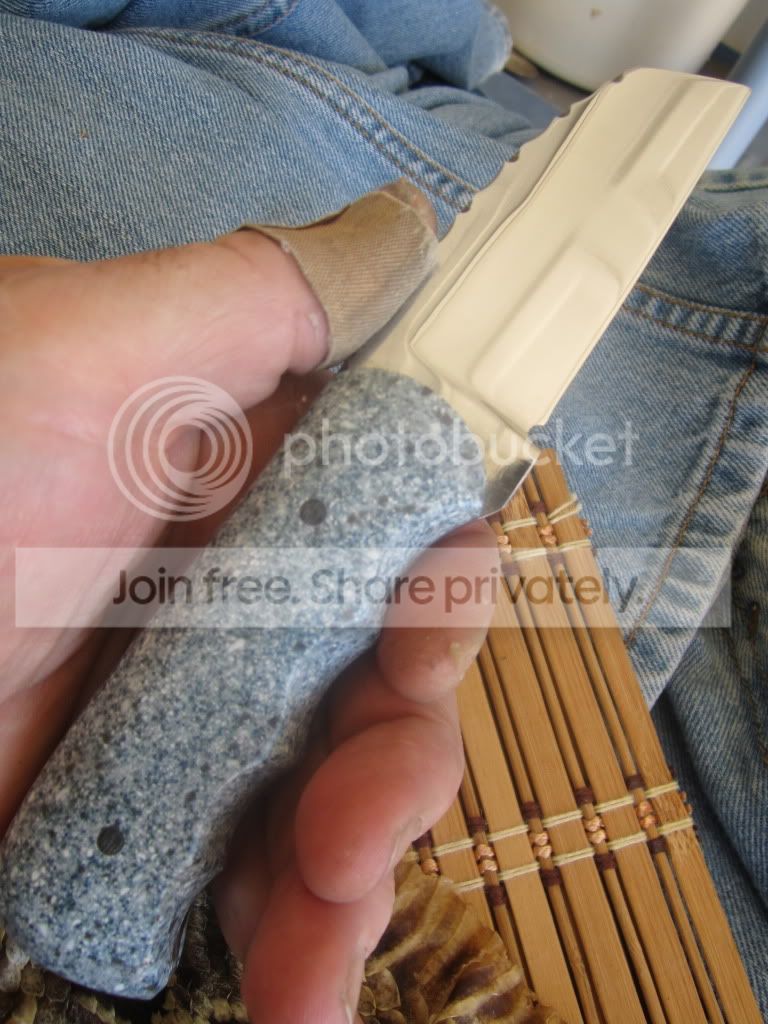
Fixing An old file knife handle

Joined
Apr 17, 2011
Messages
89
Hey y'all
Ok so my dad brought me an old Bowie made from a file today to put new scales on, the old bone scales fell off. He wants a new wood handle but the tang was never drilled for pins. Don't ask how the scales held on for the last 20 yrs cause I can't figure it out. Can I heat the tang to drill thru or do I need to anneal the entire blade again not sure what heating part of the knife would do for warping.
Thanks,
Sterling
 
Put the knife in some water. Wrap the ricasso area with a wet rag tightly!

Make sure that the rag and blade is tip down in water. I suggest a bucket. Use OA torch to heat up the handle making sure to not get any heat down the blade. Get it to a nice even red. Let it cool and it should be good to go.
 
Having two different heats won't affect the straightness of the knife? And when I'm done should I HT or will it not matter for the handle thanks,
Sterling
 
If you clamp the blade in the vise, tang up, you can heat the tang with your torch without worrying about ruining the temper of the blade. The mass of the vise acts as a heat sink and there's no way for the temp in the blade to rise high enough to do any damage. Just protect the finish of the blade with a bit of leather, etc., and go to it.

Once you've let the tang cool, you shouldn't have any problem drilling through it, though you'll still want to go slow and use lots of oil to cool the drill.
 
Another alternative (one I've used) is to grind the tang down and make a hidden tang handle.
 
frankly, a lot of people don't give epoxy enough credit for attachment power. gorilla glue will hold on wooden scales through the most extreme cases you can put it through. look at glue wars 2. there is no way that these knives will take this much abuse in real life. epoxy should be enough
 
Or you could get a couple of those carbide tipped drill bits sold at the woodworking shows and state fairs. The vendors regularly turn a file into something with more holes than swiss cheese. If you watch them do it, I think technically they are spot annealing the area below the bit because they run the bit fast in a drill press and the steel of the file glows red below the bit as they drill. But the heat affected zone around the hole looks pretty small, so it should not bother the rest of the blade
 
The epoxy will maintain without the pins? That's a much easier solution if itwould hold up, however I should say that this ain't a sit in the drawer and come out at skinning time bowie. My dad carries this thing everyday on his hip so if it would hold up to everyday use I will give it a shot.
 
I'm not a fan of carbide bits, they cost to much for what they produce. I've gone thru several of them tapping engine blocks and those were cast. I've never seen the trade show example but u better have one damn good bit to drill thru a hardened file, especially at any kindof high speed
 
The epoxy will maintain without the pins? That's a much easier solution if itwould hold up, however I should say that this ain't a sit in the drawer and come out at skinning time bowie. My dad carries this thing everyday on his hip so if it would hold up to everyday use I will give it a shot.

Head over and read glue wars. frankly, i don't think they will come off, depending on the handle material. shoot, richard J attached some stall mat scales with superglue, and they came off, after 17 years. I can replace scales every 17 years. If you have the ability, put pins on as well as epoxy. they are better together. I would suggest epoxy only as a last resort.
 
What's glue wars? I googled it with no luck and the scales are a maple Burl he's had for some 30 years in the rafter of the barn. Looks good just hope it's not split in the grains sitting for so long
 
I go with VaughnT on the vise as a heat sink, only use aluminum flashing to protect the blade from the vise jaws (leather will stink up the place). No, the heated/somewhat normalized tang shouldn't warp. Just let the knife cool to touch in the vise before drilling for rivets/pins/bolts. Shouldn't need special bits to drill, just good sharp HSS type.

Actually, You first might do a spot check drill test on the tang to see if you can drill it with out doing the heat trick. The blade may be just plunge quenched and the tang relatively soft already.

Yeah the glue will probably hold until the knife is cycled through several heats and coolings, impacts, and flexes....etc. No big deal to do the above and secure with rivets/pins/bolts whatever. Combined with good glue job should give you a fix that will last as long as the blade itself.

Guys....the gentleman is struggling with understanding the heating of the tang to "soften" for drilling. You really think he's ready to run the gauntlet of learning to get the best hi-tech glue joint down pat for a knife handle? He needs simple resolution to a one time problem.
 
I prefer epoxy and peened pins, but I wouldn't have any problem using epoxy alone if it will just be used for skinning and light tasks. A fresh coat of good epoxy will last another 20 years, but properly peened pins will the scales on long after the epoxy has failed
 
Ive used a carbide burr in a dremill to cut pin holes in some of richardj's plow steel blade.(hard stuff)It took a while ,but got the job done.
IMG_2485.jpg
 
Last edited:
A decent carbide tipped masonry bit on a slow setting will also do the job without annealing and has the advantage that the bit won't spin and burn like some of the cobalt bits tend to.

+1 on the vise as heat sink option if you do need to anneal.
 
Back
Top