flat grind?

Joined
Feb 21, 2008
Messages
350
If the grind follows the curve of the blade (the belly) and isn't the full height of the blade, is it still called a flat grind, or is it something else?

I am having trouble on a blade I am working on, and I'm not sure if its me or the method I'm trying to use, but its a blade thats about 4" long and almost all belly with a bevel thats about 5/8" tall. I've been trying to grind the bevels on my 4x36" belt sander with very little luck, but when I go back to filing the bevels, I am able to keep it much more even.

Does the 4" wide belt have anything to do with this, or do I just need to keep at it and I'll figure it out?
 
Any time the bevel is flat, it is a flat grind. When grinding any blade, the angle of approach needs to change when making the transition from the straight edge, throught the belly, and to the point. If you maintain the same plane throughout, the belly and point will be much thicker than the straight part. Since your knife has ample belly (could be said about me, too) you will need to begin raising the handle slightly sooner than on a knife that has less belly. The sander you are using should work fine. Figuring out how much to raise the handle will take practice and assume you have scribed some sort of blade centerlines to let you know if you are on track.
 
If you are new to knife making and just getting used to using the sander to grind bevels, the best advice you can get is to go slow and do not force things. If you do force it, the sander will become an animal and remove steel at an alarming rate in places that are inappropriate.
 
Thanks for the reply and the tips. Should I be starting at the ricasso, or the tip? I was starting at the ricasso and I was having a problem keeping the part of the blade that I want to keep flat off of the belt.

Thanks again.
 
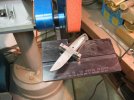
That is a common problem and there are those, I suppose, that do it all by eye. I have a cheater that can be purchased at some knife supply stores. It is illustrated in the attachment. Many makers fabricate their own versions. Most makers drift the belt 1/16" or thereabouts over the edge of the platen and begin grinding at the ricasso (the plunge) and make a continuous pass towards the point. You should grind from edge to spine. When you flip the knife over to do the other side, the belt should be drifted over the other edge of the platen to make the plunge even on both sides. I suppose there are stickies that describe the flat grinding process better than I can. I recommend going through them and see what tips they may have to offer.
 

Attachments

  • Step 7 bevels 1.jpg
    Step 7 bevels 1.jpg
    66.7 KB · Views: 129
Last edited:
i'm guessing if you are using a 4"x36" sander straight out of the box, you'll need to glue/epoxy a platen onto the sander itself that the belt will ride on top of so you can get a nice clean plunge line otherwise it would be a little far fetched when trying to grind the left side of the blade as I am guessing the tracking on the sander you're using does not go all the way to the other side and even then your plunge line will not be able to be straight up and down like most flat ground blades!

http://www.elliscustomknifeworks.com/ Go to Refractory and Knifemaking supplies then go to Ceramic Platen liners. You probably need the 4" x 8" ceramic platen ....and some JB Weld!

This assuming you don't already have a platen glued.
 
The name of grind types is somewhat argumental, but a flat grind that goes part way up the blade side and follows the edge is:

A Sabre/Saber Grind if it has a secondary bevel
or
A Scandinavian Grind if it has no secondary bevel ( bevel goes right to the edge).

The main difference between these two is in the re-sharpening. The Scandi has to have the whole flat re-ground, while the Sabre only needs the small secondary bevel re-done. After many sharpenings the bevel of a Scandi will have moved noticeably higher up the side, while the sabre grind will have the bevel slightly shorter.
The scandi will always be the same sharpness and edge angle for the life of the blade. The Sabre grind will slowly get blunter and blunter until you eventually have to re-grind the entire bevel.
 
The name of grind types is somewhat argumental, but a flat grind that goes part way up the blade side and follows the edge is:

A Sabre/Saber Grind if it has a secondary bevel
or
A Scandinavian Grind if it has no secondary bevel ( bevel goes right to the edge).

I stand corrected and thank you.
 
Here's my two cents-

Don't come into the grind at the ricasso OR the tip. Come into it about 3/8-1/2" from the plunge lightly, and establish that you're on your desired bevel.... go back to the plunge, then apply pressure, and then pull all the way from the plunge to the tip in a smooth pull.

When you are approaching the grinder, hold the blade lightly and ease it into the belt, THEN apply pressure.

You can hold a blade lightly against a 3hp grinder with a 50grit belt and just lightly scratch it once you get more practice in. :)

If you come into the grinder all tense and with a lot of pressure, you will just grind a bevel... or more likely... a facet among many facets that you don't want.
 
-

Don't come into the grind at the ricasso OR the tip. Come into it about 3/8-1/2" from the plunge lightly, and establish that you're on your desired bevel.... go back to the plunge, then apply pressure, and then pull all the way from the plunge to the tip in a smooth pull.

Very good advice, I cant tell you how much my grinding improved when I figured this out.
 
ok, so I guess I'm working on a saber grind. I did notice that I have a bit better control when I started tracking my belt off the sides of the platen and doing most of the work on the first inch or so of belt from the corners.

I do have a piece of glass that I need to get off my butt and glue on, but that means that my sander is out of commission until the glue dries.

Is it easier to maintain control on a 2" wide belt, or does everybody use them because there is a better selection of belts? What other uses are there for a 2x72" belt grinder?
 
Yes and Yes. ;) :)

Once you have a quality 2X72 you will wonder how you ever managed to drudge through life without it.

I have 3 of them, but I'm pretty serious about this whole knife deal. Blades, handles, guards, leather edges... it all goes to the grinder for one thing or another.

I use mine EVERY SINGLE time I fabricate something from steel, aluminum, wood, etc. :)
 
So far I've worked exclusively on a 4x36. Make sure that you have quality metal grinding belts, not wood (Al oxide I believe). Supergrit is where I got mine last time (and am out now). The platen is a great idea but on many of the belts I got there would not be extra clearance as it is difficult to get the belts on, especially on higher grits, so be careful. I have found the disc to be very effective for the heavier hogging of metal- it seems that the discs last longer than the belts. One thing I did was glue some cork onto the disc platen and it has extended thee life of the discs as well. Once I get new belts I'll be profiling on them, hogging bevels on the disc and finishing on the belts at higher grits. Be careful with trying to finish the flats with high grit belts as I have found that my grinder produces ripples, and sometimes perpendicular scratches. I finish by hand past 400 grit, and sometimes 200 grit. However the higher grits I have found useful for handle material finishing.

I'm nowhere near good, but thought I'd give my experiences. Check out my profile page to see what I have done on the grinder if you feel like it.

I too cannot wait until I can afford a real grinder, but with 2 children under 5, and student debt over my head it may be a while. Keep making dust and having fun, that is what matters.
 
I went from a 4x36 hitachi to a 2x42 craftsman and it really is a lot better situation. I also put the glass platen on the craftsman, the 4x36 had quite the bow in it's metal one very quickly so I had the glass ready when I got the craftsman.

For me, the biggest difference is the ability to work less of the blade at once. I've only done a couple knives since I got the craftsman, but it has made things easier. The next most important thing was that I could get 3m Trizact Gator belts. I'm loving these things. The 4" wide belts are much more limited for metal working.

Oh yeah, and a shameless plug for my new favorite knife making item. Check out Fred Rowe's bubble jig. I passed it over when I first saw the thread about them but after making a couple knives I thought that might be handy to have. Well, I used it and am a complete convert. I can't image doing a flat grind without it now. I suggest his clamp as well. I should have gotten it with my bubble jig but didn't. Now I'm deciding if I want to make my own plunge line guide or just order his. It's an elegant design I can't easily duplicate, and all the other solutions I've thought of have been far less simple and don't look like they'll be as effective.
 
Last edited:
I went from a 4x36 hitachi to a 2x42 craftsman and it really is a lot better situation. I also put the glass platen on the craftsman, the 4x36 had quite the bow in it's metal one very quickly so I had the glass ready when I got the craftsman.

For me, the biggest difference is the ability to work less of the blade at once. I've only done a couple knives since I got the craftsman, but it has made things easier. The next most important thing was that I could get 3m Trizact Gator belts. I'm loving these things. The 4" wide belts are much more limited for metal working.

Oh yeah, and a shameless plug for my new favorite knife making item. Check out Fred Rowe's bubble jig. I passed it over when I first saw the thread about them but after making a couple knives I thought that might be handy to have. Well, I used it and am a complete convert. I can't image doing a flat grind without it now. I suggest his clamp as well. I should have gotten it with my bubble jig but didn't. Now I'm deciding if I want to make my own plunge line guide or just order his. It's an elegant design I can't easily duplicate, and all the other solutions I've thought of have been far less simple and don't look like they'll be as effective.

Thanks for the feedback, Remy.

Nice doing business with you.

Happy grinding, Fred
 
Back
Top