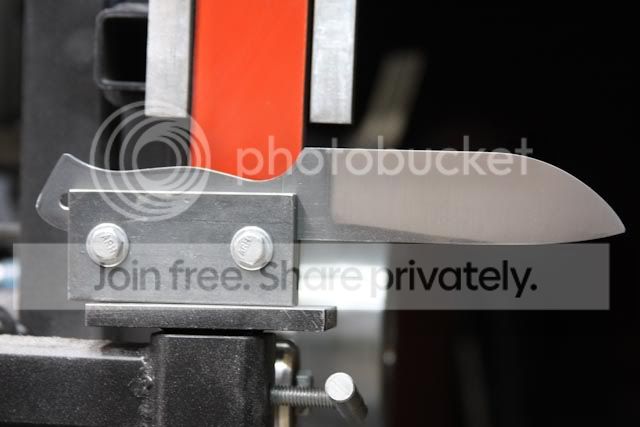
Flat grinds for the novice and some self-indulgence, professionals - please look away

Joined
Aug 17, 2010
Messages
883
[a little history] I built a grinder because my brother bought me plans for the No Weld Grinder. I had two (bench) grinders and didn't know I needed a third grinder. He was excited about this grinder that Tracy Mickley designed, sent me to youTube and I watched his videos. "ummm...OK.....", I thought. But the grinder was great and looked like a lot of fun to build so I built one. I had no idea how versatile and useful these things were at the time.

I try to do things well, so during my build I consulted not only Tracy's plans, but the internet and especially the forums - where for some reason a lot of people, including the pro's are willing to share their ideas.

I have nice kitchen knives and a folder or two from Big-5. I appreciate knives that cut well and look good. My grandpa ground his own fishing knives from old files. By no means was I "into knives."

During my internet travels I found you people. Knife-makers, artists, perfectionists, enthusiasts, teachers, critics, etc. It's hard not to get excited about making something out of raw materials that is so functional and in some cases incredibly beautiful. Stomper (JK knives), Tracy Mickley, JB Knives, Gossman Knives, and a few others are big inspirations to me.

Anyway, I'm working on my 3rd grind. My first two were OK for a novice, but I wanted to do better. I know the tenant - practice, practice, practice, but frankly, I don't want to throw away any steel. My bevel grinds sucked - so I made a jig.

Here's my second try at a flat grind pre-jig.

IMG_5606.jpg

IMG_5608.jpg


Those pictures are actually better than it went.

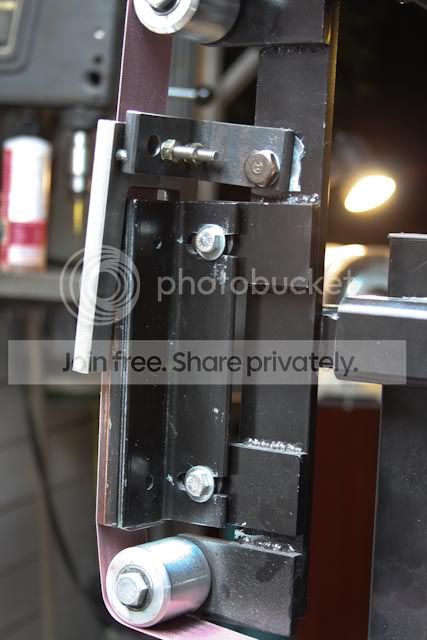
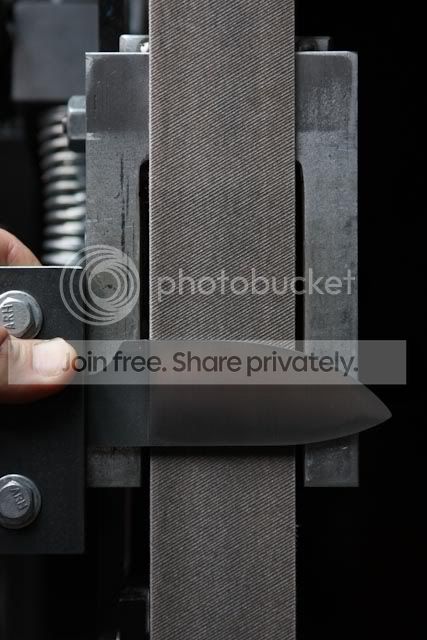
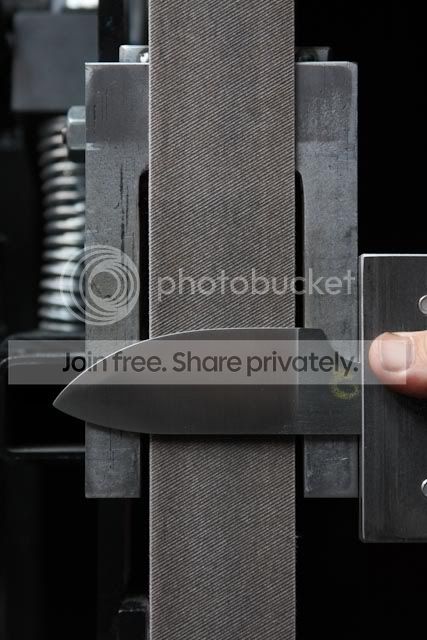
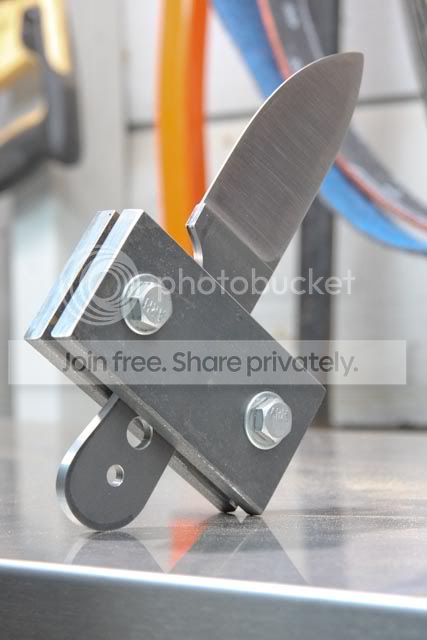
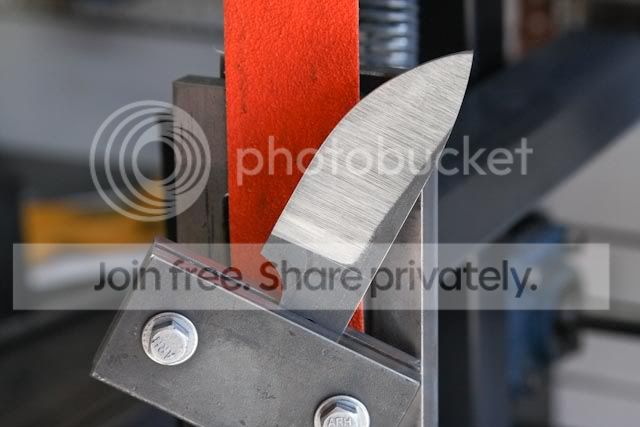
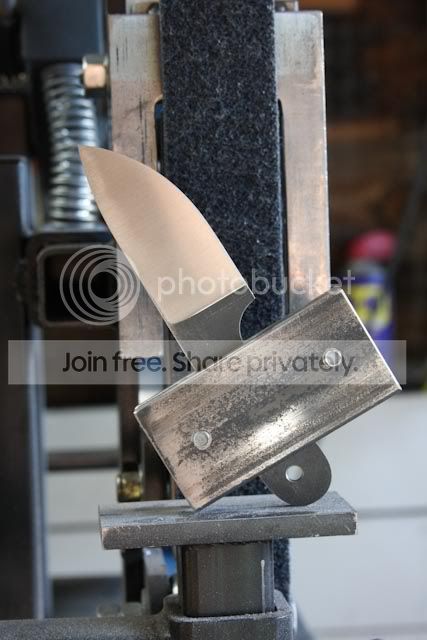
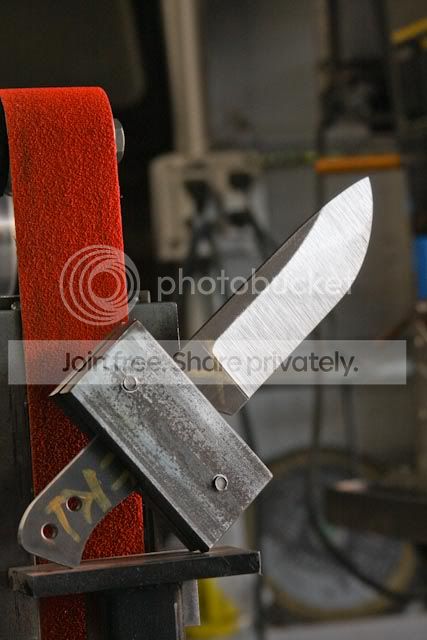
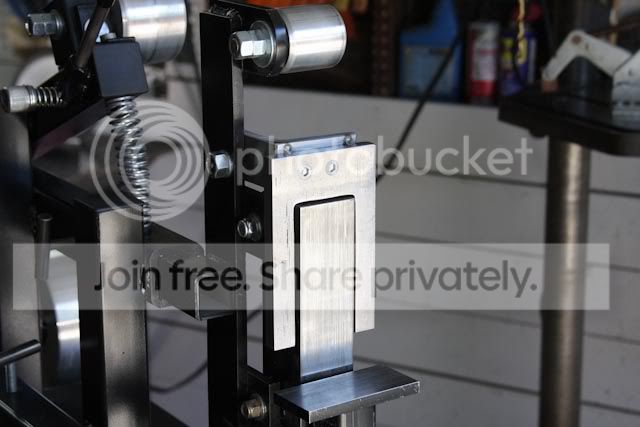
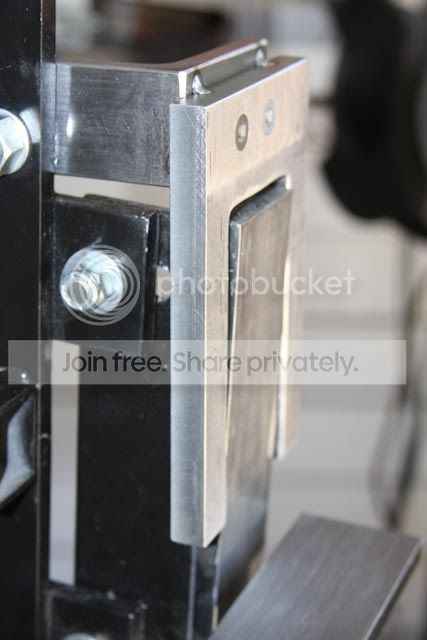
I researched this site for jig solutions and got some great ideas and saw some better results than I could achieve. I took their ideas and made this.
IMG_5609.jpg

IMG_5610.jpg

IMG_5658.jpg


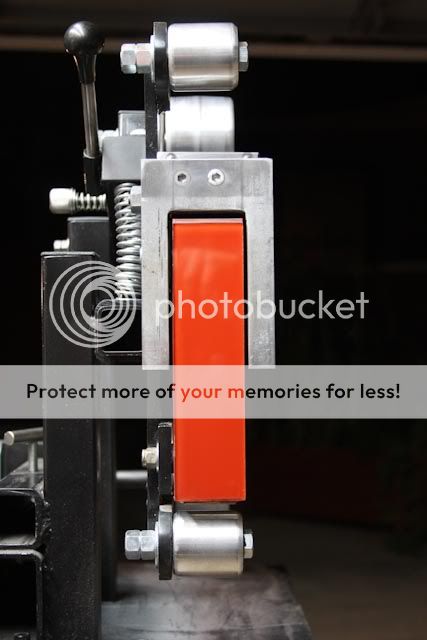
The bubble jig is awesome, the sled jigs are awesome and they probably get better results - I really don' know. I just want to inspire thought and share my limited experience. I am very happy with my plunge lines, however.
IMG_5645.jpg

IMG_5654.jpg

IMG_5649.jpg

IMG_5650.jpg

IMG_5651.jpg
 
Last edited:
Here is my third knife using the jig but before the ceramic platen. I'm looking forward to using the glass platen on #4. I see the flaws, but it sucks less than #2!

IMG_5668.jpg

IMG_5663.jpg


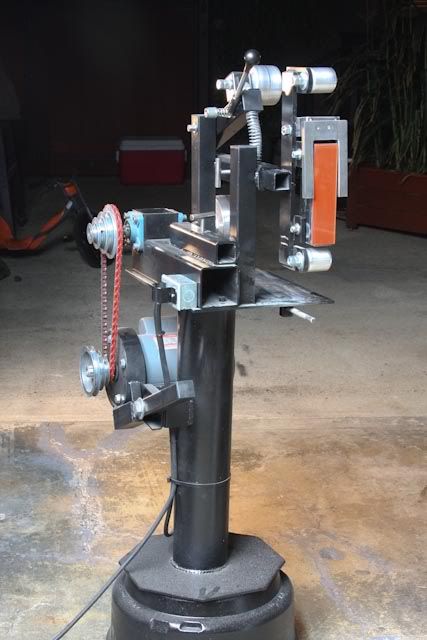
Here's my baby, courtesy of Tracy's inspiration.

IMG_5674.jpg
 
I like it. Good solution.

The open exchange of ideas within the knife community is one of the best parts of being in the knifemaking family.

Fred
 
Last edited:
How stable/sturdy is the one bolt holding the guide? That looks to be the only weak spot of it. I'd think that a little pressure on the bottom of the guide would turn it. Did you consider a second support, or a bigger support with two bolts?
 
Thanks everyone for looking. I have a lot of fun with this grinder.

Zaph1 - That's a 1/2" bolt and I used 1/2" plate. When I tighten it down it is very sturdy, very hard to move.

For anyone trying this, there are a couple of considerations. You really want to get the jig level and plum with the platen. I used welding magnets attached to the metal platen to hold it in place, clamped the jig arm really good, marked the bolt holes, tack welded in place, and then drilled the holes to ensure proper alignment.

The pivot or bolt(s) location is critical. Too high and the jig will just lift away from the platen with no useable intersecting area with the belt. Mine pivots just about as high as useable, and I do adjust the top of my platen outward slightly before fine tuning the jig to get the right angle. If the jig was flush with the platen, and the pivot point was about 1/3 of the way down the platen, you could probably adjust the jig from 0 to whatever degrees without moving the platen at all.
 
OMG! That is just genius...

I have a Coote grinder. I'm going to have to see what I can do to get a setup like this on it.

I've been using a little angle jig, and a long piece of steel attached to my tool table. Thats alot of Bs compared to your idea....wow!
 
Thanks, Pycho,

I am very excited about this thing because I went over-night from bad bevels and plunges to very good results. The idea is simple - it takes some thought to attach it in a way so it behaves the way you want. I have some ideas on how to make it better on my machine in the future. For now, I am just going to grind a while. Best of luck, shoot me an email if you want to collaborate.

Erik
 
Awesome. I have to try this now. I have to look at the Coote and see where I could possibly attach it.

I never understood guys who were so against using jigs for grinding a bevel. As long as you get the result you want, and this makes you more confident in making knives, then why not? Every other aspect of knifemaking requires some sort of jig, fixture, tool or mechanical operation to get a desired effect....what makes bevel grinding so different?

My grinds look about like the first ones you did until I tried a custom made sled jig a fellow was selling on ebay. After screwing grinds up and throwing away valuable steel I was ready to actually hang it up, and I LOVE knives and knifemaking. I was so discouraged. The sled jig made my bevels so straight and even, and I got the height and precision that I wanted. I was excited about knifemaking again. never had a problem with the jig itself, just had to modify the length of my tool table/rest.

People can say that it limits the styles of your knives. I'm not out to make a super convex/hollow hybrid recurve nightmare chisel grind, man.... For the knives I like, I can grind them with no real headache or insecurity.

Those guys can call us cheaters all they want. I just don't see it that way.
 
Cooooool!!! I like your overall machine, including the motor mount and drive belt tensioning and motor lift arm for changing steps. What is the lever(?) sticking out from under the front right corner of the table?
 
Cooooool!!! I like your overall machine, including the motor mount and drive belt tensioning and motor lift arm for changing steps. What is the lever(?) sticking out from under the front right corner of the table?

It's a piece of rod I slide in and out based on the tool location to hold a bucket of water for the sparks.
 
Awesome. I have to try this now. I have to look at the Coote and see where I could possibly attach it.

I never understood guys who were so against using jigs for grinding a bevel. As long as you get the result you want, and this makes you more confident in making knives, then why not? Every other aspect of knifemaking requires some sort of jig, fixture, tool or mechanical operation to get a desired effect....what makes bevel grinding so different?

My grinds look about like the first ones you did until I tried a custom made sled jig a fellow was selling on ebay. After screwing grinds up and throwing away valuable steel I was ready to actually hang it up, and I LOVE knives and knifemaking. I was so discouraged. The sled jig made my bevels so straight and even, and I got the height and precision that I wanted. I was excited about knifemaking again. never had a problem with the jig itself, just had to modify the length of my tool table/rest.

People can say that it limits the styles of your knives. I'm not out to make a super convex/hollow hybrid recurve nightmare chisel grind, man.... For the knives I like, I can grind them with no real headache or insecurity.

Those guys can call us cheaters all they want. I just don't see it that way.

Oh boy Psycho, you're not going to spark a great debate here are you?;)

I hear what you are saying.

Today, I would freehand everything if I could get the results I wanted. I can't - so I do my best to find the approach that suits my skills. I don't have an ego to protect, I just want to have fun and, hopefully, end up with a nice knife or two. If my experience can help someone else, that's even better.

Some very talented knife makers have been quite generous in their comments here. I think most people appreciate those who do the best they can with what they've got. I may not be a purist when it comes to grinding a bevel - I'm not interested in forging either. I do respect those who have special talent with their hands.

May our next knife be our best, regardless of how we get there.

Erik
 
When you figure this out for your Coote post some picts, because mine definitely needs one. :thumbup:
OMG! That is just genius...

I have a Coote grinder. I'm going to have to see what I can do to get a setup like this on it.

I've been using a little angle jig, and a long piece of steel attached to my tool table. Thats alot of Bs compared to your idea....wow!
 
I have learned quite a bit playing with this jig, so I thought I would share my findings.

1. It has two great advantages. It helps you start your bevel at the right, or at least consistent angle, depending on how you set it up.
2. It helps you nail the plunge line, actually almost guarantees it if you remember to adjust your belt tracking properly (and if you built, aligned, and attached the jig properly).

Now for what I'm guessing the experienced makers have been thinking.

3. At some point, you will have free hand if you want to flat grind past about 1/2 the height of the blade. (I've learned to use the angle aspect of the jig to get the bevel going, then work higher on the belt in full contact with the platen so I can apply pressure where necessary and feather the point) True.

4. At some point you will have see what you are grinding as you grind and have the freedom to adjust accordingly on the fly. True.

5. If you want a full flat grind, you still need the hand control to put the blade to the platen once the bevel becomes big enough. True.

Here are some issues that remain.

6. It is not easy to build or attach. I designed my own platen set up and made it as tall as I could and still fit a 72" belt. That was lucky for me, because it gave me enough room to fit this thing and I was certainly not thinking about that when I built my grinder.

7. Every home made grinder is different, if you do this, you will need to figure out how to execute the attachment. If you can't attach it to the platen arm, think about attaching it to the table. You will need to be very precise. When I attached my ceramic platen after building the jig, I had a change in geometry and angles.

8. If you have a commercial grinder, it's a whole other ball of wax. There is always a way, you will have to find it.

I think I am most happy that it helps me with a good start to my grinds. Spending the time to think about how to make it work and practicing really has helped my relative understanding about what it takes to grind a nice blade. Even with this aid, I have a long way to go. I still need a ton of practice, experience, and learning. A nice aside is that I now know what they are talking about when it comes to "feel." I use this to start right, and then I move up the platen and work freehand (except for the clamp on my knife, but hey lots of people use those, right?);)

Here are two I ground today in between taking the kids back and forth from school among other things (#4 and #5).

IMG_5677.jpg

IMG_5692.jpg

IMG_5693.jpg

IMG_5705.jpg


Erik
 
Last edited:
Back
Top