Folder Makers - I'm Befuddled. Questions from an ignorant bystander.

Joined
Dec 7, 2008
Messages
7,187
Javier Vogt is the winner of the stabilized Koa Scales

I have some questions for the folder makers.
I will probably sound ignorant and biased with some of my questions and comments.
It is not my intention to be offensive or critical. I just don't understand.
Please do not take this as an attempt to sell anything. I am just trying to get a better understanding.

Before I ask specific questions, I will sum up what has me befuddled or confused.
Why don't higher end folder makers use wood as scales more often? Primarily with slip joints.

I can understand the need to use man made materials and jigged bone for knives that will be taking a lot of abuse, but my impression is that that is not the norm for a mid to upper end folder. Folders I have seen selling in the forum with fancier wood scales have sold quickly and have received a lot of positive comments.

My questions;

If you have occasionally used wood scales, have their been issues that make you hesitant to use wood more often?

Is cost an issue?
I understand that really good stabilized wood scales can be considerably more expensive than micarta, g10 or jigged bone.
An example being 1/8" thick black linen micarta for $5 to $7 vs good stabilized 1/8" Koa for $30 TO $40.

If you do use wood for scales;
Is it difficult to get the quality of material you want?
Do you buy blocks and cut your own scales?
Would it be easier if scales were pre-cut?


Thank you in advance for taking the time to read and hopefully answer some of these questions.

As a thank you I will give away this set of koa scales to one of you who was willing to help me to become less ignorant.
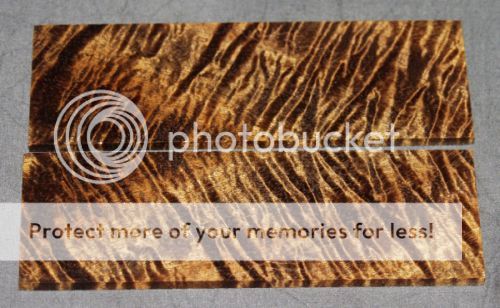
f002.jpg

I will use a random number generator on Friday June 10th to select the winner. Your post number will be your entry.
 
Last edited:
Slipjoint makers are hung up on tradition and rightfully so. The two most common woods used on slipjoints are ebony and cocobolo(rosewood). Ebony is by far the most used wood.....but they are distant to jigged bone and stag. So there is the front seat...jigged bone and stag, the back seat...probably ele ivory and a variety of man made materials, and then the rumble seat....ebony and cocobolo. I am sure there are people that will differ with me...but that is the way I see it. Ebony will last as long as anything....maybe longer. I cannot remember seeing burl lumber ever being used traditionally. Now...all that being said...you can use anything you want and there is some exquisite lumber now being used.
 
Am I understanding correctly that it is important to slipjoint makers to use more traditional and less exotic handle materials?
 
Mark ...... I would imagine cost as the primary motive for the continued use of jigged bone and stag, with some strong consideration I'm sure, toward tradition. With that being said however, conceptual posts like yours describing interesting and non-typical wood materials for consideration on slip joints, can and will create more interest in the makers attempt to offer more unique and exotic offerings with woods such as: Koa, Desert Ironwood, Redwood Burl, Tiger Maple or even Snakewood. I'm a genuine "wood nut" so I like your idea, and hope this thread stirs enough interest in some makers to be willing to create something a little unusual and distinct in a slip joint. After all, there shouldn't be too many limitations when it comes to creating a legitimate "custom" knife. I'll be looking forward to seeing samples of the work of some of the custom knife artisans willing to buck tradition, and incorporate wood in their creative interpretations of the slip joint.

The Shadow
 
The old Military TL 29's were made by over 30 different manufacturers. A lot of them had wood scales from different types of wood. I have a couple that are 1950 era that have wood scales that are still nice. One was used quite a bit and the scales are still fine. It would be interesting to know all of the different types of wood used on the 29's.
 
I think one reson is that wood can shrink and may cause problem for a folder with tight tolerances. One other reson may be that you will need extremly tight figured wood for a small folder.I think that normal figured wood usully don't look to good on a folder.

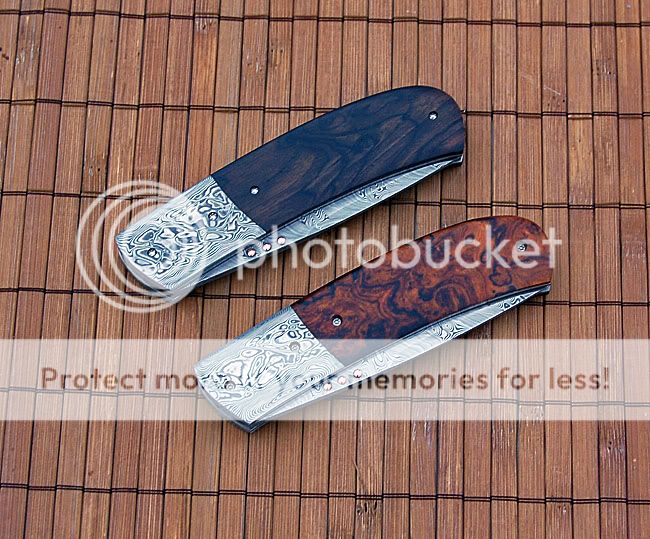
However I used wood for my two first folders, the ones below and haven't had any problem with them.

deseert2.jpg


Best regards Jakob
 
Hi Mark!
I'm trying to use wood on simple folders, like EDC ones. First of all because I LOVE wood. But when I talked with high end folder clients I've found that they usually prefer "fancier" materials (ivories, stag, etc). Even the wood is stunning, they don´t mind.
But I'm trying to use more wood anyway!!

"One other reson may be that you will need extremly tight figured wood for a small folder"
This is tru too!

Javi
 
"Makers tend to use more traditional and less exotic handle materials" is not correct. There is nothing more exotic than elephant ivory or various pearls, tortoise which is now banned, mammoth ivory, and other natural materials. Good lumber is great but, I believe, better suited to larger fixed blade knives......generally.
 
Am I understanding correctly that it is important to slipjoint makers to use more traditional and less exotic handle materials?

I think it is more that it is important to their customers.

And I agree that for a slipjoint, you would have to find wood with all of the activity in 10% of the space. Todd Davison seems to find nice examples.
 
Wood is nice, but I think a lot of folder makers are afraid of shrinkage and cracking, etc...

That Koa is killer! Gimme! :)
 
Mark,

Natural woods like most natural material can shrink and crack if not stablized. I think the big issue is cost, wood is inexpensive when compared to mamoth or MOP and buyers seem to go for the more exotic (expensive) material for high end folders.
 
Jakob,
Those are both beautiful folders. I really like the ironwood burl, but the ziricote has a classier more formal look to me.

Javier,
I would sure like to see more photos of your knives.

Ben B
I agree with you about Todd's folders. He has had some real beauties with curly koa, ironwood, spalted maple and even some dyed burl.

Danbo and Frogfish,
I think you are correct that if wood is used it should be stabilized. Especially on a folder that is used as an edc.

I am not trying to imply that wood is the best way to go.
I think some of my favorites would be crackle ivory, elephant bark with the colored lines and all time favorite tortoise shell, but you would have to keep it hidden.
 
Wood isnt expensive. We can buy a bowie sized block for around $40 and get 8 slip joints from it. Even stabilized wood gets scratched and dull looking in a pocket full of car keys and loose change. It cracks easy when peening the pins too. Ebony and blackwood are the only two woods I would use but after a year of EDC they would look bad too. Pocket knives get used for a variety of chores including dirty oily jobs like gasket scaping or cleaning fish and can absorb ugly stains get scratched, dented and shrink with time and lose their value. The books on values of antique collectable slip joint folders rate wood handles lower than the other handle materials in most cases. Wood looks beautiful on a big handled knife but a small 3/4" wide handle simply cant show much grain.
 
I would think wood is more porous and will change appearance after alot of handling and use. I think higher end folders don't have it (as has been said) because its considered less exotic then ivories. Danbo mentioned shrinkage, but I am not sure that is the issue because ivory has the same problems. For me wood is darker and is less bold looking then ivory or pearl so there is less of a presentation factor. Also people are used to wood. Its on funiture you see all day. Exotic materials like ivory get more "wows" and have seem to have more of a story behind them which intrigues people.
 
Hello Mark,

Full Integral makers like Edmund Davidson fit onto the handles
of their fixed blade knives material slabs not much bigger than those
used on medium and large folders.
In Edmund Davidson's case Stabilized woods and desert ironwood work
very well with the extreme fit and finish of his knives, and last forever.

Here are two such examples of stabilized box elder and natural
desert ironwood.

He also uses ancient elephant ivory on his Integrals to allow
skrimshaw to be applied and these slabs have not suffered
cracking or shrinkage on his knives over the past 15-20 years...

All the best,
David Darom (ddd)

Handle-materials.jpg
 
Please do not take this as an attempt to sell anything. I am just trying to get a better understanding.

Before I ask specific questions, I will sum up what has me befuddled or confused.
Why don't higher end folder makers use wood as scales more often?

First of all, you are far from being an ignorant bystander, but are a knowledgeable and successful dealer of wood handle materials. ;)

To answer your question, I believe for the same reason higher end fixed-blade makers don't use wood scales more often. It's because knifemakers (who want to stay in business) have to use handle materials which are most desired by the potential purchasers of their knives.

For the most part collectors/purchasers of high-end knives want premium stag, ivory, pearl etc as opposed to wood. Not saying exceptions can't be found, but put a $4000 bowie up for sale on the secondary market with a $40 piece of wood handle material and see how much it reduces your potential buyer pool as opposed to if it were premium stag or ivory?

And don't get me wrong as I own some and appreciate a fine wood knife handle as much as the next guy, but when it gets into the thousands of dollars it's going to have to be AN ULTRA EXCEPTIONAL knife for me to even consider one with wood.
 
For the most part collectors/purchasers of high-end knives want premium stag, ivory, pearl etc as opposed to wood. Not saying exceptions can't be found, but put a $4000 bowie up for sale on the secondary market with a $40 piece of wood handle material and see how much it reduces your potential buyer pool as opposed to if it were premium stag or ivory?
......... but when it gets into the thousands of dollars it's going to have to be AN ULTRA EXCEPTIONAL knife for me to even consider one with wood.

Here Kevin, is one of those EXCEPTIONAL KNIVES... A $30,000 mega-subhilt
with wood handles... :D

All the best,
David Darom (ddd)

Orgasmatron%2520page.jpg
 
I think I didn't make myself very clear with my questions.

My questions were not meant to ask about using wood vs ivory, stag, pearl and other exotic materials.
But more along the lines of, why are so many very well made folders being produced with man made materials such as composites and jigged bone?

In my mind I think some materials cheapen the look of an otherwise beautiful knife. So I figured there must be a really good reason that I was ignorant of.
In the past few years I have learned quite a bit here on the forums. The more I learn, the more I am able to see that there is still a lot that I don't know.
 
Composites are used because they are mostly indestructible and give a high tech look to knives in general and jigged bone is used because it is the most traditional of almost all materials for slipjoints. Wood is the most susceptible to cracking, movement and denting and generally does not have enought figure in very small pcs for scales on smaller knives like slipjoints. Curly KOA is one exception as far as figure and ebonys' longevity is another exception.
 
there have been a number of good reasons why wood is not used, but there are drawbacks with any material, wood can shift and crack, so can bone and antler, wood is cheap, some folders are inexpensive. It seems there is no strong practical reason, perhaps its just asthetics.
 
Back
Top