Forced air burner tuning

Joined
Sep 3, 2010
Messages
2,460
Everyone,
I have completed a forge with a lot of help from Mr Richards, and so I got around to firing it today. However, I don't think I'm mixing the right proportaions of the gas and air. I really have no idea what I am doing, and so would like some guidance before I keep wasting propane.
Thanks,
Steven
 
Hello. The exact mixture can vary slightly on what you are doing, but most of the time you will want a slightly reducing flame. This just means that there is a little bit more fuel than O2. It helps prevent the build up of scale. The second thing is the size of the flame. You want the whole forge to be a combustion chamber so you need enough fuel and air to get some flame coming out the front, top where ever. I don't kt now exactly what setup you have, but I'm going to proceed as if it uses a gate valve for the air and a needle valve for the gas. Set the gate valve so that you can feel a slight draft with your hand in front of the unlit forge. Set your regulator to about 10 PSI and open the needle valve all the way. Light the burner. It will now probably be set WAY to high. Use the gate valve to choke the air down till the flame extends about 6 inches or so from the front of the forge. Then use the needle valve to reduce the gas until the flame goes from blue into the yellow/orange. Start forging.

Wayne Suhrbier
 
Alright, I did what was suggested and turned on the blower till I was feeling a draft. I then turned on the gas to 10 PSI, opened the needle valve all the way and put a piece of burning paper in the forge. I then turned on the gas and got massive orange flames. If I turned down the gas, they became slightly smaller, but that is about it. There are a couple of things I observed, though. First is that I am only getting 7 PSI. I am not sure if this is a problem with the gas level or with the tank, which is a 15# that came with a gas grill. The other thing is that my blower is off a bathroom fan, and I am not sure if that means it will not work. Any advice?
 
Several things can change the air/fuel mix. Use a combination of them to get the atmosphere and flame volume you need.

1) - Is the burner properly installed. Too far in or out of the port can affect the flame. Improper burner angle can make for poor chamber circulation. Is there a restriction in the burner? A blown burner should have no orifice . Is the burner pipe too small?
2) - Add a gate valve or a choke plate to the fan. This allows you to lower the air volume .
3) - Is the fan the right type. A small bathroom fan or even a hair blower may work sort of OK, but a larger volume blower fan with back pressure ability is better. True forge blowers have different type of fan blades.
4) - Gas pressure is only an indicator. It is the gas volume that makes the burner run. A BBQ valve only delivers enough gas volume to run a small open flame. A propane regulator made for running a forge has no restrictive orifices and delivers much more gas volume. It should be capable of delivering 15 PSI. All fittings and hoses should be clear of obstructions and 1/4" minimum. The needle valve should be at least 1/4", too. Most gas grills have what is called a 20# tank, which is a misnomer, since it holds about four gallons of propane which weighs a bit less than 18 pounds. The regulator should be mounted at the tank.

Check the setup, and if all seems OK, start the fan, light the burner with the gas regulator set at at some pressure between 5 and 10 PSI, and the needle valve wide open. Change the gas pressure up or down as needed to get the forge to run with a slightly orange flame just poking out the front/back 6-10". It should not look like a rocket taking off. If the flames project too far, close off the air gate valve or choke plate a bit and re-adjust the gas. If they are billowing yellow/orange, add more air or less gas pressure. Do this until the forge runs right at full burn with the flames projecting at 6-8". Note the positions of the choke plate/gate valve and gas pressure. If half choked on the air and 8PSI is what works...those are you normal high settings. Any lower temps can be held by dropping back both the air and gas. Use the needle valve for fine tuning the flame once the pressure level has been established.
If using a choke plate, make a series of numbered lines on it and a reference mark. Use these to open /close the plate when adjusting. A note written in black Sharpie on a metal plate attached to your fan can preserve gas pressure and choke numbers for settings you have worked out.

 
A little advice about the choke plate. If your blower doesn't have one it might not develop enough pressure to blow well.
For instance. If you pull my blower off my forge and let run without my builtin choke the fan will simply swirl the air in the blower chamber. Reduce the opening and the fan will now move air through the burner.
Raymond Richard uses a bathroom fan. He uses a cereal box for the choke plate.
 
Thanks all. I switched the blower to an old vacuum cleaner that we had, and then had a wild hare and reduced the gas to 2.5 PSI, and then it went jet engine on me :D. I forged out some tongs from rebar last night, and it was hitting a consistent orange-yellow. I have a PID and thermouple, but I am having a heck of a time figuring out how to get everything wired. I found the diagram on auberins, but is it greek to me.
Edit: forgot to mention that I had it set at 2.5 for the beginning, but went back and checked, and it was reading under .5 psi. I can get pics if you would like.
 
Last edited:
Sweet!
I was running mine under 2PSI... Always stand to the side when lighting. lol....

Good job!!
 
I had the paper in the center of a little opening with firebricks on both sides, and it got blown 5 feet. still lit. I almost had a heart attack.
 
I was about to say, for a blown forge without a small gas orifice even 7 psi is a LOT. My blown forge runs well down to 1 psi, and runs welding temps at 5 psi. That's with a #52 orifice. Which leads me to wonder why Stacy says a blown forge should NOT have an orifice. If it works OK without, fine- but they work very well with, too, and I've seen quite a few people say they get better performance and economy with a gas jet added to a blown burner.

Also, people like to boast about how hot their blown forge will get at some low psi value- but without a specific orifice size it's hard to really know if it's any better or worse than a venturi forge at say 10 psi. A needle valve helps but is not really the same thing, and with a good adjustable regulator with a gauge in a forge with a gas orifice, is not necessary.

Anyway, glad you figured it out. Not trying to be a smartass, just voicing my opinion 'cause now it's unquestionably true, being in "print" on the INTERNET.
 
I'll add that I like to light my forge by pointing a propane torch into the opening while cutting on the gas. The burner will light instantly, with paper or other methods that ignite a bit slower, the WHUMP gets bigger the more gas/air builds in the forge unlit. Igniting with a torch would have been my recommendation to tune your burner, starting with your gas at 0, blower running and increasing the gas slowly until the burner will hold a flame.
 
The orifice in a venturi forge is to create high speed gas flow and thus create a low pressure area around the jet to draw in air - AKA The Venturi principle.

A blown forge doesn't need anything to draw the air in, because - It is "Blown" in.

On a blown forge the gas does needs to mix with the air to get good combustion and efficiency. That is why there should be a mixing chamber. It is a place where the pipe gets bigger by 100% and then goes down to the burner tube size. This creates a pressure drop and slows the gas speed, and then increases the speed and pressure as it enters the burner tube. This mixes the gas/air better, and it burns more completely. I suppose a reasonably large orifice would create a high/low pressure area that would mix the gas/air efficiently,too.

I have also made a twist of titanium and inserted it in the pipe on a blown forge without a mixing chamber and got good mixing. It is nothing but a 10" strip of titanium with the width being 75% the pipe ID. Put one end in a vise and twist the other 360 ° . Slide it in the pipe just after the gas needle valve entry. If it is loose and slides forward, a little bend to it will keep it in place. The gas and air will swirl as they travel down the pipe and burner tube and enter the chamber well mixed.

The higher pressure readings on a venturi burner are because the .030-.040" orifice restricts the flow, and thus lowers the volume. Raising the pressure to 5-15 PSI increases the volume, as well as makes the venturi to draw the air.
On a blown burner, with no orifice, the 1/4" pipe allows a lot of gas to flow, so only a pound of pressure will provide more than enough volume. Those who run NG forges have 3/4" to 1" piping, and use .25 to .5 PSI for full blast . They do need a meter and supply piping that can deliver the volume of gas needed.
 
I think lighting mine above 2 PSI would have sent the forge into atmosphere! I can just picture the look on your face Geek!! Lol

I use a needle valve with a regulator. No orifice... I might have to pick one up and see if my forge runs better. Hmmmmmm.

Did you use an orifice Geek?
 
I used exactly what came in the box from HTT. I didn't add anything other than some stuff to adapt my blower.

As far as the lighting goes, I was getting a TON of dragons breath and no significant heat. as soon as I turned it down and got a new blower, it started heating up real nice.
 
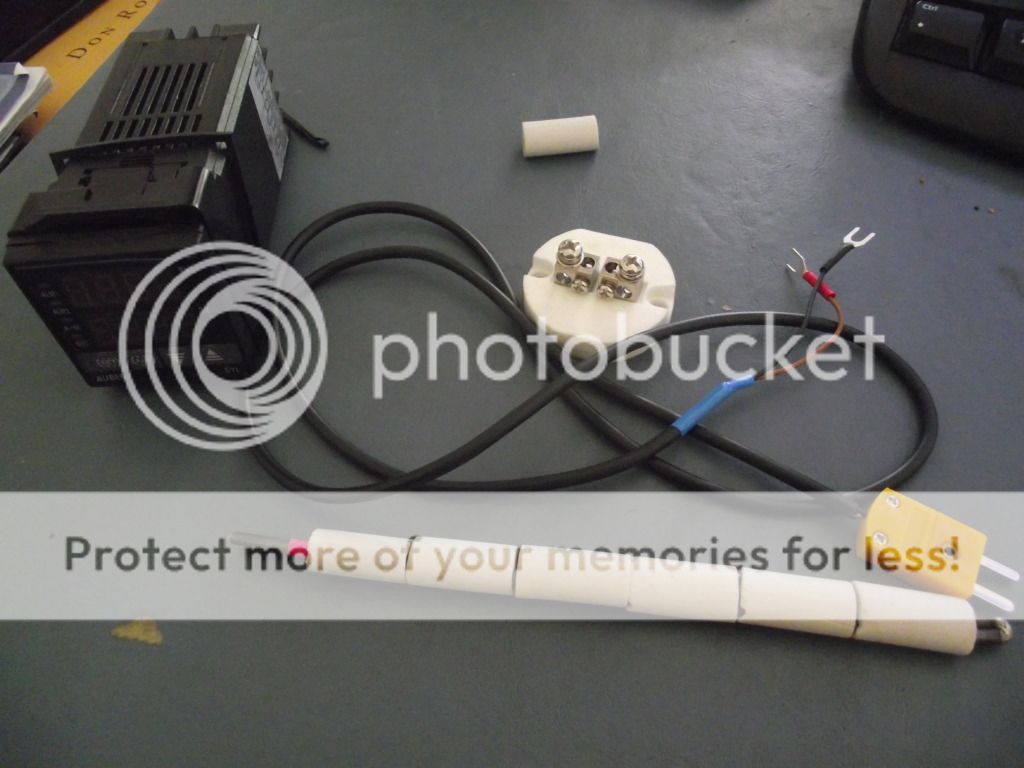
One more thing: I have a PID and Thermocouple which I will be using for monitoring temps. I have these pieces:
DSCF9079.jpg

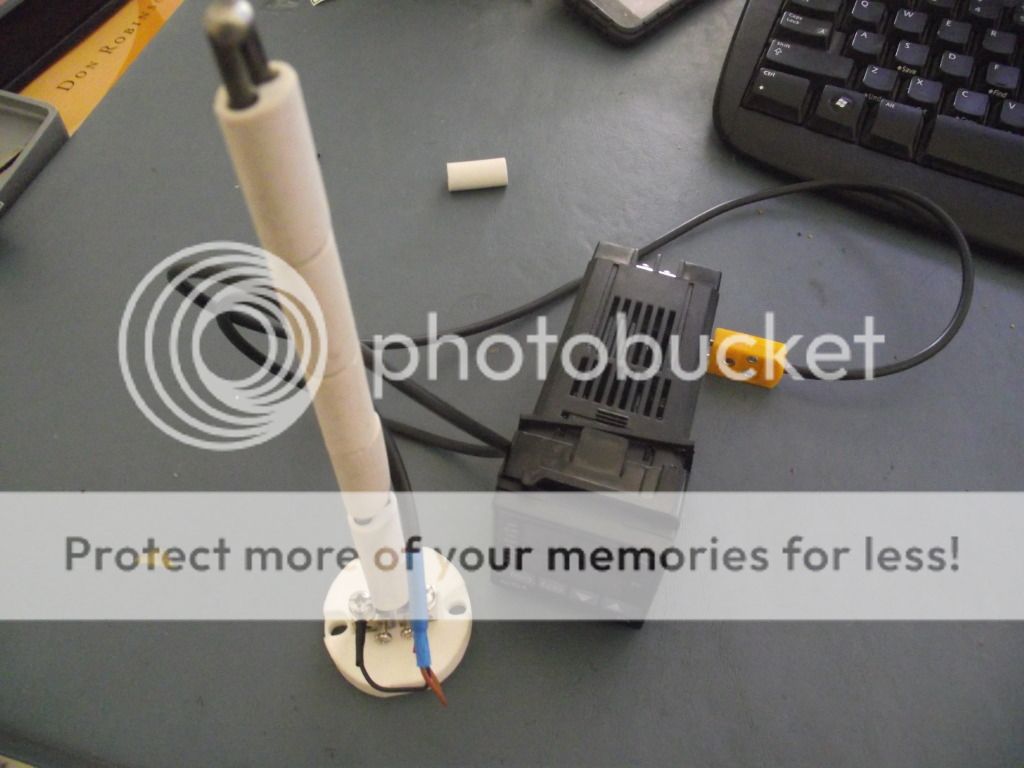
I think it goes together like this:
DSCF9081.jpg

Is this correct?

Also, it requires an AC power supply. Will any old normal power cord work, or do I have to have a specific cord?
 
The power supply can be a simple lamp cord.

Make sure the TC is hooked up with everything by polarity.
 
I'd slip the end piece/connector off and re-install so your wires are shielded by the ceramic plate.

Other than that the polarity is it. I used an old pigtail off of a garbage disposal for my power. It draws very little power so no need for heavy power supply cords.
 
I will probably go for a simple power cord. Now, 2 things. 1, is red positive or negative? 2, how would you suggest arranging the wires differently?
 
You have the TC inserted from the wrong side of the mounting block. The TC goes on the plain side, and the wires go on the side with the screws.


Here is a good mounting method:
Leave about 2" of the TC uncovered by the insulator/spacers. Bend the TC ends at 90° there. Mount the block to the tips.
Drill a hole in the top rear wall of the forge from the back end. The hole should be the size of your ceramic TC sheath ( a ceramic test tube looking protector for the TC). Cement the sheath in the hole with satanite. The tip of the TC sheath should be in the upper part and near the center of the chamber. Close is OK.
Place the TC in the sheath tube all the way. Pack the tube with scraps of K-wool to seal the back. The block with the wires should be out of the way of any flames that come out the back. Use some satanite to seal it up good, locking the TC block in place out of the way. Connect the wires from the TC to the PID. If there is an issue with the back flames of the forge melting the insulation on the TC wires, cover them with a short wrap of k-wool and wrap that in aluminum foil ( make sure not to short the leads). There is high temp TC wire available, too.
 
Back
Top