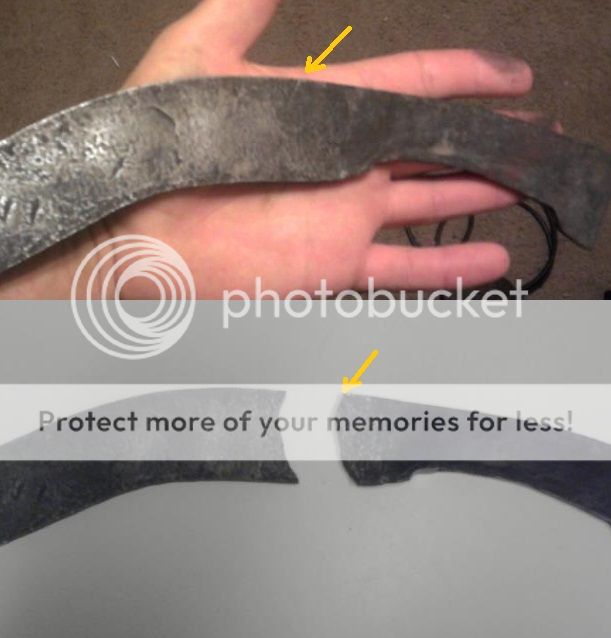
Forged a kukri, then this happened.

Joined
Nov 21, 2011
Messages
29
Aldo's 1084- An absolute blessing to forge with, after those pesky leaf-springs! I've forged a few nice blades from Aldo's 5160, but this is my first time with 1084.

404715_471583812881207_1098990762_n.jpg


Not bad, eh? Normalized 3 times, quenched in water, tempered at 450 for 90 minutes. Dropped it on the ground, aaaaaaaaand....

314139_471638539542401_408117264_n.jpg


Dang!!! So closer inspection is called for....

150119_471638766209045_252926697_n.jpg


Grain looks fine, but what are these brown spots? Did I overheat it, or forge it too cold?

Edit: I use raw wood in my forge. Eucalyptus, seasoned for a couple years, turned to charcoal in my redneck forge as I forge.
 
Well, I can't really see much with the fuzzy pics of the cross section, but it's a wonder it didn't shatter during or right after the quench. Water is too too fast for 1084. Especially straight tepid water. Even with appropriate steel, proper water/brine temps, cracks or breaks happen. I'm fairly certain that your poor khuk barely survived the quench to begin with, had a major stress crack, either obvious or internal, and dropping it just saved you some later heart ache if you'd progressed to finishing it further.

1084 is more appropriately quenched in fast or medium oil. Canola will work fine for a start, and can be had inexpensively. I use Parks 50, and usually hit max hardness without trying hard.

Unless you saw sparks popping off it at bright high yellow to white hot, overheating isn't the issue, although you could still have excessive grain growth. I cant ttell from the pics.

Try oil, and your next results should be fine.. Who told you to use water bro?
 
I just figured it'd work. Sorry for the low-qual pics. There's a huge brown spot in the steel where the blade broke- does that indicate anything?
 
The brown is rust, water got into the crack when you quenched it and it broke the rest of the way when you dropped it.

Richard
 
Yup the blade cracked from the water quench (the discolored portion of the cross section)...but methinks there is another issue here as well. The knife should not have broke in half when dropped, even with the crack. Perhaps your knife is not hitting the right temp during tempering? If it had hit 450, I doubt it would have broke when hitting the floor. Typically the area behind the crack will have just as much strength as the rest of the knife so something is amiss.
 
Domestic oven temperatures are notoriously inaccurate, get yourself a stand alone oven thermometer to be sure of the tempering. The brown is where it cracked. If you forged it too cold it may have put some microcracks into the steel which formed a stress riser on quench.
 
Normal tempering would be at temperature for 2 hours, twice. A test piece of 1084 that I did with an edge quench in water cracked all over the edge, but after two hours twice, smacking it on the anvil has produced no new cracks.
 
It's a a good thing it broke when you dropped it, and not while you were swinging wildly at a 2x4...

Though honestly, you probably would have seen the cracks when you where finish grinding. Chances are there are a few of them.
 
Surprisingly, not at all. I put the blade in a vice and hit it with a 32 ounce hammer from different angles. Not a chip. I think I'll make it into a necker.
 
Where is there still information on the internet that you can quench things in water? we need to rub that stain out.
 
I'm with you Sam,
I get emails from new guys who made a knife out of a file, or some scrap steel, saying they quenched in water to make sure it got hard. It cracked/broke, and they want to know what happened. When I ask why they used water, they usually say they read So-and-So's book or an article that said water was a good quenchant.

It never ceases to amaze me that an internet search will get 100,000 hits from knowledgeable people recommending parks #50 or a similar oil for quenching 1095, and one from someone who says he always used water ( or bear fat, etc).....and that is the one the untrained smith will go with.
 
I think that's because the untrained smith says "WTH is Park's 50 and why does it cost $XXX? I can get water out of my faucet." Just another fine example of folks tossing out good evidence because it doesn't seem to fit with their (limited) experience.

It's also worth mentioning that my second blade was made from a file, was quenched in water, and cracked in half.
 
Last edited:
1) An edge quench in water will cause the steel to bend away from the edge (hence the curve on katana) in the case of a kuk the steel will try to force itself apart. Oil would cause it to bend the other way.
2) If you didn't get the tempering regime right, what makes you think your normalising was up to scratch? That kuk had a lot of metal moved about and presumably had a lot of internal stresses built up from forging.
3) Brine, although a faster quench than water, is safer due to less cavitation and better heat transfer.
4) Unless you were going for a clayed hamon there was no need at all to do a water quench.

On the picture there is also a noticeable crack line starting from the edge

I've only done 3 clayed hamons (all on file knives) and 2 W2 edge quenches in salt water, maybe I'm lucky but none of them have cracked. You do have to be bold. The guys I've seen who cracked their blades had a few things in common, they were very nervous/worried and they were tentative putting the blade into the quench. They also seemed to go in tip first rather than the whole blade in one go, edge first.
 
One other thing needs to be addressed here.... The hammer marks in your blade are unacceptable. There's a huge difference between a forge finish and a poorly forged blade. :o

Chuck Richards had TheGeek down for a visit recently. I believe he had him forge a 1/4" or 1/2" square bar of mild into round then back again to square to practice hammer control.

It might not even be your hammering technique. Are your hammer heads dressed properly? It appears there are sharp edge marks in several areas. Look at Rick Marchands fhammerly portrait thread. His hammers are well dressed!

http://www.bladeforums.com/forums/s...mmerly-Portrait?highlight=hammer+dresses+pein

Look at Sam's blacksmith knives and other Brut De Forge blades. No hammer marks. :D

I hope this input helps! :)
 
Brian, we should all strive as smiths to do efficient and optimal forge work, so I get where you're coming from, but I would say for a beginner, those few stray hammer marks aren't that bad. Much much better than many I've seen, and theyre all pretty obviously from tilted hammer blows, where yes, a sharp underdressed side of a hammer hit and caused a much deeper indention than a square strike with the face would have.

I'm much more concerned about the heavy cheeking on the handle area, which implys the forger isn't taking care of them as he goes along.

Still, proper forging technique isn't usually intuitive for most. You've got to witness it, or atleast be explained it, and most of the bladesmiths I've seen, even the very good ones, have very little efficient technique, even if the finished result is excellent.

All I'm saying, cut him a little slack, yes, forge finish has been used as an excuse by many a poor technique, but "unacceptable" is a pretty strong word. There are no rules to this game, other than the ones nature dictates; such as "quench in water and it will crack".

Anyway, I know you're just trying to encourage good work, and it's coming from a good place, so I hope you'll appreciate the intent with which I respond to your also well intended, but easily misunderstood, post.
 
4I have no knowledge - only information. Kami's making khukuri from leaf springs pore boiling water on the edge of the hot blade to differentially harden them There used to be many pictures at the Himalayan Imports website.
 
Back
Top