Forgetting the basics: Freehand sharpening

P2P

Basic Member
Joined
Jul 24, 2010
Messages
1,770
I can usually get my knives hair popping sharp. I have a 220,1000,6000, and green compound on strop.

I figured this may be a way to make sure you have the bases covered on technique, plus I feel I need a reminder and some help from you forum guys as well.

I just bought a Military that I have been working on. Near the tang about 3/4 of an inch just isn't quite where the rest is. Any advise?
 
I use a bevel guide (an ancient Buckmaster) to establish the angle, usually when sharpening a knife for the first time, or re-setting the angle when it gets off after a few dozen freehand sharpenings -- maybe once a year or so. In between, I just try to maintain a consistent angle when sharpening freehand. Sounds like you have all the hones you need. Getting the blade sharp near the tang is sometimes difficult, depending on the grind. Just work that section until you have a good burr, using whatever technique -- forward or backward strokes or circular, doesn't really matter. Then work up to the finer grits and chromium oxide (green) compound for stropping.
 
With the military I find that the edge often curves up slightly in front of the choil(varies from knife to knife). This curvature make it hard for that portion on the blade to make contact with the stone. On my Millies that are like this I need to drop the handle a little when sharpening that area to make good contact with the hone. Sharpie on the edge is a huge help here as it will let you know if the edge is making contact with the stone. You can also use a thin stone like a sharpmaker rod or the side of a thin bench stone to work that area.
 
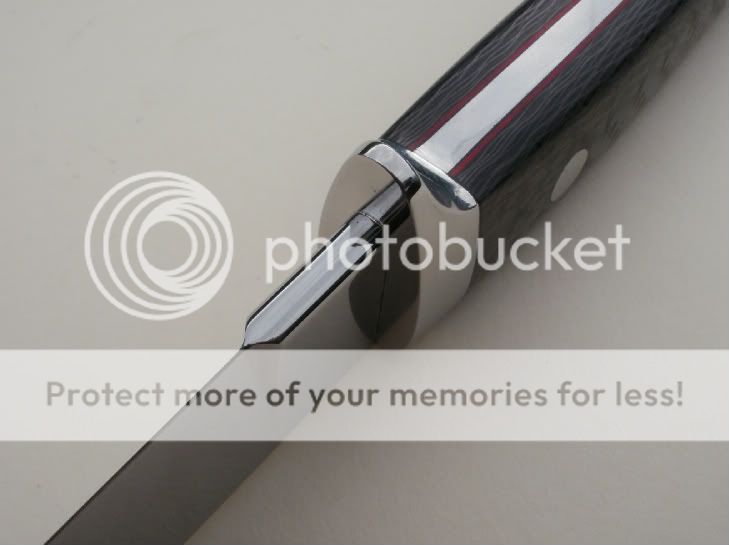
Almost every knife I sharpen is like that, to greater or lesser degree. As mentioned, the edge grind is usually a little different near the choil ricasso. Looking directly into the edge near the ricasso, the junction from edge to ricasso will have some upward 'sweep' to it, as opposed to being a perfect intersection of two flat, perpendicular surfaces. As with trying to sharpen a recurve, a flat hone won't make flush contact in that area. The edge of the hone will slide up that arc, and lift the face of the hone away from the edge in front of the ricasso. You can see this, if you lay the hone flush to the bevel on the blade, up against the ricasso; you will see daylight in between the hone and the edge, on the side nearer to the ricasso. The only way to sharpen it, is to keep 'flattening' that curvature there. Sweep the hone along the blade edge, TOWARDS the ricasso, which will gradually work metal off and flatten the bevel as you approach the ricasso. OR, you could still focus on apexing the edge in that area, but do so at a steeper angle. That'll at least help improve the edge there, but the angle will be a bit thicker. On big, thick abrasion-resistant blades (like the Mili's S30V), I usually end up doing something like that in the end. Otherwise, it'll take a good, long while. ;)

If you do fully flatten the bevel near the ricasso, the bevel width will usually look wider (because the steel is thicker near the edge there), if the same sharpening angle is maintained.
 
Last edited:
A couple of pics (from an old thread, linked below) of the edge area near the ricasso. Sort of shows the upward 'sweep' of the edge grind, as it meets the ricasso. Not hard to see how a flat hone won't make contact there:

( Pics below are linked from this (very enlightening) older thread --->: Why do some makers not sharpen the entire blade? )
dsc03087sm.jpg

P4040096.jpg
 
Last edited:
what you describe is the ver reason sharpening choil were invented :D

i've seen it happening on all my milies, my stretch2 CF and several other spydercos where the edge start is slightly recessed (if that makes sense)

in my mind it's not an issue as it's not a part of the blade that i use very often, but the solution is fairly simple. treat it like a recurve. forget diamond stones as you'll need abrasive corners and treat it like a recurve. heel to tip strokes focusing on keeping the portion of edge that's directly above the stone's corner perpendicular and drop the handle slightly below the stone's surface, just the opposite of lifting the handle to get the tip. it makes a weird down and up and back and forth movement but it works.
 
Ya i got rid of a 710 in d2 because it was just too much at the time. this will be a good goal for me though. I need to get it done before my vacation next week. Being that it is moderately sharp. Should I start a burr on 1000 or back down on 220?
 
Ya i got rid of a 710 in d2 because it was just too much at the time. this will be a good goal for me though. I need to get it done before my vacation next week. Being that it is moderately sharp. Should I start a burr on 1000 or back down on 220?

If you are looking to flatten out that area near the ricasso, I'd start LOW in grit with that steel. Even on softer blades, this particular job always takes more time, as there's a lot more metal to remove there. With S30V, it almost makes me shudder to think of doing it with high grit (it'll take forever). ;)

If you really WANT to, you might give it a few minutes with the higher grit first, to get a feel for how it's going to go. But I'm betting you'll want to fall back to the coarse grit. Using a grit too fine for the task will take too much time & elbow grease, and will only fatigue you. Sharpening always gets sloppier when that happens.
 
Last edited:
what you describe is the ver reason sharpening choil were invented :D

i've seen it happening on all my milies, my stretch2 CF and several other spydercos where the edge start is slightly recessed (if that makes sense)

in my mind it's not an issue as it's not a part of the blade that i use very often, but the solution is fairly simple. treat it like a recurve. forget diamond stones as you'll need abrasive corners and treat it like a recurve. heel to tip strokes focusing on keeping the portion of edge that's directly above the stone's corner perpendicular and drop the handle slightly below the stone's surface, just the opposite of lifting the handle to get the tip. it makes a weird down and up and back and forth movement but it works.

I kept running into this even with knives that have a choil. It almost seems to be universal on all belt-sharpened blades, a slight recurve either just at the choil, or just above it. After encountering this issue with a Bark River Necker and a TOPS knife - both with choils and purchased about the same time - decided I'd had enough of grinding the poop out of the fist 1/4 to 1/2 inch of blade. Stopped using diamonds entirely and ground a slight radius into one long edge on all of my bench stones. Problems with getting this area ship-shape are a thing of the past. Down and up, back and forth. Like playing a violin, except I don't play a violin...
 
how about grinding it out with a lankey first?

You can do that. A Lansky is what I relied upon for making my first really good edges. The hones are small, so for your Mili's S30V blade, I'd HIGHLY recommend the diamond kit, or at least one coarse/xtra-coarse diamond hone, for reshaping the bevel. The 'standard' hones in the regular or 'Deluxe' kits will really struggle with trying to remove that much metal on an S30V blade. I wore out two of mine, doing a reprofile on a ZT-0350 (S30V). Once the new bevel is set, you can finish with the regular Lansky hones, if you wish.
 
Last edited:
I just purchase an extra coarse online. when I get home I'll try a shot at the coarse one. It does take forever, but its only a small portion that really needs heavy grinding
 
I just purchase an extra coarse online. when I get home I'll try a shot at the coarse one. It does take forever, but its only a small portion that really needs heavy grinding

:thumbup:
The small size of Lansky's hones is almost ideal for focusing on small portions of the edge. I have the Lansky (2 kits), a Gatco and a DMT Aligner/Magna-Guide w/Dia-Folds, and I still prefer the Lansky for doing tips of blades in particular, because the small hones work very well with fingertip control and light touch.
 
SOLVED. I reground to 17 degrees on each side. so the edge nearest to the handle is now sharp. due to the regrind it did not quite meet on the rest of the edge (not as sharp). That was alright cause today a sharpened it up again freehand. So now the whole knife has a razor edge. To add to the story this is the older model millie with the nylon washers. Spyderco shipped me the new bronze washers from the newer millies for free. Swapped thouse out and now my current dream knife is complete.
 
Back
Top