Forging D2

Joined
Nov 1, 2015
Messages
31
I have heard how hard D2 is to work, but wow. I have my first forge and decided to take some planer blades my nephew got for me and try to hammer out a quickie blade. Hell, I already have a big ass blister and that stuff takes a lot to move.
 
I did not find it that difacult to forge. I means it’s not easy but it was a lot easier the forging cpm3v. But I would not say its a beginner steel at all. I would start with some leaf springs or buy some simple carbon steel.
 
I'm still a novice but I found an old leaf spring and other reclaimed steel to be harder to forge than D2, 440c, and O1...I have a bad habit of trying things beyond my skill level...but d2 definitely felt easier than the 440c.
 
I have heard how hard D2 is to work, but wow. I have my first forge and decided to take some planer blades my nephew got for me and try to hammer out a quickie blade. Hell, I already have a big ass blister and that stuff takes a lot to move.

Are you certain the planer blade steel is D2? Some planer blades are M series and T series tool steels. The characteristics of these steels are a bit different.
 
My nephew works a t a lumber mill and he said he checked and the blades are D2. He asked the manufacturer that provides the blades. He also got me some industrial bandsaw blade made of 15n20. Guess what is the next project now that I have my first MIG welder? Yep - Damascus.
 
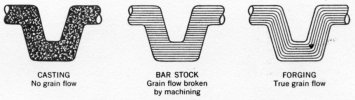
Noooooooooooooooooo. How do we allways come full circle back to forging vs stock removial. Alot of you guys probably know my stance one this. But I will lay it out one more time. Does forging blades to shape make them stronger then blades ground to shape, yes. But is it any amount that we would beable to notice and test for, don’t know. But what I do know is steel has a grain and that grain runs in the direction it was rolled or forged. When you grind a blade to shape your cutting through that grain. When you forge you move the grain inline with the profile. This is the reasion things like hooks and other life saving things are forged. The industry has found that these items when forged to shape are stronger. I had found a paper awhile back that talked about it. Also a test we are all familiar with that tests toughness requires the grain to be running lengthwise through the coupon.

So to just flat out say forging is not any better is false. But on the other hand if you don’t have the skills needed to do it right then it can be worse. Oh and in my search for research I had come across a paper talking about forging and that the high alloy steels like D2 benefit more from forging then the simple carbon steels. I wish I would have saved that paper.
 
Nope, not stronger. Forging is fun, but doesn’t improve steel.
Any proof for that claim ? I can write here thousands of links where they claim that is other way around .It is funny how claim about this most time come from knife makers who don t forge steel . . . :D
 
I'm still a novice but I found an old leaf spring and other reclaimed steel to be harder to forge than D2, 440c, and O1...I have a bad habit of trying things beyond my skill level...but d2 definitely felt easier than the 440c.
That's because most knife steels we buy are in an annealed state. That leaf spring was still hardened for its intended purpose and unless you fully anneal it... it will feel harder to move for a while. But Larrin could explain that way better than me lol
 
That's because most knife steels we buy are in an annealed state. That leaf spring was still hardened for its intended purpose and unless you fully anneal it... it will feel harder to move for a while. But Larrin could explain that way better than me lol
Yeah I'm about 98% sure I did not anneal it properly, I didnt slow the cooling at all.
 
Ok, I will bite.

How much stronger is a forged blade over a stock removal blade of the same design?

All evidence welcome.
 
Just gonna leave this hereView attachment 1154206
Nice, you making "U" shaped knives in D2?

That diagram shows how drop forging applies to complex parts like crane hooks but not knives being hand hammered out in D2.

Those lines are called "grain flow" or "grain direction" but it's actually carbide stringers. If a steel has sufficient carbide volume and size especially in a non PM steel those carbides will be elogated with rolling.
The grains themselves can change size with time and heat. The grains are actually being blown up with forging tempertures which need to be reduced after forging and before austenizing and quenching.

While the carbide stringers can be aligned with the shape of the tip if your doing 20-30 heats to do it and not using good temperture control you are most likely just decarbing the steel and adding cracks and blowing up the structure for no reason.

So I'm not sure I'd be bragging about adding strength to D2 with forging. Most likely it's being ruined without attention to detail with little to gain.

There are some dudes that go through the trouble to forge and make excellent knives but it's the sum of all parts not the forging itself.

I'd be more concerned with the protocols and process control than forged vs not forged.
 
Last edited:
That's because most knife steels we buy are in an annealed state. That leaf spring was still hardened for its intended purpose and unless you fully anneal it... it will feel harder to move for a while. But Larrin could explain that way better than me lol

Once the blade is at forging temp it’s no longer hard from heat treating. When it reaches temp the martensite has been converted to austinite.
 
Back
Top