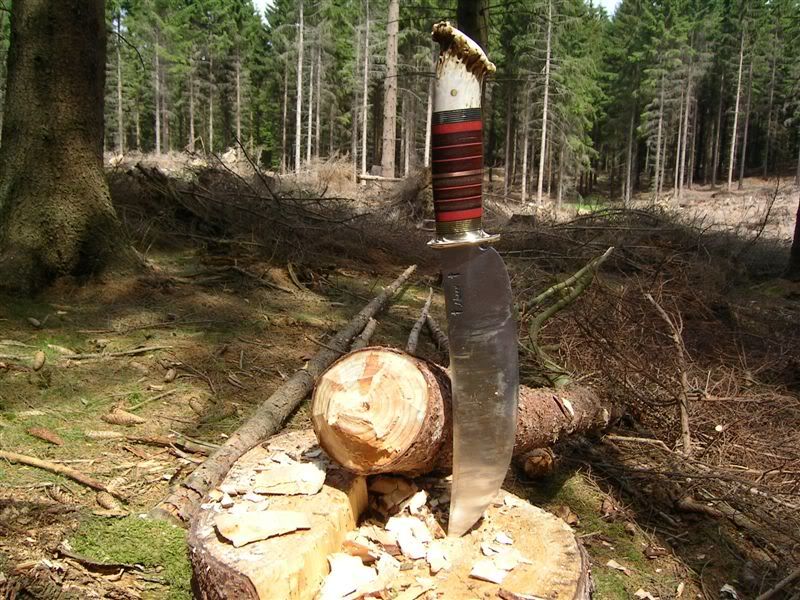
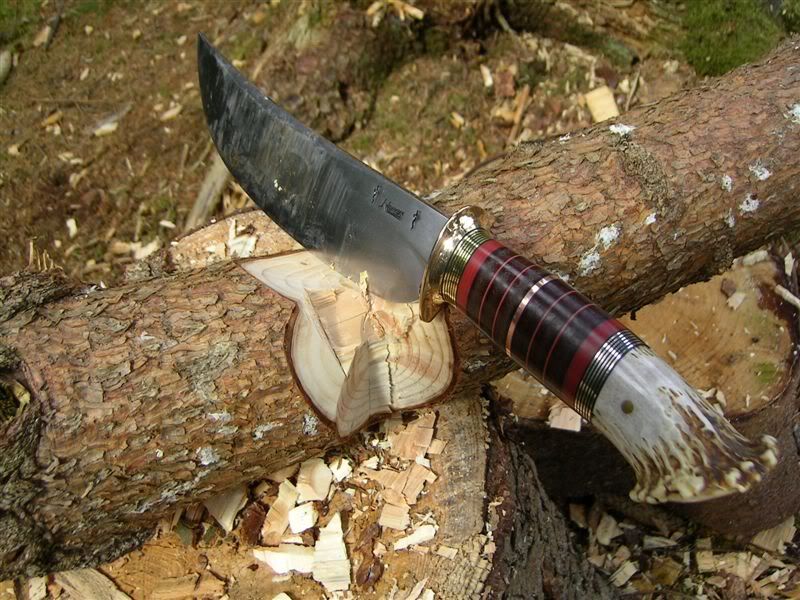
Forging or stock removal - Custom or Busse

Joined
Jun 19, 2004
Messages
51
Many master bladesmiths maintain that for large knives there is no substitute for a forged blade with differential heat treatment. this argument gets stronger the bigger the blade.
Busse makes some of the most popular high end production knives of large size, and I believe they are made with no differential heat treatment, and using a stock removal technique.
Granted that forgeing a blade is not something for mass production, Busse blades sell at a similar price to custom blades that are differentially forged, so it is fair to compare them.
I would be most interested in the (informed) opinion of members as to the merits of the two methods in producing the ultimate large heavy use blade.
I would also be interested in hearing opinions as to what steels would be the best to use for such a blade (if forged)
 
IMO, it’s not fair to compare them.

Some steels have the right properties to benefit hugely from forging, and some steels would not benefit from forging.

I love 52100, and prefer it forged than stock removal. 5160 is good stuff, and again I prefer forged than stock removal.

But this is not an option with INFI, unless Jerry decides to do something new and very different.

I have beaten the living daylights out of INFI, and it survives remarkably unscathed.

I really don’t want to abuse beautiful hand made knives in the same way as I am prepared to do with a Busse.

Differentially hardened 52100 both looks good (the hardening line) and works very well, and this is because of the particular properties of the steel rather than because differential tempering is a magic bullet.
 
iht@intekom.co.za said:
Many master bladesmiths maintain that for large knives there is no substitute for a forged blade with differential heat treatment. this argument gets stronger the bigger the blade.
Busse makes some of the most popular high end production knives of large size, and I believe they are made with no differential heat treatment, and using a stock removal technique.
Granted that forgeing a blade is not something for mass production, Busse blades sell at a similar price to custom blades that are differentially forged, so it is fair to compare them.
I would be most interested in the (informed) opinion of members as to the merits of the two methods in producing the ultimate large heavy use blade.
I would also be interested in hearing opinions as to what steels would be the best to use for such a blade (if forged)

I tested a forged Scagel knife By MS Doug Noren, It is a huge 9.5" convex forged blade.
I also tested the Busse HOFSH LE.

They performed about the same, the Scagel was a little etter but also bigger.

Cheers,

André

ScagelForesttest36powerstrokes.jpg


ScagelForesttest15powerstrokes.jpg


Choptesttwo8.jpg


Choptesttwo9.jpg
 
iht@intekom.co.za said:
Many master bladesmiths maintain that for large knives there is no substitute for a forged blade with differential heat treatment.

Most people selling something tend to always advoate that whatever they are offering has the exact combination of properties necessary to be optimal. In general you don't look to them for sources of unbiased information about their products, knives or anything else. There are lots of makers like Cashen, Wilson, Martin, etc. that are very frank, but there are also a lot that are promoting ideas which have no basis in fact - Cashen's forging article being an obvious example pointing out a pretty serious problem with a strongly contended point by many makers. Start asking for actual evidence/facts and clear public performance statements and a lot of the hype falls away.

The main differences that you will see in comparing a large forged bowie to a Busse don't come from the fact that they are forged but how they are ground, specifically the extent of the tapers, distally, in the tang and the main blade taper. There is of course no reason why you can't stock removal the same blade shape as any forged knife, you can just end up wasting a lot of steel. Forging with a power hammer does of course allow the maker to work with steel sources like ball bearings and round bar stock which are difficult for a stock removal maker to use.

Note all the steels used by stock removal makers are forged, it is done by heavy rollers by the steel manufacturer. For reference on the influence of hammer forging and rather detailed discussion of how to refine the grain in steels see:

http://forums.swordforum.com/showthread.php?threadid=68731

Nice work as always Andre.

-Cliff
 
I tend to agree with the general thoughts expressed here. Forging in and of itself will not necessarily result in a better blade. A stock removal guy can shape the steel just like any forger, (take a look at some stock removal integrals to get an idea of just how much steel these guys are perfectly willing to waste! :D ) and a forger could just as easily make a blade that looked more like a classic stock removal piece.
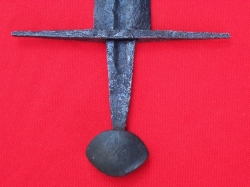
Choosing a steel that's appropriate for the application and its subsequent heat treat would be more important than how the maker shaped the steel. That said, very few guys forge stainless, and few grinders use certain tool steels that aren't readily available in normal stock sizes. So the application will dictate the materials and methods; not the other way around.

Cliff Stamp said:
The main differences that you will see in comparing a large forged bowie to a Busse don't come from the fact that they are forged but how they are ground, specifically the extent of the tapers, distally, in the tang and the main blade taper.

This is one of the main differences I was thinking of as well. Though I believe there is a lot of misconceptions on this topic in the forged community as well, in general I still think they have the upper hand overall. The "dynamic balance" of the blade can have a very dramatic impact on its performance, depending on what you want to do with it.
 
There is a big misconception that you need full slab thickness tangs for prying, this isn't the case. How much of this is because the makers actually believe it or it is just easier to make a slab handle than an enclosed one is up for debate. It is hard to argue why having all that weight right in your hand is productive when it could be elsewhere with use of tapers.

I was doing some splitting with smaller blades recently and noticed that few of them are balanced for tip impacts. This usually isn't a concern for most utility applications but considering how many of these are constantly promoted for wood craft/survival it would be nice if they were balanced so as to provide less tip impact vibration

Note that shifting weight to the end of the handle out of the handle proper would actually shift the center of mass back so it would also have a lighter static balance as well which can also be of interest in much precision cutting. In general after using a lot of tapered tangs, full slab ones are not that attractive, even on the lighter knives.

Of course on some knives this ceases to be an issue, I have some knives which are 1/16" thick, only a fraction of an inch wide. They can't take impacts and they have no significant intertial moments, static or dynamic. However even on 1/8" blades I can see a strong preference.

-Cliff
 
Cliff Stamp said:
There is a big misconception that you need full slab thickness tangs for prying, this isn't the case.

I can see what you're getting at, but we gotta be careful not to throw out the baby with the bath water. On something with thick slabs of micarta, the handle material itself adds a good deal to the handle's strength and stiffness. But if we're talking about a stacked leather handle or something, then the tang pretty much has to take all the stress on its own.

Also, there's the issue of stiffness. If we had a thinly tapered tang and, oh, say, some kind of thin horn or antler scales, the whole handle could flex slightly. Not enough to normally break things outright, but it could pop the epoxy loose, or cause little cracks around the pins. And if our design has a substantial pommel, then the tang needs to have the right combination of lightness combined with stiffness, or the shock of the tang flexing will split the handle material completely. Witness antique swords where the blade's fuller extends halfway down the tang. Or even wide tangs with holes drilled through can provide the right geometry/framework to be very stiff without being too heavy.

I am a bit surprised that you're noticing a significant difference even on relatively small and thin knives. Maybe I'll have to revisit the issue one of these days, if I can convince myself to leave the bowie at home.
 
My research has shown me that forging does make superior steel… from the cast ingot! Steel in ingot or billet, directly from the pouring process, requires heavy reduction and deformation in order to improve its properties by the working out of undesirable conditions, as in redistribution of brittle segregated constituents, closing up porosity and scattering any undesirable inclusions. Because of this, all traditionally poured steels undergo heavy rolling and other mill operations very soon after their creation. It is funny that if one looks at it like this, even stock removers use forged steel.

The above is taken from the article by Cashen, referenced by Keith Montogomery.

That deals with forging - not differential tempering - pointing out that most steel used by stock-removal makers has already been through a forging process. Some would argue that the rollers used by the mill probably produce a more uniform forging process than a guy with a hammer could produce.
 
The tang is loaded, both in prying and impacts and going too far would also be a problem. As with everything, it depends on the function of the knife. You would expect a short sword to need a thicker tang cross section than a 7" utility blade.

the possum said:
I am a bit surprised that you're noticing a significant difference even on relatively small and thin knives.

Quite frankly it is only really obvious since I am now looking for it. If you take a 7-10" knife and give the tip some severe impacts when the impact node isn't close to that, then you can get some extreme vibrations in the palm. I have seen these so severe for example that I could not hold onto the blade, the shock was actually painful. In smaller knives the blades would not take such impacts so it isn't an issue to that extent. However you can still feel the vibration, though much reduced. Then there are other issues of weight, plus enclosed handles being thermal barriers, etc. .

-Cliff
 
Cliff Stamp said:
The tang is loaded, both in prying and impacts and going too far would also be a problem. As with everything, it depends on the function of the knife. You would expect a short sword to need a thicker tang cross section than a 7" utility blade.
Yeah. I guess the reason I mentioned it is because I did bend the tang on my Blackjack 1-7, in the middle of the handle. I feel it would not have bent so easily if the knife had stag or micarta handles instead of leather washers. I bent it back by hand without much effort, leading me to believe the tang was not even heat treated, which doubtless also played a role.

Always eager to hear more about observations regarding rotational centers and such.

Getting back to the origional question, what is the poster referring to when he's talking about hard use? Are you talking about impact resistance, or prying strength, or a little bit of everything? How important are things like speed and dynamic handling qualities, and cutting power? Are you looking for an edge that will hold longer for things like woodwork, or are you focusing on damage control from occasional impacts with hard materials?
 
the possum said:
I bent it back by hand without much effort, leading me to believe the tang was not even heat treated, which doubtless also played a role.

I have seen similar on an Ontario, I have also seen a knife tang (S30V) actually crack in prying and the G10 slabs keep the handle together. That handle (Raven) was full of holes which is never a good way to reduce weight, horrible strength to weight ratio and not a great way to adjust balance either.

-Cliff
 
Cliff Stamp said:
That [tang] (Raven) was full of holes which is never a good way to reduce weight, horrible strength to weight ratio and not a great way to adjust balance either.

I'd think a fuller in the middle of the tang would be a better way to reduce weight, combined with a tang that tapered a bit in profile towards the pommel. At least, that's the route I'm thinking of going on my next big bowie. Something like this:

Fig17.jpg


But to be clear, I wasn't talking about making the tang full of smallish holes. I mean using a couple big holes in the center, leaving metal at spine side and edge side of the tang, so we reduce about as much weight as a fuller would, and leave about the same amount of full thickness metal at the top and bottom.
 
Exactly, it is hard to argue that the same principles that work well on the blade won't on the tang. Fullers essentially follow I-beams for a high strength/weight ratio.

-Cliff
 
Back
Top