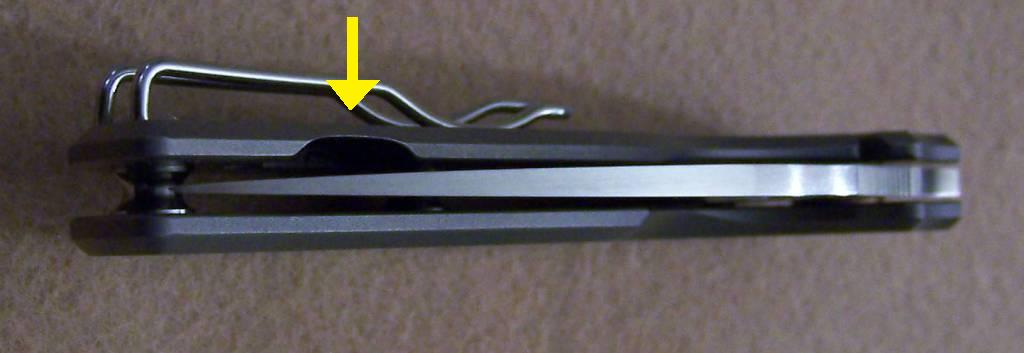
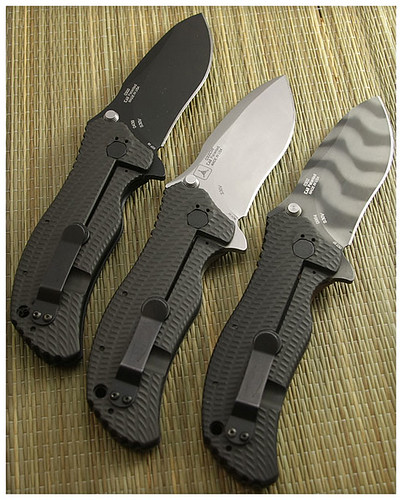
Frame lock cut outs

Joined
Nov 2, 2009
Messages
1,460
This is kind of a weird question but I noticed some frame lock cut outs are on the inside of the scale and some are on the outside. Is this purely a cosmetic choice or is there some kind of added function? Here are some examples off Google images:

Inside
sage_2_lock.jpg


Outside
3822339752_764eb2b922.jpg
 
The typical arguments are:

When the cutouts are on the inside, like in the top picture, they help prevent the lockbar from getting stretched past the point where the lockbar is vertical when disengaging the knife. This feature actually does help in many designs.

The argument that's a little more controversial for the cutout on the outside, like on the bottom picture is that the metal left in the cutout area is left in line with where the pressure comes down the lock when force is being applied against the spine of the knife. The argument says that it's more secure or strong because of the way the metal lines up. Some folks don't buy that argument.
 
Yes....but I think the real answer is that there are so many variables in how strong and how reliable (not the same thing, btw) a framelock is, that you really can't make a decision on the basis of this single variable. But it makes for good discussion. :D
 
You can't do much contouring or texturing of the handle if you have the cutout on the inside. You pretty much only find the cutout on the inside on knives with plain flat slab handles with at most some chamfering on the edges.
 
I asked a custom maker this question and was told that you had "better lock geometry" with the external cutout. Take that for what it's worth.
 
The outside cutout would make the lock a little stronger, since it would reduce the force to mostly compressive stresses. But that difference is so small, and failures of the lock due to that part breaking are so rare (I've never heard of this happening), that it makes no difference. What does make a difference, though, is that cutouts on the outside tend to catch on your pants, whereas cutouts on the inside don't. Then there's the issue of not being able to texture the cutout area. The cutout area should be smooth so it can bend, and it would look kind of weird to have just a patch smooth compared to the rest of the knife in the case of an inside cutout.
 
I find the entire matter to be irrelevant as I have yet to break any frame or liner lock I own, and I don't intend to use the spine as a hammer anytime soon, thus my only real concern is whether the lockup is snug and secure.
 
1. I spoke to a civil engineer about this and the simple answer: Does not make a difference. The bigger issue is to get a balance between the metal left and to provide a usable lock (see point 2). As long as there is enough material left and not thinned out to much there is no engineering advantage of any of the two styles.

That was according to him, I am no engineer.

2. There is a big discussion about removing to much metal in a framelock thereby creating a very weak part. STR (a forum member known for his work and modifications) has made knives without a cutout only to have it returned from the user stating that the lock is to difficult to unlock. Therefor the cutout is made in order to make a more user friendly lock.
 
Last edited:
1. I spoke to a civil engineer about this and the simple answer: Does not make a difference. The bigger issue is to get a balance between the metal left and to provide a usable lock (see point 2). As long as there is enough material left and not thinned out to much there is no engineering advantage of any of the two styles.

That was according to him, I am no engineer.

2. There is a big discussion about removing to much metal in a framelock thereby creating a very weak part. STR (a forum member known for his work and modifications) has made knives without a cutout only to have it returned from the user stating that the lock is to difficult to unlock. Therefor the cutout is made in order to make a more user friendly lock.

Consider the lock to be acting as a column supported where the lock bar cutout starts. Ideally, the lockbar would be directly behind the blade, and precisely in-line with the centerline of the blade. Then, the load on the column (lock bar) would be purely vertical. Of course, this is impossible, as the column (lock) needs to be off-center so that there is room for the blade to close. But, putting the lock cut-out on the outside means that the lock-bar needs to bend at a smaller angle in order to engage the tang of the knife. Thus, the column is more nearly vertically oriented. More vertical=harder to push off-center, which is one way that locks fail.

If you make an analogy to cutting down two trees, one that stands perfectly vertical, and one that leans, you will see what I am saying. For the vertical tree, you will have to progress pretty far with the felling cut, and possible need to push (or pull) the tree to get it to fall. The leaning tree will fall much easier, because gravity is helping you and the tree is already unstable.

Fun stuff to think about............

Now, this is a small point-You can certainly make strong, reliable locks in either configuration (I have made them both ways), but, putting the cut on the outside definitely keeps the line of force on the lock more in-line with the blade/centerline of the knife. How the geometry of the tang interfaces with the end of the lock bar can have a much more significant impact on lock failure than which side of the lock is relieved.

As to the points about leaving enough material for strength vs. having a lock that is too stiff to manipulate, that can be balanced by choosing the right width for the lock bar. For two locks, relieved to the same thickness, a narrower lock will release more easily than a taller(wider) lock.

 
Consider the lock to be acting as a column supported where the lock bar cutout starts. Ideally, the lockbar would be directly behind the blade, and precisely in-line with the centerline of the blade. Then, the load on the column (lock bar) would be purely vertical. Of course, this is impossible, as the column (lock) needs to be off-center so that there is room for the blade to close. But, putting the lock cut-out on the outside means that the lock-bar needs to bend at a smaller angle in order to engage the tang of the knife. Thus, the column is more nearly vertically oriented. More vertical=harder to push off-center, which is one way that locks fail.

If you make an analogy to cutting down two trees, one that stands perfectly vertical, and one that leans, you will see what I am saying. For the vertical tree, you will have to progress pretty far with the felling cut, and possible need to push (or pull) the tree to get it to fall. The leaning tree will fall much easier, because gravity is helping you and the tree is already unstable.

Fun stuff to think about............

Now, this is a small point-You can certainly make strong, reliable locks in either configuration (I have made them both ways), but, putting the cut on the outside definitely keeps the line of force on the lock more in-line with the blade/centerline of the knife. How the geometry of the tang interfaces with the end of the lock bar can have a much more significant impact on lock failure than which side of the lock is relieved.

As to the points about leaving enough material for strength vs. having a lock that is too stiff to manipulate, that can be balanced by choosing the right width for the lock bar. For two locks, relieved to the same thickness, a narrower lock will release more easily than a taller(wider) lock.

Very valuable points made on the trees.

One question though. If the more vertical lock (cut on outside) would fail due to slipping of the blade lock interface, wont that result in it slipping easier past that center line on the blade? Whereas a more obtuse angle (created by the cut on the inside) will be harder for it to slip past that center line on the blade (I have a picture in my head of what I am trying to ask, hope it comes across)? I know the lock interface angle etc plays a more critical role in the lock slipping.

I understand the logic of the taller/wider lock, but I do feel one is limited in its application. Since you have three points of contact on a framelock. The lock/blade interface, stop pin and pivot pin one can only make the lock as tall/wide before the lock reaches the the center line of a pivot or close to it before lock roll starts occurring? Some feel that a thick slab of titanium means a strong lock, but it does not help it is a 4mm thick piece of titanium with a cutout of .2mm (scale is exaggerated for affect).
 
Possibly/probably, if all other things were equal - but they never are. In real life, it shouldn't be a factor in a buying decision, as far as I can tell.

I asked a custom maker this question and was told that you had "better lock geometry" with the external cutout. Take that for what it's worth.
 
I've talked to several mechanical and civil engineers and everyone says the same thing, its not going make a measurable difference either way. I'm sure Mr. Martin is correct with you'll have better lock geometry but all the licensed professional engineers I spoke to about relief cuts say doesn't matter in relation to strength.
 
Back
Top