Framelock with overlay vs Standard Linerlock

Joined
Jan 13, 2010
Messages
732
Emersons have been described as framelocks with g10 overlays.

I've heard the same about numerous other knives.

What differentiates them from standard liner locks?

Thanks guys,

-ethan
 
Emersons have been described as framelocks with g10 overlays.

I've heard the same about numerous other knives.

What differentiates them from standard liner locks?

Thanks guys,

-ethan

Basically, your hand will lay on and apply pressure to a frame lock while it is locked up. A liner lock is as a rule thinner and your hand is prevented from touching it by the scales.
 
Basically, your hand will lay on and apply pressure to a frame lock while it is locked up. A liner lock is as a rule thinner and your hand is prevented from touching it by the scales.

That is correct but I feel that a well made liner lock is just as safe as a framelock.
 
I'm not quite clear on how your hand would apply pressure when there is a scale of G10 or CF in the way...

Don't get me wrong, I'm familiar with framelocks (in fact I'm waiting on a Volt as we speak), but the concept of a framelock still being defined as a framelock and not a liner lock when the frame is covered by a scale baffles me.

P.S: What's PEBCAK?
 
I'm not quite clear on how your hand would apply pressure when there is a scale of G10 or CF in the way...

Don't get me wrong, I'm familiar with framelocks (in fact I'm waiting on a Volt as we speak), but the concept of a framelock still being defined as a framelock and not a liner lock when the frame is covered by a scale baffles me.

P.S: What's PEBCAK?

I love it when people ask me that - Problem Exists Between Chair And Keyboard. ;)

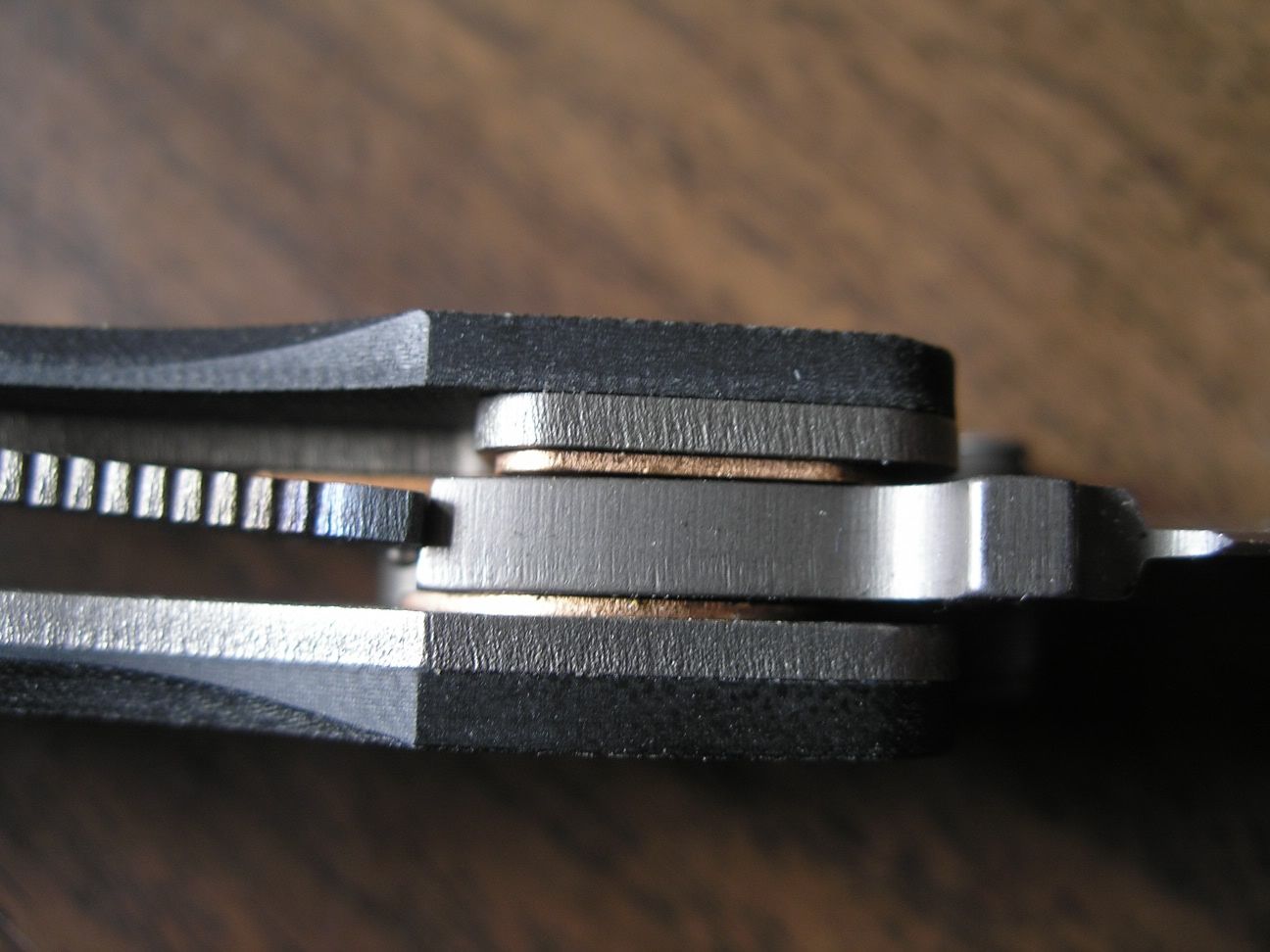
I hear what you are saying and allow me to post an illustration.

P1070063.jpg


The above is the liner lock of a Strider/Buck. The liner is a massive Titanium construction. If you took the full scales off the knife, a good argument could be made that it is a frame lock, however, with the scales on, as they cover the lock bar, it magically becomes a liner lock, because the titanium becomes a liner under the G-10 scales.

If anyone else wants to chime in, please feel free.
 
I say that if it has a scale on the lock side it's a linerlock, because the lock it lining the scale.
 
I agree - hence my confusion when people try to sell me a "framelock with G10 overlay"

Thanks for the pics!

If anyone else wants to chime in (Ernest Emerson, maybe? :P), feel free.
 
It's just an expression. You hear it sometimes when referring to a liner lock with thick liners ie. ZTs, Emersons, striders... It doesn't make it a framelock though, its either a liner lock or framelock. Now there are framelocks with g10 overlays like a lot of Yunas, or the new Benchmade 755 but thats a whole other story. However if someone is seriously telling you the knife is a framelock with g10 overlays when trying to sell it to you and it is obviously a liner lock I would steer clear of that person.
 
Benchmade MPR 755 can be described as a framelock with a G10 overlay. As well as few others.
 
Benchmade MPR 755 can be described as a framelock with a G10 overlay. As well as few others.

But the G10 only covers the back half of the lock. All I know is it is rock solid but is it a "framelock"? I don't really care.
ry%3D400

ry%3D400
 
im no more partial to a good ril than i am a good linerlock. i feel identically as safe with a military than i do a sebenza. the gray area in between is just one of those things that is hard to describe and commit to paper/post. if you show me a knife i could tell you what i would say it is, thats the best i can do. i would call the buck strider a linerlock, i would call the spyderco ppt an ril, i would call most emersons linerlocks, and i would call the sibert an ril. just my opinions
 
If my hand can exert pressure on the lock it is a frame-lock (or Reeve Integral Lock).

2 knives I own for example:

Strider GB - massive liner, but it is covered by G10 = Liner-lock.

Boker Wharcom - slim liner, but I can exert pressure on the lock while gripping it = frame-lock.
 

Some makers in the industry believe that knives done as that Spyderco PTT are a liability. The jury is still out on that and I'm not saying I agree with it as some very reputable makers have done that on knives. Bob Terzuola for one, has built knives with the lock exposed as shown on that Perrin folder by Spyderco or similarly and Michael Walker the inventor of the liner lock has done this also so obviously they see it as an improvement aspect in the design. So, with that in mind we have a debate where some say liability while other makers feel that when done this way it adds security to the lock by giving the folder the advantages of the frame lock. I'm not sure about that one way or the other. I think the scale should be removed from there altogether to allow the hand to get in there behind the lock well for the best fit and that on thinner liner lock models that exposing the lock this way could indeed be more of a liability at times if the lock moves too easily than if it was done that way with one that had thicker more frame lock stock liners. Thats just my feelings though and I'm not sure its a liability at all. It seems a very unnatural movement to imagine the fingers could disjoint to suddenly pull back in a grip when you are squeezing the knife to where they would even have the slightest chance of moving that lock. I think if some want to call this a liability that its perhaps then a liability to install traction grooves in the bottom of the lock to aid release. Maybe those traction grooves would help the fingers move the lock the wrong way too?

Some feel the liner lock is perfectly secured without the need of the hand getting physical contact with the lock to help secure it. I disagree here completely and know from experience the liner lock is the most unpredictable untrustworthy lock you can own. I've seen in testing both my own liner locks, and company knives when sent to me to go over that in some uses the lock can be iffy, particularly those involving shocks to the lock such as spine whacks at times, overstrikes for sure, hard stabs and in twisting lateral stress movements during cuts such as what can be reproduced by simply cutting down a card board box with a dulled down blade. In these cases there are times a liner lock becomes unpredictable as to how it will behave. The lateral twisting torque stress and the greater leverage of that longer handle and longer blade often times becomes a liability of its own and the reason the lock can move unpredictably is because the hand is not there to keep it in place IMO but also you can't predict if the lock will move in tighter to better secure the blade or pop out and free up the blade completely during some of these situations.

Now it may be true that with one made such as the Perrin model or PTT as its called that it would be possible for the hand to actually move the lock during use but its a very unnatural movement in my mind to imagine the hand to pull back on the lock to release it from the lock side of the folder. This of course is if the folder is right handed and you have it in your right hand as I sit here playing with one trying to imagine a white knuckle grip with it and how it may cause the lock to behave. Looking at the knife in my hand the thumb ramp cut away to release the lock from the non lock side is actually more of a liability on a lot of knives because when that is real big and opened up wide then it is not so hard to imagine the hand moving the lock some toward release in some grips just from that huge access point to get your thumb on the lock to release it.

Personally I feel there is still nothing better or more reliable than a true frame lock with no scale on the lock side. I think these designs are just flat out the best tactical choice all around even over lock backs and mostly due to the fact that even the best lock backs can be nullified completely by a little thing we call pocket lint. Rarely have I seen pocket lint become a problem in any of my knives but if I'm contacted about a lockback that suddenly quit working its most always the first thing I recommend the owner look at. In a lot of cases thats all it was too. It is amazing that even a great lock like the new Triad lock could be zeroed out completely by one little ball of pocket crap! It happens though.

With frame locks this is not much of a deal and to me no scale means the hands right there on top of the lock squeezing in, squeezing down, squeezing up and basically holding it right there in place as an unmovable object. In this case the only way that lock is moving is if your hand does with it and in a lof ot these situations where you are really working the knife (not speaking of defense) you have such a good grip that I can't imagine it is going to move unnaturally to one side to free up the lock by accident. The exception would be on some models that have big gaudy pocket clips that actually block access to the lock every bit as much as a scale would if it had one. To me this is counter to the benefits of having a frame lock in the first place and reason to get a new clip or do away with it or perhaps flip it away from tip down which is usually the culprit. One knife guilty of this is the JYDII frame lock model by Kershaw. The clip counters the advantage of the frame lock IMO but the good news is on flipper models even if the lock defeated its darn hard to imagine much more than a serious pinch of the hand from the flipper as the blade tries to rotate as opposed to a nasty cut.

Keep in mind that this is all just my opinion. I think you have some bit of a liability with a lock exposed a lot on the non lock side to release it if the liner is thin stock or thick stock either way. This is when the cut away to access the lock is excessive. You've all seen them. It need not be done that way to gain access to the lock on a liner lock or frame lock. Truthfully it need not be any different than Emerson does his on the non lock side on most of his models whether liner of frame lock where the non lock side liner and scale are nearly the same height width and shape as the lock side with very very little difference on most models.

Other knives like some from Lone Wolf where the lock tab to release it is actually lower than the handle so it sticks out to me seem to be as much a liability with a thinner lined model as a huge access but again thats just my opinion. Generally speaking I don't see a lot of reports of defeats on these knives or the ones with the lock exposed like that PTT so take my opinion as just that. Its just a guess at best.

STR

 
Last edited:
And Chris Reeve neatly sidesteps the whole issue by calling his version an Integral Lock :D

its actually the other way around, Chris is regarded as the father of the integral lock, Reeve Integral Lock to be precise, which he trademarked, so others had to call their versions something else, like framelock.

Like how benchmade calls the lock on its framelock folders the mono lock.
 
#15 Today, 12:22 PM
STR
Knifemaker/Moderator Join Date: Aug 2004
Location: Bartlesville, Oklahoma
Posts: 10,885

Quote:
Originally Posted by Neo
what about the spyderco PTT

http://www.spyderco.com/catalog/details.php?product=462

http://www.youtube.com/watch?v=PK1beQ_AuyE

http://www.youtube.com/watch?v=XSHr0r6xMwc

Some makers in the industry believe that knives done as that Spyderco PTT are a liability.

While I have not handled one of those , since first seeing the pics of that model and similiar models it pops into my head that the knife looks a little unsafe. I do not like when my linerlocks have any part of the lock exposed for 'easy disengagement', I would rather have a slightly difficult time disengaging the lock than cut a tendon.

Tostig
 
While I have not handled one of those , since first seeing the pics of that model and similiar models it pops into my head that the knife looks a little unsafe. I do not like when my linerlocks have any part of the lock exposed for 'easy disengagement', I would rather have a slightly difficult time disengaging the lock than cut a tendon.

Tostig

Yeah again, it seems a highly unnatural movement to me to make it a likely scenario that when that knife is gripped and in the hand that your fingers could suddenly disjoint and move the lock backwards toward release. That is of course if you are squeezing and holding the knife firmly. The only way that knife could possibly shift in the hand is if you have not really gripped it and let it go so the entire handle of the folder could spin in your hand and you were actually not aware that your fingers were moving the lock. It seems if you buy this that traction grooves cut into the lock could just as easily get caught on enough skin in the hand too and in that scenario to make the lock move toward release those traction grooves could be deemed bad. Therefore if someone believes this lock exposure is a liability then traction grooves for more accurately releasing the lock must be a liability also to some degree.

Still some do contend that its unsafe to expose the lock on the lock side of a liner lock and I know at least one very well known maker that everyone loves that feels it is a liability to do this by exposing the lock on the non lock side on a liner lock because he wrote me and told me that was how he felt about it when we discussed this same idea some months ago after I showed him a knife done that way. No disrespect but I'm not sure he knows a liability when it stares him in the face though to be honest with you because some of his knives sometimes seem to be a liability in many other ways to me even without that feature built it and thats often times with them just the way they ship out every single day but whatever. To say this seems to me to indicate that they must feel frame locks are a liability also and I feel that often the worst frame locks are more secure than the best liner locks available.

The point is its debatable as to if this adds to the security or if its not detracting from it. For what its worth even Michael Walker the inventor of the liner lock designed the Spdyerco Walker with that half moon shape on the lock side exposing the lock if you check out that model. Bob Terzuola the man said to literally have written the book on tactical folding knives has done his custom knives which are super high dollar knives this way on occasion also and I've worked on them to install clips right here in my shop.

Fred Perrin is a well respected maker and designer. I think he has probably thought this through. He probably feels like others that if anything it puts the hand and fingers in physical contact with the lock and thats a good thing because so long as the fingers are in contact with the lock the lock cannot move unless the fingers do also. In other words in a good grip like that of most men that knife is not going to twist unless the hand is what is twisting it into what its cutting and if you hard stab that knife in a good grip chances are unless your hand slides off to the side that the lock will not move either because your hand didn't budge. So since the hand was in contact with the lock and your hand didn't budge the lock could not move a mm one way or the other and had no choice but to stay put.

STR
 
I'm not very familier with Emerson knives, but from what I can see, aren't they just standard liner locks, with G10 scales, in such a way that added pressure on the scales do not increase or impede the strength of the lockup ?
 
Back
Top