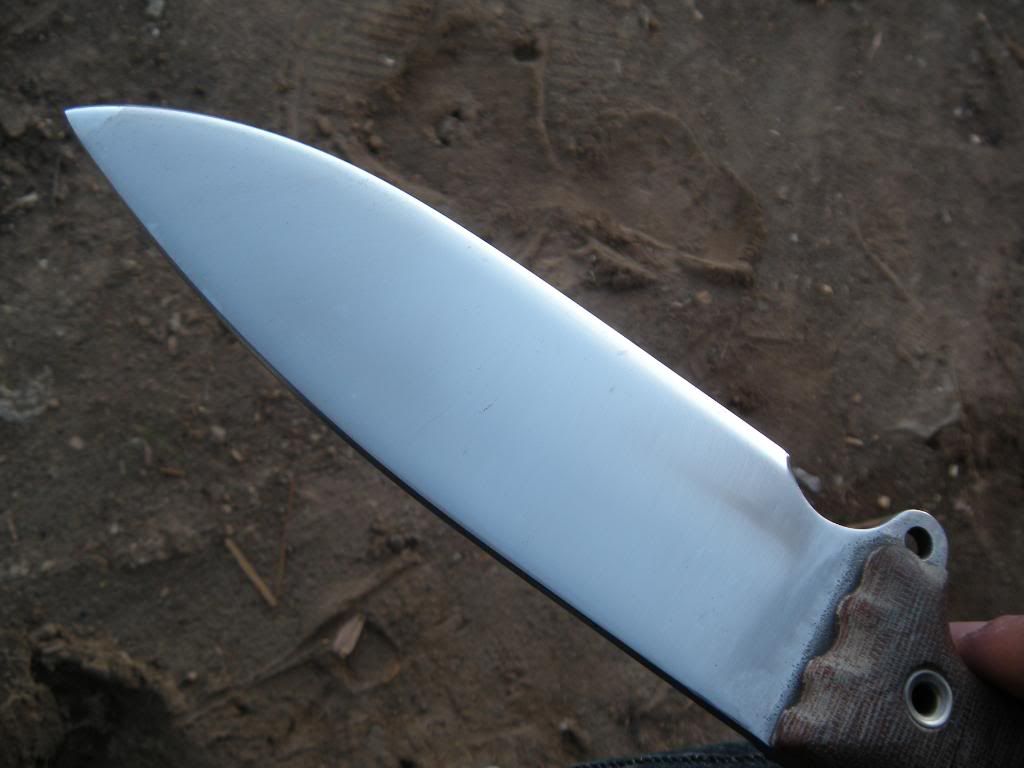
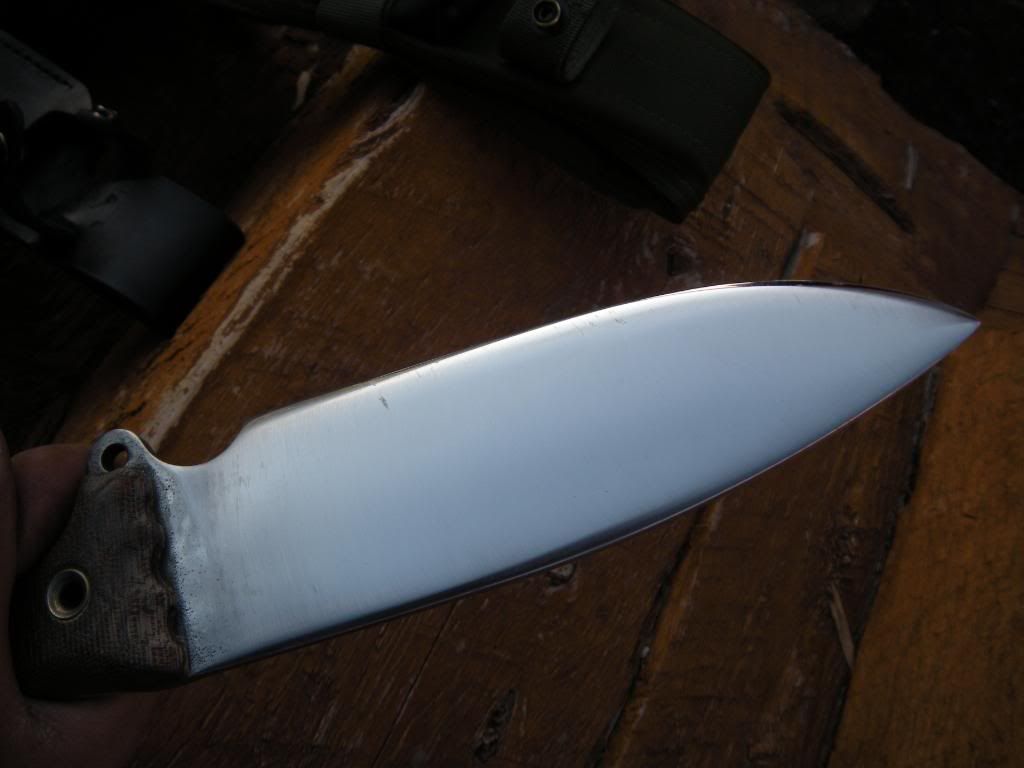
FULL convexed grinds

Joined
Jul 10, 2009
Messages
3,094
How are they achieved. I love looking at work from BAN on bussekin knives etc.. and the idea of a full convex seems great to me. How does one achieve it? I've been getting good at doing a standard convex grind on my belt sander, but im still not achieving the aesthetic quality that many here seem to be getting with a near satin finish and really high grinds. Is it as simple as just holding the knife flat against the slack belt and grinding off the plunge etc?
 
It's all about the tension of the belt and the operator. I don't believe it's a simple pull and drag like a flat bevel, there is some serious movement to the passes.
 
I gave a Skinny ASH a full hand convex, using leather and sandpaper......and 16 hrs of hand sanding....

Make sure that if you plan on fully convexing a knife, especially on a belt sander, that you have to keep a bucket of water nearby to prevent overheating the blade and ruining the heat treat.

Heres a teaser pic.
DSCN0499.jpg

DSCN0494.jpg
 
Barring heating problems, it's basically pressing the knife against the belt flat until the plunge is ground off? Same idea with a mousepad and sandpaper?
 
Its really not as easy as it sounds, doing a full convex on hardened steel eats through 80 grit belts and heat is a big problem. If you can adjust the speed of the grinder then it probably wouldn't be too bad but most I see only have one speed. Try it on some blades that you never want to use again and don't think of it like sharpening.
 
Its really not as easy as it sounds, doing a full convex on hardened steel eats through 80 grit belts and heat is a big problem. If you can adjust the speed of the grinder then it probably wouldn't be too bad but most I see only have one speed. Try it on some blades that you never want to use again and don't think of it like sharpening.

It's true. I've been doing it on my D4, and I was wondering why it was taking forever. Turns out the sanding belt is dull. And it takes a long time to progress. You've gotta keep dipping to avoid the heat, and there is crazy static buildup.

Doing it isn't all that hard, though. I actually did it on a S&W with little to no problems, and I was impressed with the job.
 
Its really not as easy as it sounds, doing a full convex on hardened steel eats through 80 grit belts and heat is a big problem. If you can adjust the speed of the grinder then it probably wouldn't be too bad but most I see only have one speed. Try it on some blades that you never want to use again and don't think of it like sharpening.

Is it as easy as holding the blade flat against the slack belt though? I'm testing it on a 10 dollar coated knife and so far the coating in the middle is still there, but the top and bottom of the edge is bare. Am I doing it right?
 
Things that have helped me regrind:
- Dip the whole blade in water every 2-3seconds
- Keep moving the blade, never stay in the same spot for more than 1 second
- Have extra belts, I usually use 1 1X30 80grit belt per side for big regrinds(I save the worn belts for dirty jobs like grinding off rust), using a worn belt for regrinding is like using a dull knife to shave your face
- Don't be afraid to go at a very low angle, that is the point of a regrind.
 
No not really flat, but almost flat. You don't want to grind at the very top, spine. Angle the knife just a hair. A full regrind does take a little time.
 
if you're grinding hardened blades i would strongly recommend using the Norton R981 50 grit belts.best hoggers in my experience.and keep the blade cool.i used to place a few frozen 2 litre bottles of water in my cooling bucket.
 
I was playing around with a cheapo knife, I got the edge itself to look pretty sick, but am I supposed to be grinding the plunge line as well? Grinding it completely off? What i'm doing is holding the knife ALMOST flat against the belt and taking some passes. Then after I grind it on the belt at a normal angle for the actual cutting edge. Am I correct in this or is the entirety of the sharpening done at the almost non existent/flat angle?
 
I was playing around with a cheapo knife, I got the edge itself to look pretty sick, but am I supposed to be grinding the plunge line as well? Grinding it completely off? What i'm doing is holding the knife ALMOST flat against the belt and taking some passes. Then after I grind it on the belt at a normal angle for the actual cutting edge. Am I correct in this or is the entirety of the sharpening done at the almost non existent/flat angle?

Anyone?
 
If it's like a zero-convex grind... Then I guess that means you ground at a higher angle such that the bevels got ground, too. That's fine; your knife will be a little shorter (edge to spine.) All you've gotta do is put a bevel on it.

I'm not sure what you mean by grinding normal to the cutting edge, though. Don't flatten the edge, if that's what you're talking about.
 
what is the knife and what is the use? A flatter held angle will give you a thinner shallower convexed edge and blade.If you want thicker do the two different angles.
 
If it's like a zero-convex grind... Then I guess that means you ground at a higher angle such that the bevels got ground, too. That's fine; your knife will be a little shorter (edge to spine.) All you've gotta do is put a bevel on it.

I'm not sure what you mean by grinding normal to the cutting edge, though. Don't flatten the edge, if that's what you're talking about.

What I mean is, if I were going to sharpen a knife on the sander I would simply hold the knife at 20 degrees and sharpen it. With this im basically holding the knife so that the spine is ALMOST touching the belt. What I'm asking is, will holding the blade at such a shallow angle, only a few degrees actually sharpen the edge or do I still need to sharpen the actual bevel at the usual 20 or 15 degrees etc..? When I hold the knife to the sander so that the spine is almost touching, it grinds above the primary bevel and also the plunge line on most knives. Am I removing the plunge line as well?
 
Last edited:
What I mean is, if I were going to sharpen a knife on the sander I would simply hold the knife at 20 degrees and sharpen it. With this im basically holding the knife so that the spine is ALMOST touching the belt. What I'm asking is, will holding the blade at such a shallow angle, only a few degrees actually sharpen the edge or do I still need to sharpen the actual bevel at the usual 20 or 15 degrees etc..? When I hold the knife to the sander so that the spine is almost touching, it grinds above the primary bevel and also the plunge line on most knives. Am I removing the plunge line as well?

..........
 
What I mean is, if I were going to sharpen a knife on the sander I would simply hold the knife at 20 degrees and sharpen it. With this im basically holding the knife so that the spine is ALMOST touching the belt. What I'm asking is, will holding the blade at such a shallow angle, only a few degrees actually sharpen the edge or do I still need to sharpen the actual bevel at the usual 20 or 15 degrees etc..? When I hold the knife to the sander so that the spine is almost touching, it grinds above the primary bevel and also the plunge line on most knives. Am I removing the plunge line as well?

If you hold the blade at such an angle that it's going to get down to the edge, then yes, you're going to affect the edge and its bevels. I kinda accidentally ended up doing that on one side of my S&W, which is the first knife I fully convexed, and the other side came out without doing that. I just simply made a new bevel on that side whose edge bevels got ground into.

I'm not sure what a plunge line is... But you can do it if you want. Like I said, if you end up grinding passed the edge bevels, then you can make a new set of edge bevels (20˚ or whatever you want) if you like.

There are no rules.

PS: I'm not an expert on this at all. I'm just a guy who did it once on a S&W and once on a gerber and stopped in the middle of doing it to my Delica :o
 
Back
Top