Full tang Buschcraft knives

Status
Not open for further replies.

rexromic

Platinum Member
Joined
May 28, 2011
Messages
5,263
Hi interested to know which buschcraft knives in 4"-6" have full tang handles(not skeletonized).I have a Fallkniven F1 and that one has full tang.I also own GSO 5.1 3V,and not sure if the tang is skeletonized.Like Koster knives too but heard some of them have partially skeletonized handles for better balance.Just trying to get a quality fixed outdoor all round blade to accompany my F1.Any info appreciated and thank you.
 
No trying to derail your thread, but I would be curious as to why you are asking.

I don't recall hearing about a failure of a knife from a reputable company due to the tang being skeletonized. I could be wrong, and would not argue if someone posted info to the contrary.
 
No trying to derail your thread, but I would be curious as to why you are asking.

I don't recall hearing about a failure of a knife from a reputable company due to the tang being skeletonized. I could be wrong, and would not argue if someone posted info to the contrary.
It is not about full tang skeletonized being inferior to non skeletonized full tang,it's just my personal preference.
 
Look at Enzo knives. They are also Scandinavian made. Good steel. Full tang. Take a great edge and hold it.
Rich
 
The new GSO 4.1 is full tang, not skeletonized. The previous versions were skeletonized. This is according to their website. I have a 4.1 starter, but have not received it yet. Not sure about the other sizes.
 
I make them.

[video=youtube;sqcZiTE_oF0]https://www.youtube.com/watch?v=sqcZiTE_oF0[/video]
 
Schrade schf frontier knives, I have the schf36, 37 and 38, for about 35 bucks each they are full tang 1095 carbon steel and almost 1/4 inch thick.
 
The new GSO 4.1 is full tang, not skeletonized. The previous versions were skeletonized. This is according to their website. I have a 4.1 starter, but have not received it yet. Not sure about the other sizes.

I thought I saw that too but wasn't sure. I believe the budget line was full tang too but that's second hand market.
 
Bark River Bravo 1 in A2 or 3V
Bark River Bravo 1LT in 3V
Swamp Rat Ratmandu in SR101 or Infi
Benchmade 162 Sibert
Fallkniven S1

Don't think you can go wrong with either of them. My personal favorites are the Bravo 1LT for the comfort of the handle, light weight, and it's the best slicer. The Ratmandu is my favorite knife that you can beat on and it'll keep going. My least favorite is the Benchmade 162 Sibert because the handle isn't comfortable for me personally. However, I've used it backpacking and had no problems with it's performance. Just personal preference, but I still plan on keeping it. I want to pickup a GSO 5.1, but I can't seem to get my hands on one.
 
No trying to derail your thread, but I would be curious as to why you are asking.

I don't recall hearing about a failure of a knife from a reputable company due to the tang being skeletonized. I could be wrong, and would not argue if someone posted info to the contrary.
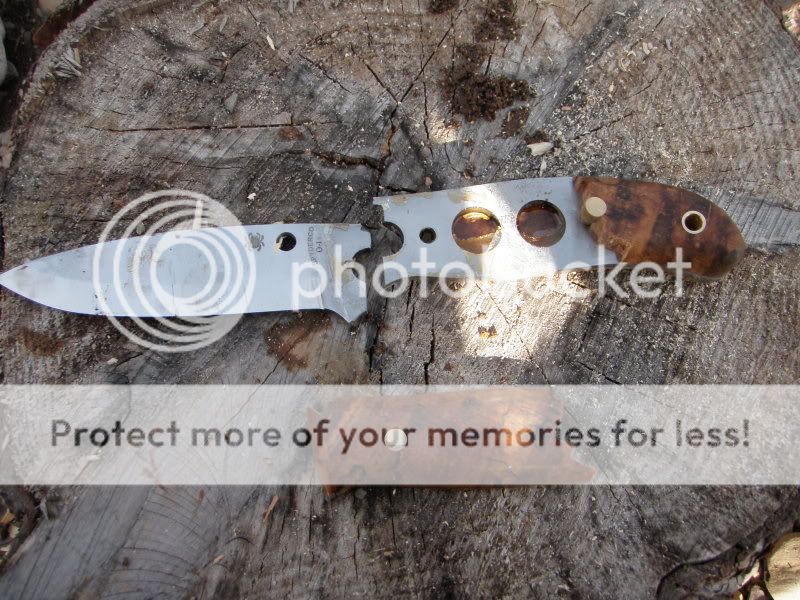
This is probably the most famous one:
P3171255.jpg


I don't really think "skeletonized" really reflects the potential failure issue. Too many supposedly super tough full tang knives have the smallest cross section right behind the ricasso where your index finger goes. And then they put one large or a couple of small holes right there, and don't bond the scales on to help support the weak area. Like the GSO's:
maxresdefault.jpg


The point that gets the most leverage from your hand is not only the smallest cross section anywhere on the knife, but it also has a hole in it. If this knife breaks anywhere but the tip, it will be at that first hole. Just like the Spyderco.


trapperO1blade2014.jpg


In contrast, this Enzo O1 blade locates the first hole another 3/4" back in an area that is both larger and sees lower stress. And that works because you bond the handles on, instead of the currently fashionable screwed on scales.

If strength is an question (as it should be with a survival knife), the location of the holes closest to the blade are more important that the total amount of holes.
 
Last edited:
Status
Not open for further replies.
Back
Top