gathering meaningful statistics on knife/steel performance

Cliff Stamp

BANNED
Joined
Oct 5, 1998
Messages
17,562
In reviewing the reviews recently it has become obvious that they are lacking in regards to performance evaluation in certain respects. While some parts are well quantified others are not. Can you read a review and have it immediately obvious if the Delica is a better paring knife (from my point of view) than the Opinel. I decided recently to add a ranking page where I put such information for various tasks. Right now I am thinking of the following :

Kitchen : paring, utility, chef
Brush : carving (rough,precision), chopping (soft,hard,springy)
Utility : light (ropes, cardboard), heavy (thick plastics, light metals)
Non-knife : prying, hammering,

I will probably add and refine the above and I am not sure how I will exactly break it down. For example a paring knife basically is judged (by me anyway) on how it cuts, how it handles, and the steel. In the following I have called this grind, steel, ergos :

http://www.physics.mun.ca/~sstamp/knives/blade_stats.html

Now each of these can be broken down further, steel would depend on corrosion resistance, edge retention for cutting, durability, etc. . So the ranking is a general one which is essentially an average over all of these. The ranking will be a simply 1-5 and is a linear scale, this means that a knife ranked at number 1 is five times as good as a knife ranked at number 5.

I want this to be more than just my perspective. So for anyone who wants to add their ranking send me an email. I am open to pretty much any meaningful catagory, but I am mainly interested in specific catagories as noted in the above. What I need is a real name, an actual email, and some way to identify yourself as the raw data will be made public. So basically your email will be something like :

dbfan Cliff Stamp sstamp@physics.mun.ca paring knife folder U2 1 1 1

Follow this with a brief commentary such as the U2 is pretty much an ideal folding knife, the blade is very narrow so it turns well. The edge is thin and acute so it cuts well. The handle works well in all paring grips and is comfortable and secure. The knife is also very light and short so it is lightweight and easy to use for coring and other point work. This information will be made public as :

dbfan 1 1 1

In a link in the voters entry in the specific table. This not only lets people see the breakdown but it also gives you the ability to edit your entry. Maybe after using a knife for awhile you learn more or use other knives and you decide that the U2 isn't perfect and it rates more of a 2 on blade steel as you would perfer a simpler steel, or a hollow ground blade. So you just send an email with the corrected versions.

Be as specific as you want in the rankings, 1.5 or 4.3, whatever, however personally I think it is difficult to be more precise than a 0.5 seperation. Ideally I will javascript this and use a login so you can see your votings as do other groupings. But for now I'll just keep it simple and see where it goes. Just title the email with [KNIFE STATS] in the title so I can filter them readily. In a few days I will have the tables I want, and start to fill in the knives I have used. However there is no need to wait for this and as I have noted I am open to other rankings anyway.

-Cliff
 
Numbers are great. They can have very specific meaning. However, the way the numbers are acquired and what they correlate to is very important. With an open rating system like this that uses a scale, someone that has only ever used two knives can only compare them with eachother.

For example lets say i own a high carbon asian style cleaver and a six inch french style chefs knife, thats it. When i compare the performance of the two blades in paring exercises i might give the chefs knife a 4 as its the best tool i have for this job (but still clumsy) and give the cleaver a 2 as its the worst i have for paring (but an axe would be worse still). Another reviewer could just as easily give a wusthof pairing knife a 4 because he feels it doesnt work quite as well as his leek with a 10 deg incl edge which was given a 5.

In other words numbers are great but you must be careful how you give them meaning or they are no better than saying "this knife is wicked good!"
 
Exactly right, this is why in the beginning you would expect the numbers to oscillate a lot. However after awhile as the tables fill out with more knives added, and more people voting then they would stabilize. So for example after 150 people have "determined" that a Spyderco Delica rates as about a 2.5 as a paring knife but it is the best you have seen, you take this to maybe realize that there are better knives so you look at one of the higher ones and see what happens when you use it.

-Cliff
 
Ah yes, averages and large sample sizes. Sounds good to me. I'll try to do my part and post my experiences.

What kind of a data base are you using as the back end. Sounds tedious if you have to enter all the stats in manually. Good luck getting significant sample sizes!
 
I am old school using scripting languages to manipulate text files. I was doing this type of thing 15 years ago on linux with awk/grep/sed etc. . I don't expect mass participation in a flood to be a problem. I mainly need to do it for me to get a better idea of knife rankings anyway as well as to develop a better and more focused approach to knife evaluation so am just opening up the floor basically for anyone else to participate.

-Cliff
 
Gotcha, the first data set i ever worked with was an old D-base. I wrote scripts to handle the data and never had a problem with it. It was a shoe store, when a new order would come in the text file would be grep'd and numbers updated manually. Outgoing stock was managed through the barcode scanner and the gui. Eventually i ported it to an access server (just because i could) the script for this required the addition of a couple semicolons to the text file and i made $2k. I've never set up a webscript to access a sql backend but i imagine it would be easier to just use a good ol formatted text file.

I agree that the data you acquire through this endeavor will enable a more pertinent knife evaluation procedure. You cant answer the question without knowing what the question is.
 
I'm a little dubious as to where this will go. It's an excellent idea, and definitely worthwhile, but the testing methodology concerns me. With no benchmark as to what constitutes a “1” or a “5” in any particular category, it leaves no frame of reference for ranking. A very large sampling size would greatly help to improve accuracy, but I just don’t see a large enough and impartial enough sample, to tell the real truth. Add experience to the mix, and things get really shaky.

With that said, I do like the idea. At this point, anything is a start in the right direction. With enough input, however unlikely that may be, some meaningful purchasing advice could come from the data.
 
Sample size is of course a real concern in those sort of subjective comparisons. Nonetheless seeing how others rate various knives would be interesting. I think that this information would help to evaluate what an objective benchmark would consist of. Its easy to determine the 0-60 mph characteristics of a car and compare them. Its not so easy with a knife and especially outside of a lab.
 
The benchmarks will come with time, as noted the statistics are likely to oscillate rapidly early on but will stablize as more knives are added and especially as more people share their data. Note there are no benchmarks initially specifically because I don't want it to reflect my perspective they come from a group viewpoint.

-Cliff
 
While this may be democratic, I think a major obstacle would be the ability to dissociate the brandname and other imbued attributes not intrinsic to performance itself from the ratings.
 
There is always this, ideally you would get this information from a blind study on unmarked blades. But reading the blurb will allow a measure of such judgement anyway, and I tend to have a very efficient hype responce filter. The statistics are thus going to be skewed by those who wish to participate with me in a study of knife performance and I really have disassociated myself from the fanboy/cults anyway. I realize the statistics are so baised but it isn't a bais that I am concerned about. As I noted, it is mainly something I want to do to make my viewpoint more concrete and I am just opening it up to see if others want to participate in a meaningful way. Ideally it can be used to allow such questions as, is there a distinct pattern of ideal camp blade from people going from southern to northern canada for example? There are a lot of questions which could be answered.

-Cliff
 
So is it right now open to those knives that appear on your webpage? How does one differentiate from paring, utility, and chef in the kitchen category? Peeling is obviously paring, but is digging out bad parts and coring considered utility or paring? What is the difference between utility and chef?

Would ergo include ease of cleaning for the handle/pivot as well? And cost or availability should not be a factor in any of the evaulation, right?

As for the rating, would the following be a rough guide? I'm thinking 1 should be very very rare, and 2-3 being a good place to be?

5-hard to get any worse
4-starting to get some function
3-good
2-moving toward ideal
1-ideal
 
kel_aa said:
So is it right now open to those knives that appear on your webpage?

No, it is open to anything.

How does one differentiate from paring, utility, and chef in the kitchen category?

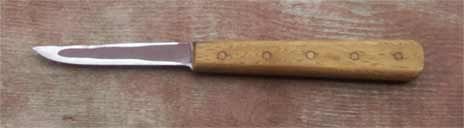
They are not at all similar, paring knife :

johnson_paring.jpg


utility :

aj_utility.jpg


Chef's knives and paring knives are at the extreme ends, utility knives can do both and can be more slanted towards paring, such as the above, or can be like small chef's knives like the Japanese utility from Lee Valley :

ok_ju_ms.jpg


There are many other types of kitchen knives of course and the lines on those blur, I would not even argue strongly that the above utility knives are not simply small chef's knives. In general though a utility pattern usually means more general like the above Johnston custom.

Peeling is obviously paring, but is digging out bad parts and coring considered utility or paring?

All small work is generally done with a paring knife.

Would ergo include ease of cleaning for the handle/pivot as well?

This could indeed be a relevant issue for folders, I have not seen anything significant from one to the other in general but others may vary depending on what is cut and how they are cleaned. Some natural folders like Opinels can't tolerate cleaning method which are ignored by modern tacticals.

And cost or availability should not be a factor in any of the evaulation, right?

5-hard to get any worse
4-starting to get some function
3-good
2-moving toward ideal
1-ideal

Yes, I think this is easier to understand than a linear scale which has problems.

-Cliff
 
this is a great idea, and I really don't see any need to worry about how the numbers are going to turn out. I shop online a lot, and I use user reviews to help make a lot of choices. Amazon, Cnet, Epinions, IGN, Gamespot, IMDB, Circuit City, etc. etc. take tons of user submitted reviews and I find them very useful.

If you get an average rating with # of votes, you can see very quickly if that score is supported by a large enough sample. If a blade gets a 3 in paring with 150 votes, then 3 is probably a pretty representative score for the performance. If it's only 4 or 5 votes, then go ahead and read through the accompanying review descriptions.

I like to read the low scoring reviews to see what happened. With consumer electronics, it's often user error, a misunderstanding of the product, or even scoring the product poorly when it was the vendor who irritated the reviewer instead of any actual shortcoming of the merchandise. I'm sure there would be similar issues with knives-personalities, misuse, misunderstandings by some.

I would suggest a value rating, as perceived value can have a big influence on performance evaluation. Also a quick Pro/Con to go along with the written evaluation. I find it can speed things up when skimming through. If a person gives a knife 3's across the board, the Pro/Con would list anything that stood out to that person even though the scores were very middling, and you don't have to read the entire text to get that.
 
How does one differentiate from paring, utility, and chef in the kitchen category?
They are not at all similar.

So then these are categories of general attributes, as opposed to tasks? I had understood it to be the latter. It simply reflects the suitability of the knife being used for that category of tasks, no? The example you gave is of a Fulcrum in the paring knife category. Unless you are paring fossilized dinosaur eggs...

Take a Military for instance; it is not as fine as a paring knife, or have the size of a chef's knife, but shouldn't their function in both of these categories be evaulated? Or does utilitiy knife encompass both then? And some kitchens only have several cleavers and a potato peeler, and they get all their tasks done with them.
 
kel_aa said:
...but shouldn't their function in both of these categories be evaulated?

Yes, the knives get rated for all catagories or at least the non-trivial ones anyway. A lot of knives like the Military are not actually specific focus so the rankings are to gauge where it lies. It isn't unreasonable to use a Military to peel potatos, slice them up, dice up an onion, slice off some bread, etc., basically run the full spectrum of food preperation chores. So it would show up in multiple tables. Some of the "survival" knives for example are expect to handle pretty much anything including all food preperation and wood craft/utility so they are in almost everything.

The Fulcrum is an example of pretty much the worst folding knife I have seen for paring work. I intended to have at least examples of 1 and 5 for a few tables but there are problems with the server the pages are hosted on and I can't get updates currently. The U2 for example is a very nice paring knife for a folder as is the Jess Horn. They are about 1.5 or so. The Jess Horn has a nicer tip for such work as it is finer but the U2 is slimmer at the edge when stock. Both could be improved with deeper hollow grinds and a more narrow blade. The U2 could also benefit from a longer handle, but this is fairly minor.

The reviews will have my reasoning in detail for the rankings. If anyone wants to make theirs public then they can put them here, or in responce to a review, or on rec.knives (not moderated) which I will be posting to shortly once I update the page so it is more obvious what it is to be used for.

-Cliff
 
Are you putting this all in a data file and using a program to extract the desired information? Maybe it would be easier to use a form webpage if your server can read information too? It might be difficult for the data reading-algorithm to read the proper fields. Anyways...
_______________________________

kel_aa Kelvin Xie kel_aa@yahoo.com paring knife fixed Frosts_Carbon_Laminated 4 3.5 2

This knife will do in a pinch, but the grind, even reworked, is way too thick. The steel will stain heavily on some foods, but in general doesn't corrode. The edge retention is high and the handle comfort is outstanding.

kel_aa Kelvin Xie kel_aa@yahoo.com paring knife fixed Victorinox_Paring_Drop-Point 2 2 4

This is a typical basic factory-produced paring knife on a molded handle. Very thin and narrow stock with flat grind makes it handle well. The steel choice makes it easy to work with where damage against hard objects is the most likely source of edge degradation. The handle is a too small to be comfortable, however, resulting in cramps from extended use.

kel_aa Kelvin Xie kel_aa@yahoo.com paring knife fixed Antelope_Hunter 3.5 1.5 4

Ideally the flat grind would be more agressive, leaving a thinner edge. The edge requires thinning to make it handle better. The Aus-8 steel doesn't present any difficulties. The blade width however makes paring somewhat unnatural. The deep slot in the handle traps crud readily.

kel_aa Kelvin Xie kel_aa@yahoo.com utility kitchen fixed Antelope_Hunter 3.5 1.5 3.5

Ideally the flat grind would be more agressive, leaving a thinner edge. As it is, the edge requires thinning to make it handle better. The Aus-8 steel doesn't present any difficulties. The deep slot in the handle traps crud readily. Cleaning game without access to running water to wash the handles might be a smelly/unsanitary endeavor.

kel_aa Kelvin Xie kel_aa@yahoo.com paring knife folder Military 2 3 2

The fairly thin edge and the pointy tip (along with distal taper) makes this a good paring knife. The handle is large and comfortable. The benefit to using S30V is not apparent, however. From a psychological prespective, making the handle more resistant to corrosion by using an more inert material for the liner would be a plus. The tight clearance between the tang and the handle makes it ideal in terms of keeping out crud.

kel_aa Kelvin Xie kel_aa@yahoo.com utility kitchen knife folder Military 2 3 1.5

The fairly thin edge, long blade and broad belly makes this a functional kitchen utility knife. It functions well in most areas and is able to take on the whole range of tasks involving meal prepration. The benefit to using S30V is not apparent, however. The tight clearance between the tang and the handle makes it ideal in terms of keeping out crud and maintaining rigidity.

kel_aa Kelvin Xie kel_aa@yahoo.com utility light knife folder Military 1.5 3 1.5

The thin edge and the pointy tip (along with distal taper) makes this an very excellent work knife. The handle is secure, comfortable, and inspires confidence. The high wear resistance of S30V is really functionally offset by the lack of toughness. As it is, ease of sharpening will not be a problem for a while due to the accute factory edge. The tight clearance between the tang and the handle makes it ideal in terms of keeping out crud and maintaining rigidity.

kel_aa Kelvin Xie kel_aa@yahoo.com paring knife folder AFCK(800) 4 3.5 3.5

The partial grind is conservative and the edge thick in this well-used older model. The tip is pointy and tapered. The benefit to using ATS-34 is not apparent, and a real detriement to sharpening and reprofiling. The corrosion resistance of the steel is below average, especially in the unpolished tang areas. The use of corrosion-free materials in the handle is plus, at least from a psychological prespective, but not necessarily well matched with the steel. In the edge-in grip, the large finger notch in handle require choking up higher on the handle, increasing the exposure of that hand to the substrate.

kel_aa Kelvin Xie kel_aa@yahoo.com utility kitchen knife folder AFCK(800) 3.5 3.5 1.5

The partial grind is conservative and the edge thick in this well-used older model. The benefit to using ATS-34 is not apparent, and a real detriement to sharpening and reprofiling. The corrosion resistance of the steel is below average, especially in the unpolished tang areas. The use of corrosion-free materials in the handle is plus, at least from a psychological prespective, but not necessarily well matched with the steel.

kel_aa Kelvin Xie kel_aa@yahoo.com utility light knife folder AFCK(800) 3.5 4 2.5

The partial grind is conservative and the edge thick in this well-used older model. The major hinderence to performance is the thick edge and the choice of steel. The benefit to using ATS-34 is not apparent, and a real detriement to sharpening and reprofiling. The handle could be wider and more filling.

kel_aa Kelvin Xie kel_aa@yahoo.com paring knife folder Rucksack 2 2 3

The longer blade lends it to more effective uses. The full flat/slight hollow grind and the steel choice makes customizing the edge easy. The handle is large enough to be comfortable and secure, but the large number of parts/spaces makes cleaning more problematic.

kel_aa Kelvin Xie kel_aa@yahoo.com utility kitchen knife folder Rucksack 2 2 3

The longer blade lends it to more effective uses. The full flat/slight hollow grind and the steel choice makes customizing the edge easy. The handle is large enough to be comfortable and secure, but the large number of parts/spaces makes cleaning more problematic.

kel_aa Kelvin Xie kel_aa@yahoo.com paring knife folder Opinel-9 3 2.5 3.5

The clip-point doesn't lend itself to be the most useful as a paring knife. The thin well-ground stock functions well and is easy to rework. Although this is carbon steel, only staining, as opposed to corroding has been observed. The handle is however not as comfortable as one would imagine.

kel_aa Kelvin Xie kel_aa@yahoo.com utility kitchen knife folder Opinel-9 2.5 2.5 3.5

The blade lacks enough belly to be as effective as some other knives, but the thin well-ground stock functions well and is easy to rework. Although this is carbon steel, only staining, as opposed to corroding has been observed. The handle is however not as comfortable as one would imagine.

kel_aa Kelvin Xie kel_aa@yahoo.com paring knife folder Calypso_Jr 2 3 1.5

The flat grind on this leaf-shaped blade makes for a thin edge and decent tip. The handle is comfortable, and combined with the not so wide nature of blade, makes for a highly functional knife. The VG-10 has not been very easy to work with, however, compared to something like Aus8. The benefit to using S30V is not apparent. The nature of the construction leaves it easy to clean and resistant to corrosion (at least pyschologically).

kel_aa Kelvin Xie kel_aa@yahoo.com utility kitchen knife folder Calypso_Jr 2 3 2

The flat grind on this leaf-shaped blade makes for a thin edge, with a well balanced tip and belly. The short cutting edge length however hinders efficiency. The handle is comfortable, but the lock can be partially depressed at times during heavy pushing. The VG-10 has not been very easy to work with, however, compared to something like Aus8. The benefit to using VG10 is not apparent. The nature of the construction leaves it easy to clean and resistant to corrosion (at least pyschologically).

kel_aa Kelvin Xie kel_aa@yahoo.com utility light knife folder Voyager(3"Tanto) 3 2 3

The Aus-8 steel is easy to work with, the inital edge acute. The secondary point can be used as an exato knife and the chisel tip effectively used as an scrapper. The hollow grind is competitive, but not really notabe. The clip is too tight and the tip angled inward. The stepped-pyramid pattern on the handle pinches the user during tight grips. Very light and a solid lock makes this a competitive choice if this profile is desired or is indifferent. The nature of the construction leaves it easy to clean and resistant to corrosion (at least pyschologically).

kel_aa Kelvin Xie kel_aa@yahoo.com utility light knife folder Native(SE,S30V) 3 2.5 2

A light lockback with a finger-choiled spear-point blade that is 70% serrated. The tip section is tapered and thus usuable for finer work. The straight edge part is linear and can be easily sharpened on a stone. The edge is un-necessarily thick, however. The ergos on this piece is very high. A longer and straighter handle can be of benefit in use. The nature of the construction leaves it easy to clean and resistant to corrosion (at least pyschologically). I would argue here the use of S30V might be decent as with the serrations you can not touch them for a time and the grindability of the straight edge not a problem as it can be easily worked on with a stone.
 
Back
Top