Getting a hamon to really POP in 5160?

Joined
Aug 26, 2010
Messages
4,441
There's a maker on the forums that's making me a custom kukri with a Hamon. All the pics that he's sending me have me really interested in this process.

He says he's rubbing with warm vinegar or FeCl, then polishing at 2000 and 2500 grit, but since i don't know ANYTHING about this stuff, it got me to wondering if this is the way that most custom makers get a nice well defined hamon.
 
5160 is a tough steel to get a good hamon with. Your maker is skilled if he can get any sort of activity beyond a wavy line.
 
He might get a quench line, or some sort of a temper line, but a true hamon on a steel with that much alloy content is all but impossible.
For a hamon you need a shallow hardening steel, like 1095, W1 or W2, or tamahagane. 5160 is about as deep hardening as steel gets.

5160 has only .60% carbon, and about 1% chromium and around 1% manganese. This makes it harden deeply and slowly. 1095 has 1% carbon, only .35% manganese, and no chromium. Tamahagane has even less manganese. These steels need an extremely fast quench, and to attain a hamon, you need to use the fastest method you can. 5160 given that severe a quench could be severely damaged. Even if it isn't cracked, it may have severe internal weaknesses.

Post photos when you get them.
 
Here's what he has so far. It's looking quite nice as far as i can tell

I understand that it might not be a real genuine hamon, but i'm more interested in the look than the function in this case

Much bigger version of the pic here

http://imageshack.us/photo/my-images/696/hamonjpg.jpg/
scaled.php
 
For a hamon or quench line the maker could bring it to a high polish and etch. I went to a very clean 1000 grit and used a light lemon juice etch for a nice quench line on 5160. I only tried this a few times just to see how the hardening was going. I no longer differentially harden but it looked cool.

I am surprised to see even that much of a wavy line on 5160, has it been ground and etched or is that with the clay just off? It looks etched, that is wild!


EDIT - btw I don't think anything will make the hamon pop as I doubt there is any activity, my directions would likely yield a quench line

This is just my opinion and I am not very experienced with hamons.


:foot: edit 2 - I just realized this was about another makers work and am not saying it will not work, just that I don't know how to make it work.

That is a great looking knife by the way and will be looking awesome with black/blue G10!
 
Last edited:
that has not been etched. It is polished up to i believe 220 grit so far. He says he'll be taking it to 1500 before etching then up to 2500 or 3000 as a final polish

I am VERY lucky that i commissioned the first of these, because it looks like he's considering making more of them, and the price will be more that double what i'm paying.

it's going to have blue and black G10 scales :)
 
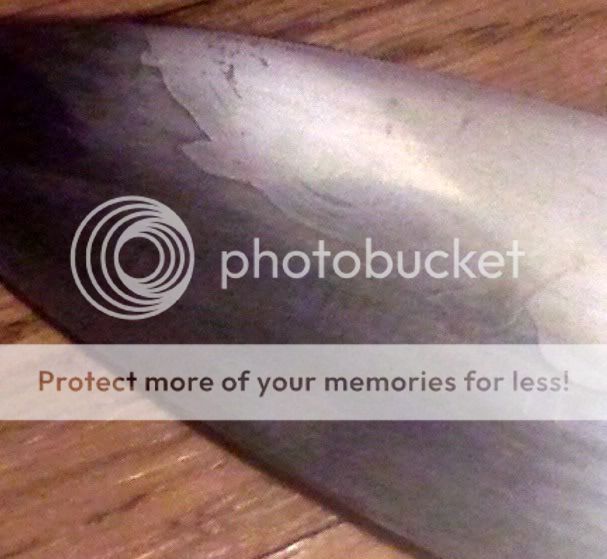
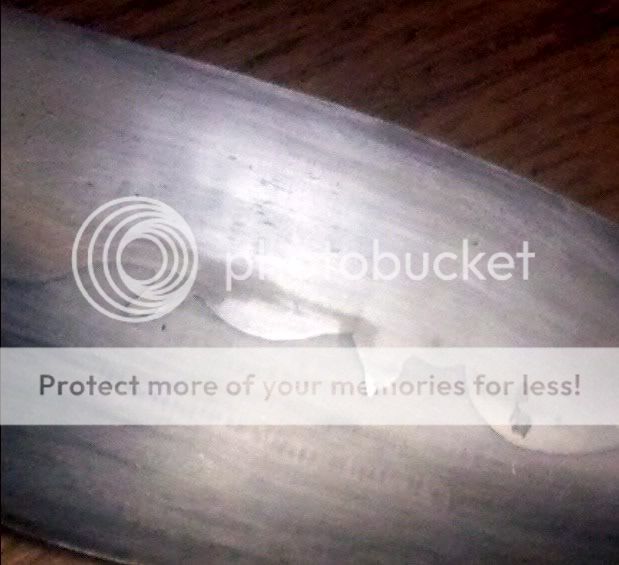
Off hand, that doesn't look like a temper line at all. It seems to be surface decarb. I can't tell from a dark picture and don't want to claim unfounded things about another maker's work, but I get marks like that from clay, too. Once is gets ground off, it won't come back. It is superficial. I might be wrong so don't take this as a dig on your maker. It would be nice to talk to him about it.
 
Last edited:
The line was created during the heat treat by the gentleman to whom my maker sends all his blades for HT. It was (if i am remembering correctly) created with clay.

I don't know what a decarb transition is though, so i can't speak to that.
 
If that really is a Hamon, my guess is that the maker used something other than 5160. Probably 1095.
 
It looks like surface decarb. Maybe you are not interpreting the maker's explanation correctly. It would be good if he chimed in.

hamon3.jpg

hamon2.jpg
 
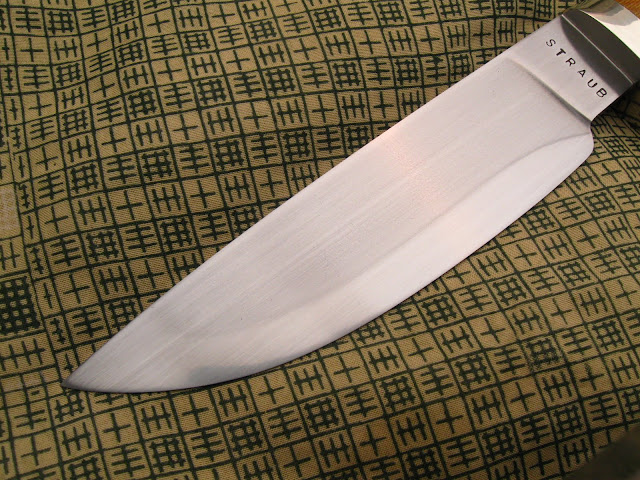
That does have the simple tu-tone look of a quench line in 5160. I haven't really seen it done with that much of a pattern to he line before, though. I am a bit dubious that the blade in this pic has not been etched.

Interesting that the maker sent it out for clay treatment. I'm guessing to Texas supply? Usually a guy who does odd things like try to get an active quench line in 5160 would be HTing the blade himself. Especially if planning to go to 2500 grit for the finish.

I've never tried to clay a pattern into 5160, just clayed straight or curved lines into it. I've never gotten one that was more than a simple line, just sanded to 600 and etched a few times, scrubbed oxides. Wouldn't have looked much better in 2500 grit finish.

IMG_5583.JPG


IMG_3034.JPG


I'd be very interested to see this blade when done. I'm predicting no habuchi, hataraki, shallow hardening phenomena but then the pattern of the line is surprising, who knows. Maybe not 5160, as mentioned above.
 
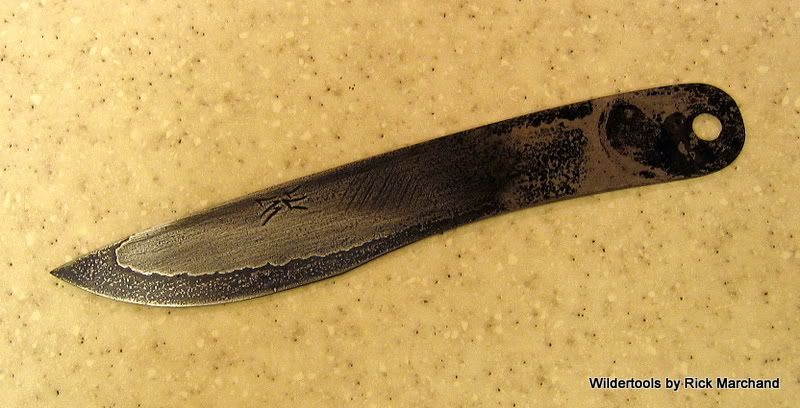
Actually, seeing Rick's post there, it does look more like decarb up close. The steel at the edge being darker and lower. Oddly, with W2 etc, the opposite effect will occur in water- the hard edge will stand proud and white of the soft back as quenched.
 
If that really is a Hamon, my guess is that the maker used something other than 5160. Probably 1095.

i have no reason to disbelieve him. He said he had 5160 stock on hand and was willing to use it for this project. Everything he has mentioned has been in line with that.

IIRC the HT was done by darrin sanders.
 
I got this from 1084FG...
IMG_0060-1.jpg

It was obviously surface decarb but cool as heck. After I removed the decarb layer it was gone. The only thing that remained was a cloudy line about half way up the blade... not even worth etching out.
 
Not doubting the maker's word, just thought maybe some miscommunication possibly. Sounds like that's not the case. And I think Darrin is a good guy and knows what he's doing, it would be interesting to hear if he's got an advanced method for 5160 quench lines. Not that he needs to share it. Just an interesting thread, is all. Enjoy your kuk!
 
Did i H/T that blade? Yep. Any special gris-gris added? Nope. Just a wavy clay coat and regular H/T for 5160. I'm thinking there is still some decarb there also but I could be wrong. Maybe Nick will chime in and tell us about it.
 
he just messaged me to let me know that he has completed the etch and is working on more polish. He has also started on the file work on the spine. I'll have pics up as soon as i have em
 
Cool... thanks for chiming in, Darrin. I don't think there is any intentional miscommunication going on here... just missing pieces.

Darrin, have you any experience with bringing out a hamon in 5160?
 
Brian VanSpeybrock (/sp) used to do a decent bit of 5160 with TRUE hamon over on DFogg's forum

it is certainly possible through extreme grain reduction to lower the hardenability of 5160 into a good range for Hamon.

possible does not mean practical. I believer Brian was up to over 10 reducing thermal cycles before he could get any activity.
 
Yep, Darrin put a clay temper on there. BePrepared wanted a distinct two-tone hamon line, and as Rick has pointed out, that seems to be all but impossible with this type of steel. I don't think that getting a "real" hamon is going to be possible at my skill level (which, for these purposes, is negligible), and certainly the two-tone line I think is representative more of some sort of a san mai construction. The pics I received for what he was looking for were from claudio-cas's work, and I'm pretty sure he used a san mai to get those looks. The closest I can come is to carefully etch with FeCl along the line that showed after heat treat, so that the front part of the blade is more oxidized (patina?), than the back portion. I hope I'm using the right terminology. I'm using FeCl and some q-tips along the line (maybe that's the decarb you guys are talking about? I'm still too new at this to understand the terminology perfectly) to create the effect that was requested. Is it a true hamon? Not in the slightest. Does it look interesting aesthetically? Well, I think so, and I hope BePrepared does too. If not, well, he doesn't have to pay for it unless he likes the blade. It's a cool project, and it's a good chopper. Darrin's heat treat really holds up nicely. Some day I hope I'll have the equipment and skill to make a san mai version of this blade, and get it to look just the way I want. That day, alas, is not today.

One of the things I also learned while attempting to get the hamon to come out is that if you missed any scratches during the polishing phase, they get revealed in a big way when you etch. Also, white vinegar does very little to 5160. It's been a good learning process, and I think I'll be asking darrin to do a few more clay lines on some 1095 so I can see the difference on those as compared to the 5160.

-edit- Also, I had no idea this thread was getting created. I hope my response has cleared up the confusion. If any of you have some tips on how to best simulate the look requested beyond what I've done so far, please feel free to chime in. I've learned a ton from doing this project.

 
Last edited:
Back
Top