Getting a mirror finish.

Joined
Oct 1, 2009
Messages
193
I'm not talking about the edge,i'm speaking of the rest of the blade in this case.
I got my dad's beaten(really bad) U.S.N Mark I and it was halfway beat to hell.
It has an edge on it now and I want to make the blade portion shiny.
I used metal glo twice and it helped alot but it doesn't really look very nice.
Is there an easy way to polish a blade?(I assume a buffer would work)
 
Easy would be by machines, but it can be done by hand using sand paper. Keep progressing to a finner grit until you get the finish you desire.
 
Easy would be by machines, but it can be done by hand using sand paper. Keep progressing to a finner grit until you get the finish you desire.

Would you lay the blade flat on the sanderpaper
(which I assume isn't on a mousepad)?

Then what motion would you do? Circles, strokes, etc.
 
Strokes would work. You want to progress to get rid of the scratches you have just put in the blade. Don't start with to coarse a paper as the coarser you use the longer it will be to get to where you want. You can finish with wet/dry paper to get the finish you want.
When you start keep the presure as even as you can over the entire area you are working on. A product I have used in the final stages is semi-chrome which can be purchased in hardware stores. Fitz is another polishing paste many have used with good results. Have fun as you will enjoy the results that you have achived.
 
Strokes would work. You want to progress to get rid of the scratches you have just put in the blade. Don't start with to coarse a paper as the coarser you use the longer it will be to get to where you want. You can finish with wet/dry paper to get the finish you want.
When you start keep the presure as even as you can over the entire area you are working on. A product I have used in the final stages is semi-chrome which can be purchased in hardware stores. Fitz is another polishing paste many have used with good results. Have fun as you will enjoy the results that you have achived.

How fine of a finish will 1200 grit achieve? That's as high as I have.
 
If its really badly dinged up start with 220 or 320 rubbing straight lines lengthwise. Then move up to 400 and sand diagnal to the blade until all previous grits scratches are removed. Once you think you have those scratches gone check it in both flourescent and incandescent light at different angles to make sure. Go to 600 grit and sand at a 90 degree angle to the blade until all of the 400 scratches are gone. Then check again in the lights. Go to 800 and sand lengthwise and repeat light check. Continue those steps as high of a grit as you have available. You'll really start to see the mirror look right around the 1200 - 1500 grit levels. You'll also notice that the higher numbered grit papers wear off much faster and once they load with metal dust they'll start to give you more of a polish than a scratch pattern but there is still scratches there. Once you are at 1500 or so, if you have a buffer with rouge you can put a really shiny mirror finish on.

Remember to dull the blade until you are done or you'll cut yourself. Trust me! It also helps to back the paper with something rigid and flat such as a piece of micarta or hardwood. If you don't have a buffer, take a pair of old jeans and cut them up and wrap it around whatever you used as a sanding block. Load that denim up with chrome polish and polish until you don't see scratches.

You can polish a 220 grit scratch pattern to a mirror finish with a buffer but if you look close you'll still see the ridges and valleys of the 220 grit scratches. The sanding at different angles and grits gets rid of those deeper ridges and valleys and smooths them out flat. Its just a matter of getting those ridges and valleys smooth enough that the naked eye can't see them anymore.

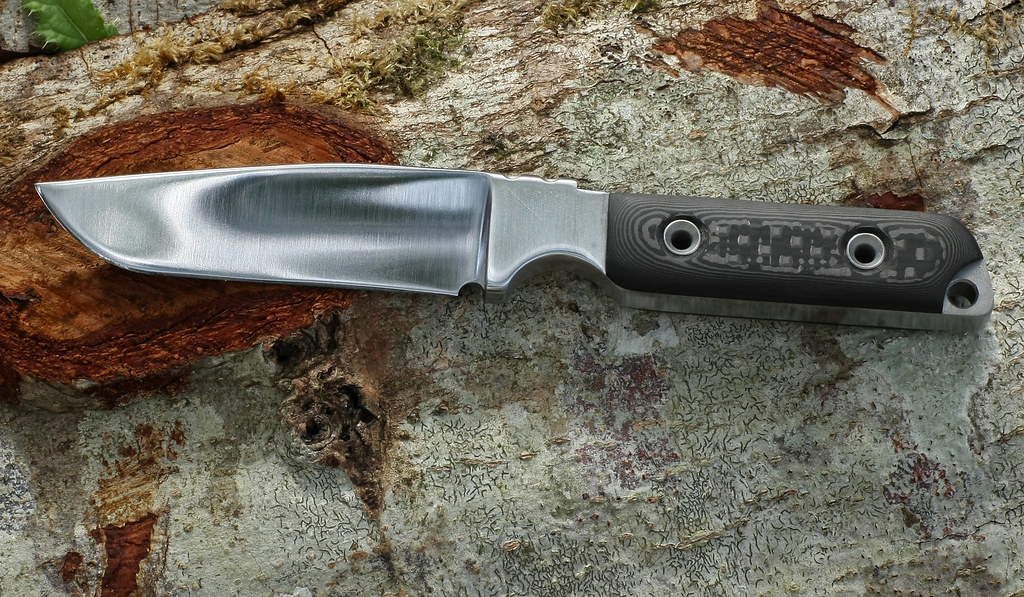
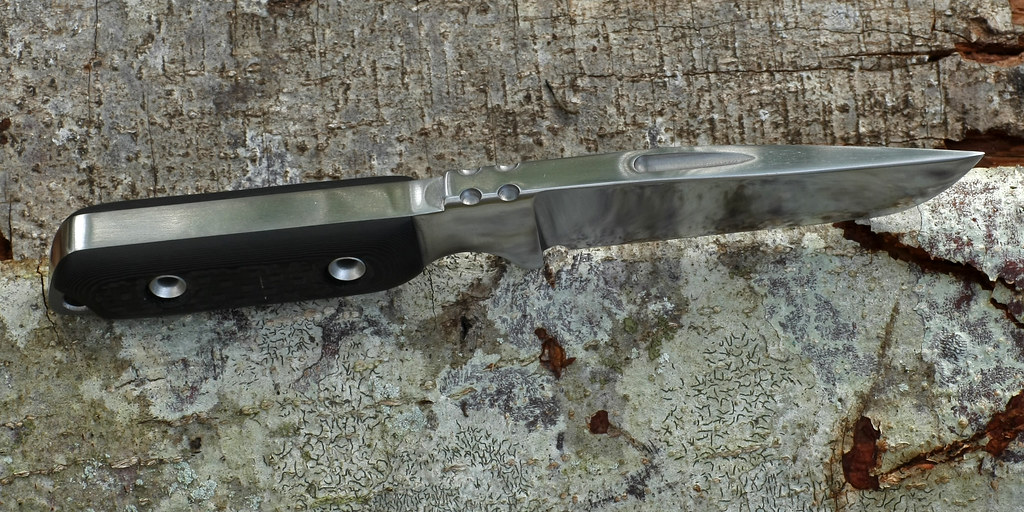
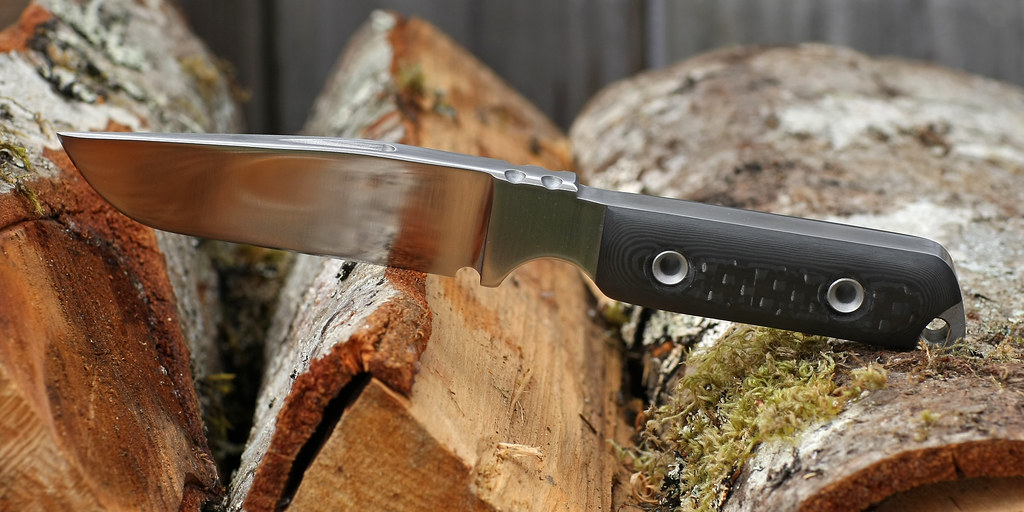
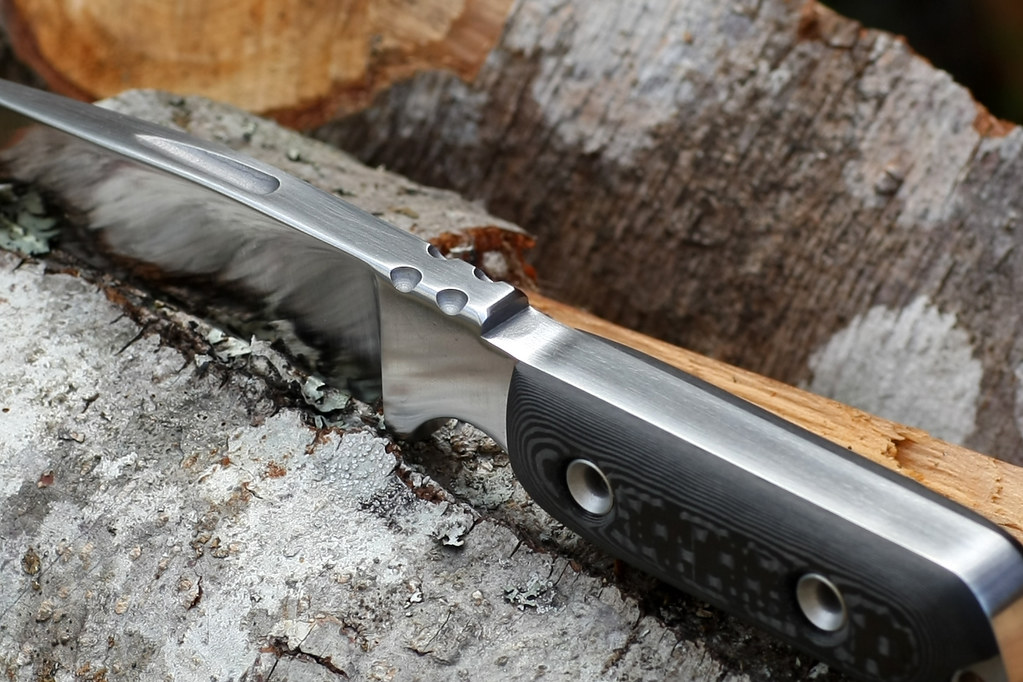
Doing it this way will give you a killer mirror polish but it is a lot of work and uses a lot of sandpaper. Take your time and don't skip any of those steps and you'll be amazed at how shiny you can make a blade. Like this:

DSC00928.jpg
 
Not the same quality finish as Garret Schmidt shows but a step up for me. It comes with a stone wash finish. Most of the final work is done by hand. This is one of my EDC knives with an S30V blade steel. Not the best picture showing the final finish.
Good luck with your endevor.
P1010003-vi.jpg


Post some pics if you can.
 
Garrett Schmidt's post is spot on... the first few times I tried this, I would start with too fine a sandpaper, and it would never come out right. Laying a good foundation with a coarse grit, then going thru to a fine finish is key in my opinion. Also, changing direction between grits, and the other advise he had is what makes it work. The only difference I have, is I don't use a hard backing... so maybe try both ways and see what works best.

tnt-user, you can find finer grits of sandpaper at most auto parts stores.

cbw
 
Thanks guys I have have pneumonia so i'll wait till the afternoon to try it.
Of course I took a picture for you.
What it looks like now.

Picture14.jpg
 
There's a thread in this forum with pictures of forced patinas. Maybe you could trade this knife already patina-ed for one of their shiny ones.
 
I'm not talking about the edge,i'm speaking of the rest of the blade in this case.
I got my dad's beaten(really bad) U.S.N Mark I and it was halfway beat to hell.
It has an edge on it now and I want to make the blade portion shiny.
I used metal glo twice and it helped alot but it doesn't really look very nice.
Is there an easy way to polish a blade?(I assume a buffer would work)

Yeah, a buffing wheel would work. If the blade is really beat up, you may want to do some sanding first to level out all the scratches and stuff.
 
Always make sure your will is up to date before using any high speed buffing wheels though. :D
Great pic, Mr. Schmidt!
 
Always make sure your will is up to date before using any high speed buffing wheels though. :D
Great pic, Mr. Schmidt!

Uh oes :confused:

Before I go and try to put a mirror finish on my Gerber Big Rock, what's so dangerous about them? Any advice you could give me to avoid losing life and limb?
 
Getting a mirror finish is much harder than just using a buffer. The metal has to be sanded absolutely smooth by using various grades of metal-cutting sandpaper and sanding blocks. It needs to be proerly sanded to 800 grit or higher before even thinking about buffing. Buffers can grab items and throw them with considerable force AT YOU!
They can cause you to cut or stab yourself, or rip off a finger. Leaning to use motorized polishing equipment takes time and concentration.
 
Last edited:
Uh oes :confused:

Before I go and try to put a mirror finish on my Gerber Big Rock, what's so dangerous about them? Any advice you could give me to avoid losing life and limb?

Most buffers that are commercially available are the half buffer/half stone grinder type. Most of those are 3450 RPMs. In my opinion that is way too fast for most buffing tasks and especially for something with an edge of any kind. Most of the makers that I know use 1725 RPM buffers or slower. Even those are probably one of the most dangerous pieces of equipment in their shops. The danger comes in the fact that if angled just a little bit wrong the buffer can "grab'' the blade and either pull it out of your hands or cause it to catch and get spun around the buffer going in whatever direction luck decides. I would suggest the slowest speed possible, practice with something a little safer than a knife blade first, and take your time. If you have done the prep steps well, the buffing step shouldn't take long at all and it definetely shouldn't take much pressure on the buffing wheel. Oh, and never buff with a sharp edge!
 
I just polished up one of my knives. It wasn't as bad as yours but it had some kydex scratches and other general use marks on it. I found a hard felt pad at Home Depot (it said hard felt on the package). They are in the isle with all the little felt thingies you put on the bottom of the furniture so it wont scratch the floor. What I bought was a 4x6in piece that has a sticky back to it. Then I stuck it on an old glass cutting board. Then I loaded it up with some MAAS metal polishing creme. Then I just worked the blade around on the pad any which way, and in no time I had a pretty shinny blade. Shinny enough that I could see myself , but I would not say "mirror" quality. Pretty darn close though with minimal effort and cost.
 
Last edited:
3978541207_ec9467b54a_o.jpg


3978541527_19c87c93a4_b.jpg


3978541921_ecc53f7b96_b.jpg


3978542887_d6defab12a_b.jpg


3979303886_9095859202_b.jpg


tnt,

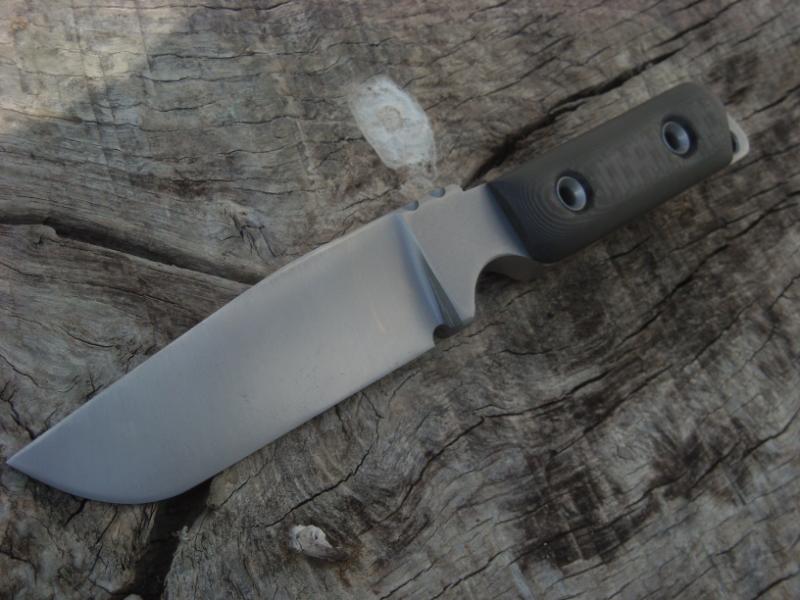
Here is an example that I did by hand. The top photo is the before shot. I stopped at 320 because I wanted a satin finish but from here just hit it with 400, 600, 800 and 1200 and finish with your polish. I've used Flitz and Mothers mag polish with mirror finish results. Also, like Garrett Schmidt stated before, you can jump to polish sooner but you will still have small scratch ridges on close inspection.

Supplies: standard sanding block, flat on one side and curved on the back. Wet/dry sandpaper in: 100, 220, 320(for satin) and up through 1200 or higher for mirror. Polish.

I use a sanding block and work it all by hand.
Start with 100 and work back and forth from spine to edge using the curved side of the sanding bock while maintaining a perpendicular orientation to the spine. You can also work around the slabs on the ricasso with the block...more on that later. Once you get it fairly even apply some masking tape to that side. This will protect it from incidental scratches while you work the other side.

Once the other side is where you want it tape it also.

Next do the spine and underside with the block, using a small piece under the handle with your fingers . I usually end with a smallish, say 3 inch piece of 100, which you have removed from the sanding block, rolled like a dollar bill and work the spine with that in a parallel rather than perpendicular orientation. This keeps the focus of the paper on the center of the spine rather than on the edges.

I should note here that you will most likely be resharpening due to paper contact with the edge.

Take another small piece of 100,again from what you used on the block already, and, with your finger tips work around the ricasso up next to the slabs.

Now do whole thing with 220 in the same order.


In the last step, using 320, try to make single strokes in one direction as you will sometimes see ''curly cues'' from changing directions.


Note, I usually have the tip of the knife, or the side lying flat on a chopping block or any piece of wood as a working surface.


Remember to tape the sides after each step to avoid unwanted scratches.

I hope this helps.

 
Back
Top