Getting the perfect polish?

Joined
Aug 28, 2009
Messages
7,951
I just found out that a friend is getting married soon, its kind of surprising because he normally goes through women like most of us go through sandpaper.

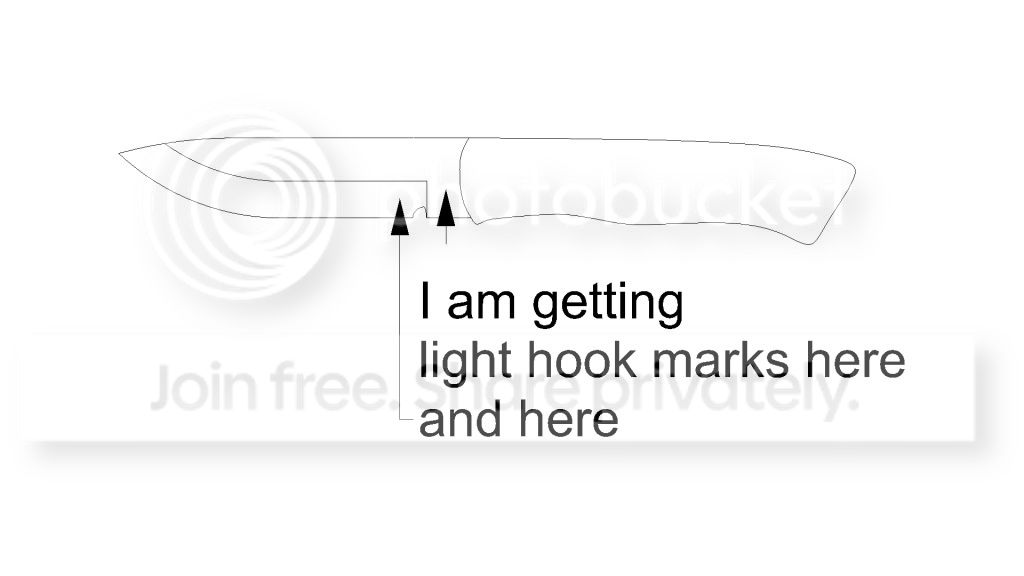
I know that he really liked the two bushcraft style knives I made, so I thought I might make him one. Thing is if I am going to do it I want it to be perfect, and I still can't seem to get the perfect polish on a blade. No mater how hard I try I still get little fish hook like smudges near the ricoso and plunge line. Is there some trick I am missing? I only sand in one direction per grit, either north south or east west, I arrange it so that my highest grit (2500) is run from from butt to tip, and I use a mixture of dish soap and water for the wet part of my wet sanding. Any help here would be greatly appreciated.

Thanks
George
 
There was a thread about using Mobil synthetic oil for final sanding and folks said with it you get no fishhooks.

Bob
 
A buffer.

Guess I should have mentioned that the marks are showing after buffing, so I am guessing that my problem is in the sanding. That or my buffing wheel or compound is wrong. I have a loose linen wheel and have been trying green AO (0.5 micron) compound. Every knife I have made to date has the same problem
 
Are you finishing the blade before or after assembly? The fishhooks you are seeing is because you have to change directions in that area thus creating the hooks. If you do not get this area fully with the next lower grit it will not come out with buffing. You need a tool that will contact the area fully. I normally finish the blade fully before I assemble the knife. This will make it easier to finish the ricasso with no fishhooks. Just do not change directions on the ricasso. The choil area is a little more difficult. You have to start in the choil and pull out in one smooth motion. It take a lot of practice but can be done. Just make sure the previous scratches are removed before moving on. The motor oil, windex, wd40, or water is not a cure all. They provide a little lube that makes the paper last a little longer but you still have to make sure you do not change directions mid stroke.
 
Yes I do my finishing before the assembly and to the best of my knowledge I am getting rid of all the previous grits scratches before switching to the next grit. From what you are saying I must be getting a little backwards motion as I am setting my sanding block on the blade. Not sure how I will fix that. I have 3 knives to finish up before I start on the wedding knife, I will have to try even harder not to back up at all while sanding. Any tips on that?
 
Last edited:
Try to start off the blade finish area. I do the ricasso by starting on the tang a pull forward. For the choil I push the backed paper into the plunge and pull forward in one smooth motion. I cut only on the forward motion. Make sure you finish to one grit finer than what you expect the final to be. Then it is much easier to go back a do a nice even stroke for that final finish with the heavier grit. If you are buffing you might need to have a couple of different grits to remove some of the heavier scratches. I do not like a buffed finish since it is so fragile that once the knife is used it is scratched badly and is difficult to repair. I prefer a nice hand rubbed finish that also can be repaired if damaged but does not look horrible if used. The buffer also has a tendency to smear the surface. This causes problems like orange peeling etc. It should be a final touch on the buffer rather than a scratch removal process. Find a stick that you can push into the shoulder area on the blade then what I do is rotate it up in the front so only a very small area contacts the blade. Then I pull it forward. Other than that it all takes practice. Once you get the hang of it is only a little less aggravating.
 
I use a sanding stick and hold it in my off hand while holding the blade in my strong hand. I put the choil on the side of the stick, not the flat and pull, then replace and repeat. When I do the flats of a blade, I place it on the flat of the stick. I find it gives me more control when sanding lenghtwise. When I sand across, I switch hands. I dont have a buffer so i can't get the perfect mirror polishes, but I do get close to mirror when I want to.
 
I am getting a mirror polish by hand in every other spot but just out side the plunge and a touch up on the ricoso. My sanding stick is a piece of scrap brass if that makes a difference.

These are the exact locations of my marks, if that helps diagnose my problem
hookmarks.jpg
 
Here is my suggestion to try. I can't say I've done this because I only make liner locking folders and don't encounter that problem produced by the space confinment.
Get some Mobile1 motor oil I use 5-30 and try a few drops on the blade with the sandpaper backed by a sharp edged stick. For hollows make yoursely a curved one. One that is an undersize curve will work well. As a matter of perhaps being able to help before that use it on your blade when doing all your hand sanding. I hope this will help and honestly believe it will. Candian Tire has Mobile 1. Frank
 
My experience has been the fish hooks appear at the back edge of your sanding block, this has happend with me on the back stroke. I start at the ricasso and pull toward me all the way off the blade. Just for the last couple of grits. A light oil such as mobil 1 does seem to help but the problem is most likely a slight change in the paper when you pull back.
 
All good advice and I will try them all.

I start one way sanding as soon as I get the scale off the blade when it comes back from HT. There is never that much so it doesn't take long to get it off. I think I ma going to have to make myself a few new sanding blocks to try and get rid of some of the drag and narrow the area I am sanding at one time. My current brass block is about 1/2" wide so maybe id I chamfer the edge and stand it up so that only about 1/8" is touching the steel instead of 1/2"
 
Some people wrap sandpaper around used planner blades to get the sharp edge right in to the ricasso. I haven't tried this myself.
 
Haven't tried planer blades yet, but I tried 1/16" x 3/4" steel for a bit and didn't like it. I went back to the 1/4" x 1" lattice slats I was using. If you change your pressure at the end of your draw that may be where the hooks come from.
 
When I do a hand rubbed finish I use a piece of stainless about 3/4 wide and 3/8 thick with bicycle hand grips for comfort. If the sanding block is to narrow you will not get a good flat surface on your blades. To narrow and it follows the highs and lows. The key to inspecting between grits to make sure you are getting out the deeper scratches is good light. I use a goose neck light with a 50 watt halogen bulb. The bright white light makes the scratches show up much better so you can clean them up. I even use a magnifier for the last inspection. You will be amazed at the difference with the halogen light. The hard sanding block is good until the last sanding when I have found that a medium hard rubber layer on a steel bar gets to the last scratches better. You may be getting the fish hooks from the back edge of the sanding block when it hits the end of the blade bevel. I have learned to tilt the back edge up just before you reach the end of the stroke and then lower it back just after you begin the return stroke. I sand on both the push and pull. Also If you do not wear glasses you should try some cheap reading glasses in a +1.5 or 2.0 just for the inspection. You can pick them up cheap at any Walmart type store. For the buffing you are on your own. The pink no scratch seems to go good after the green chrome. I just use soapy water but have tried WD-40 and Cool Tool. I will try the Mobil 1 soon.
 
I use a 10" wheel to grind the hollows and a 3/4" thick block of micarta cut with an arc of an 8" circle to place my sandpaper on. Frank
 
I try to eliminate the fish hooks by using a couple of the sugestions above. What really helped me eliminate them was to use a piece of grey Scotch Brite. Use it just like your fine grit paper; only go in one direction along with a thick lubricant.
 
I paid $30 shipped for mine, and think it was worth every single penny. I haven't taken it past 7 yet but the shaves are as close to perfect as I have gotten yet on my own
 
Back
Top