Going big

Joined
Jul 9, 2019
Messages
55
well, my interest in blade making started with my martial arts training going back 15 years.
Specifically, sword. I’ve loved training and the sword itself for years.

So, decided to jump right into the deep end :-)

That said, I’m starting with the easier end of the Japanese sword styles. Smaller and simpler.

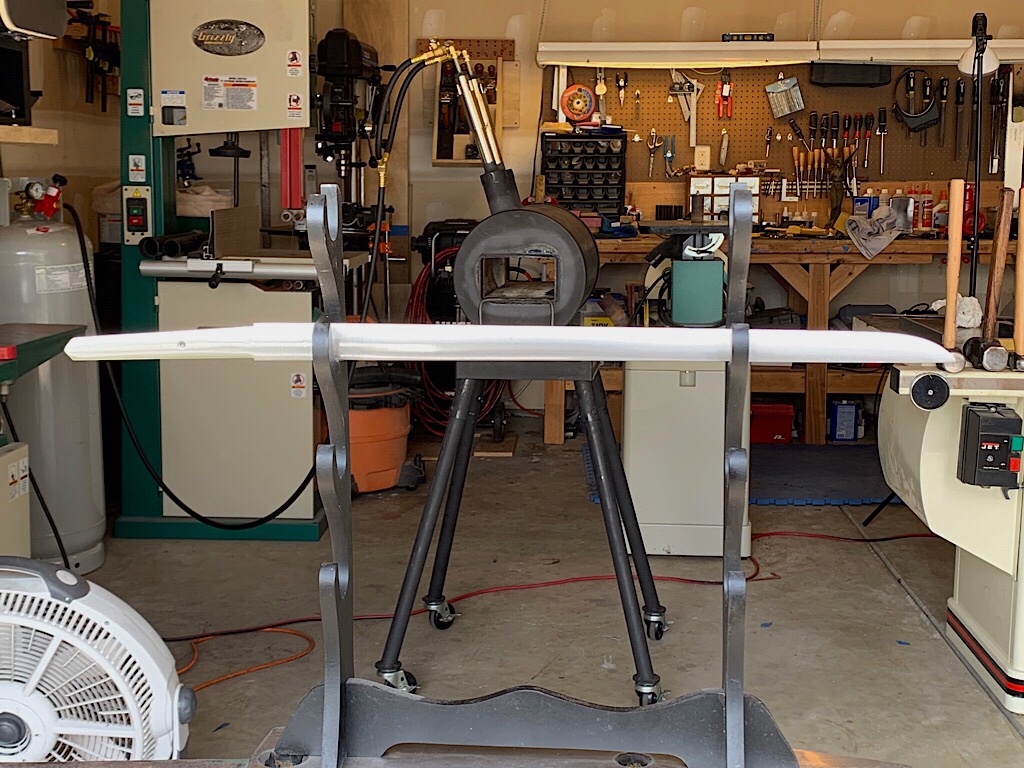
A hira-zukuri wakizashi

So, it’s shorter (20” cutting edge) and simpler (no shinogi ridge on the sides)

All going pretty well so far. Forged it from a 1 1/4” x 3/8” x 11” piece of 1095 using a 4 lb hammer for most of the drawing out, and a 2 1/2 lb hammer for forging the bevels.

It’s 98% ready for heat treatment. Broke my drill bit drilling the nakago, so I have to finish that yet, cut the machi notches and filed the ridge on mune today.

Now I have to fabricate some kind of trough for the quench. It’s too long for the bucket.

Like my chef knife, I’ll be doing an interrupted quench, first in water and finishing in parks 50.
This worked very well and produced a really nice hamon. I’m a touch more nervous about it though as I’ll be eyeballing the temp with magnet and color instead of the super accurate kiln I used for the knife, and 1095 is reputed to be picky so I’ll have to eyeball it right :-)

Next couple days will tell.

A7184FC0-093B-4937-873A-986C02E74A76.jpeg
 
Thanks, I guess my question was, how would you temper the blade if it was too long for a oven.
 
Thanks, I guess my question was, how would you temper the blade if it was too long for a oven.

Ahh, well that’s a problem yet to be resolved. I’ll have to find a solution for that when I forge a full-sized katana in the not-too-distant future.

This wakizashi has an overall length of 26” and just fits in my oven
 
My puzzle for this blade was figuring out a quench tank.

I managed to put it together from parts I had laying around. I cut up and welded together some angle iron to make a frame for cheap plastic window box. The box itself isn’t strong enough to hold the water, but with the frame and a liner of 4 mil plastic it totally works...

My welding is the ugliest, but it’s good enough for this :-)

34499968-AC49-470F-BDE8-DC103FA8DC3F.jpeg


2C7E8EDD-B109-4578-AE44-E5CC2ADE7364.jpeg


2E945A3D-AA6B-4746-9BF0-FA7372636A51.jpeg
 
That will work, but you REALLY need to put several layers of heavy duty aluminum foil lining the inside. Trust me that a 1450F blade will melt through that plastic liner and pan in a heartbeat.

You might want to set a section of aluminum gutter or a wallpaper pan in it to do even better than foil.
 
That will work, but you REALLY need to put several layers of heavy duty aluminum foil lining the inside. Trust me that a 1450F blade will melt through that plastic liner and pan in a heartbeat.

You might want to set a section of aluminum gutter or a wallpaper pan in it to do even better than foil.

I’ve considered that very thing.

With the wakizashi I’m confident I can quench it without touching the sides. The tank is 36” and the entire blade is 26” including the nakago. If I do touch the side or bottom and it melts through the plastic it’s cheap enough to replace for the next blade.

That said, I have some used pieces of heat treat foil I’ll line with just in case.

I’m going to have to come up with a different solution for a full sized katana. 36” is about the lenght of the whole blade including nakago, and a 36” blade in a 36” tank doesn’t leave much wiggle room, literally and figuratively :)
 
Lol. I misspelled the word “length” in my previous post, but when I try to correct it, it won’t let me. Apparently with correct spelling, my post is spam.
 
What many folks do is get a 12 foot length of 2X10. cut three pieces 42" long and two 8" long. Screw the three long pieces together in a "U" and add the end pieces using a few 3.5" deck screws . Once assembled, take apart and reassemble with construction adhesive in all the joints and add screws every 6". This will hold water nicely for yaki-ire. It is also of sufficient volume.
 
What many folks do is get a 12 foot length of 2X10. cut three pieces 42" long and two 8" long. Screw the three long pieces together in a "U" and add the end pieces using a few 3.5" deck screws . Once assembled, take apart and reassemble with construction adhesive in all the joints and add screws every 6". This will hold water nicely for yak-ire. It is also of sufficient volume.

Sounds like a cheap, easy solution. Wish Id thought of it before I did my welding yesterday because I'm now going to make your suggested trough on Saturday and the one I made wont get used :)

Well, I needed the welding practice anyway :)

Thanks!
 
Plant some flowers in the trough you made and set it outside the shop. Succulents are a good choice, because they survive being ignored. You will love the wooden trough. When not in use for yaki-ire, put it by the forge pile tongs and hammers in it. Putting sturdy caster wheels on the bottom makes it even more useful, BTW.

I made one close to 20 years ago and disguised it as a watering trough. It sat outside the forge. It was painted with epoxy paint to be fully waterproof. When I made a bigger steel trough, I drilled a couple drain holes in the bottom and filled it with dirt as a planter box. It is still beside the old shop after all these years. I'll take a photo if I think about it when outside.
 
Plant some flowers in the trough you made and set it outside the shop. Succulents are a good choice, because they survive being ignored. You will love the wooden trough. When not in use for yaki-ire, put it by the forge pile tongs and hammers in it. Putting sturdy caster wheels on the bottom makes it even more useful, BTW.

I made one close to 20 years ago and disguised it as a watering trough. It sat outside the forge. It was painted with epoxy paint to be fully waterproof. When I made a bigger steel trough, I drilled a couple drain holes in the bottom and filled it with dirt as a planter box. It is still beside the old shop after all these years. I'll take a photo if I think about it when outside.

Im batting a thousand today. Went and bought the 2x10x12 and promptly cut it into 48" lengths. Measuring twice (as I usually do) made no difference because I had the number 48" firmly embedded in my brain because I was just about to order a 48" length of something. If I'd measured 3 times I would have said "Yep. 48 on the nose!" and proceeded to cut.

The saying should be "read twice, measure twice, cut once"

Anyhoo, I was fortunate enough to have a 20" piece of 2x10 left over from another project so its all good. Wont kill me to have the thing be 6" longer, and a couple gallons more will take a few more minutes to get heated. By my calculations, it should hold just shy of 16 gallons.
 
Thanks, I guess my question was, how would you temper the blade if it was too long for a oven.

I believe my solution will involve a 48" length of 4" x 6" rectangle steel tube filled with canola oil and heated to 400 F.

The heat source, and method of maintaining a consistent temp for an hour is still pending....
 
You can make a heated oil tempering tank if you use the right oil and heat it properly. Use a large steel pipe quench tank that is at least 6" deeper than needed. Use high flash point oil like canola or refined peanut oil. Heat with a drum rod that hangs inside (about $250 new), or make a circulating heater from 1/2" copper tubing. Draw from the top and return to the bottom. The tubing can pass through a heating source like a HT oven with a small hole in each end. Set the oven at 400F and also put a thermometer in the oil tank. Use a small pump rated for hot oil. Adjust the HT oven temp to get the tank at 400F and you will be fine. Don't go much above 400F or it will start smoking ( around 450F).
 
What many folks do is get a 12 foot length of 2X10. cut three pieces 42" long and two 8" long. Screw the three long pieces together in a "U" and add the end pieces using a few 3.5" deck screws . Once assembled, take apart and reassemble with construction adhesive in all the joints and add screws every 6". This will hold water nicely for yaki-ire. It is also of sufficient volume.

So let it be written, so let it be done!

Truth to tell I feel a bit dumb for not coming up with this myself. Worked construction and landscape construction for 20 years and can build or fix just about anything. My initial solution was a one trick pony and not very durable. I usually do better than that.

Your suggestion was cheaper, easier, a thousand times more durable, will work for any length sword I’m ever likely to make, and simple.

My inside dimensions are 8” x 9.5” x 48”. There’s a generous bead of construction adhesive between every board, and 3” construction screws and pretty tight joints. Even so, once the glue is dry I’ll hit the inside seams with a good bead of caulk just for good measure. 2 dollar insurance against leaks.
Should certainly hold water long enough to quench

91C06E2F-5325-4ED8-A831-EB59DFA7247B.jpeg
 
Back
Top