Good morning from Canada.

Joined
Jan 23, 2014
Messages
6
I'm a long time reader but a first time poster here.

As long as I can remember I've found the idea of sharpening blades to have a completely primal satisfaction, not unlike the feeling I get from hunting, growing food, or building something useful. I've just never been willing to dedicate the time and energy into learning how to do it properly. The more I read though, the more I am coming to realize that while there are seemingly a number of hard and fast guideline to sharpening, there are also a whole lot of different ideas as to what the best way is to develop an edge.

This is the part that intrigues me. I'm not worried about having a dangerously sharp knife or ever being able to make money from the craft. I'm more drawn to the ethereal side of the craft. In watching videos of some true craftsmen plying their sharpening skills I can't help but have crazy respect and admiration for the dedication and instincts that they've developed over the years.

I've read all the "go-to" articles that I could find and I'm now onto the videos of some more highly recommended sharpeners (Pete Nowlan, Jon Broida).

I was wondering if anybody could possible answer a few questions?

- What would be your idea of the grails for sharpening form and technique information?

also to the more developed folks here who are quite confident in their craft:

- What percentage of practice vs education would you say went into the development of your craft? I'm completely ignorant to most things sharpening so if I can, I'd like to invest my time and energy into the most efficient channel.

I should clarify, I'm only interested in hand sharpening at this point. I've owned and used a few guided sharpening tools over the years and am now focused on learning and developing a hand sharpening technique.

I do have some gear on its way to me, at the recommendation of a gentleman who has absolutely forgot more than I'll likely ever know about sharpening. Kind of a good quality "starter kit".

- Naniwa Professional stones in 400, 1000, and 5000
- Atoma 140 for stone flattening
- Naniwa sink bridge stone holder

If there are any glaring commissions in the tools I have coming please feel free to point them out.

Thanks for having a fantastic wealth of knowledge here and for being willing to share it with amateurs like myself. I'm already getting the impression that the sharpening community is built on a brotherhood of folks willing to go out of their own way to help other people get on the right track, so thanks for that as well.

Kevin.
 
I too find sharpening relaxing. There is something pleasing about a well-honed blade. I use diamond hones 99% of the time as the current generation of high vanadium/chromium content steels (S30V, D2, CTS-XHP, etc.) are very difficult to sharpen on conventional hones. Diamonds are about the only material harder, so diamond-coated hones work best on those steels. I save my Black Arkansas stone for conventional high carbon blades (1070, 1095, 50100, 51200) There are lots of excellent books available on sharpening; do a Google search or have a look at your local library.
 
I'll attempt to answer a couple of them:

- What percentage of practice vs education would you say went into the development of your craft?


It is an iterative process. Read/watch videos/study -> practice -> observe your results -> figure out what you are doing right/wrong -> read/study (in light of your new-found experience) -> adapt your techniques -> practice -> observe -> repeat until happy. There will be plateaus. There will be "aha" moments. There will be regressions. There will be trial and error. If you watch a lot of videos, you will see different people using completely different techniques all getting good results. Your challenge is to figure out which techniques, or which blend of techniques, work best for you.

If there are any glaring commissions in the tools I have coming please feel free to point them out.

That is a great set of stones. I see you chose quality from the outset rather than learn on cheaper things then move up. Assuming you don't need to do any major edge repair or rebeveling, that should cover you. You can of course use the Atoma plate for that, but I personally prefer to reserve the Atoma as a stone flattener. So you MAY need to add a more coarse stone at some point.

You need a sharpie marker and a loupe or some other magnifier, 10x or better. The loupe does not have to be expensive, but needs to allow you to see the edge really well. I bought a cheap Carson brand document inspection loupe at Office Depot for around $10. There are much better options, but it helps. The sharpie is for marking the edge before sharpening so you can stop and see where you are taking off the marker. You don't use this every time, just when you are trying to learn and get the feel for the right angle of a particular knife.

I like to use a strop of some kind. My current preference is for balsa wood with a diamond stropping compound. You can buy a nice 12"x3"x2" balsa block for about $6, and pick up some diamond spray or paste for about $15-20. Since your highest grit stone is the list there is the Naniwa 5000 which is about 3 micron, you can go with a 1 micron diamond on the balsa.
 
Last edited:
I'll attempt to answer a couple of them:

- What percentage of practice vs education would you say went into the development of your craft?


It is an iterative process. Read/watch videos/study -> practice -> observe your results -> figure out what you are doing right/wrong -> read/study (in light of your new-found experience) -> adapt your techniques -> practice -> observe -> repeat until happy. There will be plateaus. There will be "aha" moments. There will be regressions. There will be trial and error. If you watch a lot of videos, you will see different people using completely different techniques all getting good results. Your challenge is to figure out which techniques, or which blend of techniques, work best for you.

If there are any glaring commissions in the tools I have coming please feel free to point them out.

That is a great set of stones. I see you chose quality from the outset rather than learn on cheaper things then move up. Assuming you don't need to do any major edge repair or rebeveling, that should cover you. You can of course use the Atoma plate for that, but I personally prefer to reserve the Atoma as a stone flattener. So you MAY need to add a more coarse stone at some point.

You need a sharpie marker and a loupe or some other magnifier, 10x or better. The loupe does not have to be expensive, but needs to allow you to see the edge really well. I bought a cheap Carson brand document inspection loupe at Office Depot for around $10. There are much better options, but it helps. The sharpie is for marking the edge before sharpening so you can stop and see where you are taking off the marker. You don't use this every time, just when you are trying to learn and get the feel for the right angle of a particular knife.

I like to use a strop of some kind. My current preference is for balsa wood with a diamond stropping compound. You can buy a nice 12"x3"x2" balsa block for about $6, and pick up some diamond spray or paste for about $15-20. Since your highest grit stone is the list there is the Naniwa 5000 which is about 3 micron, you can go with a 1 micron diamond on the balsa.

Thanks a lot for taking the time to help me, I appreciate it. Your description of the learning curve makes sense, I think I suspected that to be the case but I'm glad to hear it. It sounds to be somewhat of a "no shortcuts" progression which typically makes the journey as well as the end result more personally satisfying.

Good to know that I may need something coarser, I'll keep it in mind and revisit the idea if I find myself struggling on a specific piece. I've also not even began to explore the stropping aspect of things. I'm trying to kinda take small bites of learning so I've intentionally been avoiding certain aspects to date, stropping being one of them. I'll absolutely dive into the stropping part of things though once I feel like I have a fundamental understanding of the stones.

Thanks again.
 
The sticky at the top of the page is a good resource, as is the Seven Secrets, a very good primer:

http://www.bladeforums.com/forums/s...Secrets-of-Sharpening?highlight=Seven+Secrets


A lot of the practice was educating myself, but education without experience in this case is largely useless. You need a base level of competency to make use of some of the strategies/techniques out there. And then initially at least you have to practice often enough that any improvements you make to your technique become locked in and can be built further upon. Get a handful of cheap knives to learn on - do not learn on anything you treasure. When you treasure your practice knives for the quality of their edges, move on to your better stuff.

I ultimately came to a relatively small number of conclusions.

Your ability to mechanically hold the angle is crucial. Not necessarily to getting a good edge, but in being able to do so quickly and reliably. It is also invaluable to troubleshooting things like warps or twists. This can only be learned by practice and studying your actual hands and the tool you're sharpening and correlate to the grinding effect it is having. When studying video or photo tutorials, take note of exactly how people hold their cutlery to get max control - its a little different for everybody and one of those things few people really go into detail re the why's and not just the hows.

Muscle memory can only take you so far and then you have to be capable of feeling where you are on the edge via tactile feedback. Look for this sensation every time you work. This becomes critical when you want to branch out - muscle memory won't help you sharpen a buck saw blade or hatchet.

Your ability to match the amount of force to the operation is also crucial. One can use a fair amount of pressure early in the process, to finish it needs to be as light as possible.

Own the burr, do not try to avoid it. Learn to make one, remove one, work without intentionally trying to make one etc. All grinding produces a burr, is unavoidable and important that you understand and master it to some extent. This can have a profound effect on how well you ultimately learn to sharpen your gear.

One factor that cannot be learned in any other way than direct experience is how different steels (RC, carbide content, grain size) will react to different abrasives. Still, you can familiarize yourself with the more common cutlery steels and keep the tools on hand to deal with them. A small set of diamond plates will be essential at some point, or at least some diamond films or grit for finish work.

Your starter kit looks pretty good.

Another factor is how to finish the edge to best suit your intended task - if its a task-specific cutting tool.

Observation is the most important quality that needs to be cultivated. Stop and inspect often, make sense of what you're seeing, and make corrections based on this.

Freehand sharpening is relaxing, rewarding , and the journey never really ends.

Edit to add based on your response above:
you can get your feet wet re stropping by using paper or newspaper wrapped around a dry stone or similar. It won't have much effect on high carbide steels, but on fine grained stainless and carbon steels it works great - also shines up residual burrs so they're easier to see.
 
Last edited:
Good morning from The Wild Wild West, USA,

What we need here is perspective.

Well before we all get too "romantic" and primitive . . . and I am all about "The Zen" of doing stuff.
and
Zen is about cutting the crap and simplicity.
My perspective :
I am a metal rat meaning I have been drilling, bending, bolting and finally welding (once my parents could finally reconcile them selves to let me fool around with very, very, very . . . very hot things. Oxy-Acetalene ~6000F and TIG arc ~10,000F) since I was allowed to go outside and play in the yard by myself.

So I'm not a knife maker but I have a pretty good over view about metal and machining etc.

Most of the cutting done in the world today is done with machine sharpened edges.
There is a reason for that. They are faster to produce, the angles are exactly chosen and produced for the task at hand. Exact angles quickly produced are best done with a guide with angle calibrations.

Trying to reproduce precise "machining" if you will by hand, by feel, by eye guesstimation . . .
well it is just a waste of motion, time, abrasive, causes undue wear and so excessive stone maintenance . . . not to mention wasting blade steel . . .
why . . . it is an abomination under heaven and . . .

That said I touch up by hand, when forced to, but real sharpening happens off a guided "machine".
That can be as simple as a bit of plastic or metal stuck to the side of a blade or running on the iron cladding of a laminated Japanese blade . . . the iron drags on the stone the hard core metal feels slick if you raise up (more of a woodworking edge tool thing than knives).

Nah sharp and accurate and efficient edge production is A MACHINING OPERATION best done on a machine.

Oh and you don't need more stones to sharpen by hand just use the stones from your guided kits if you want to fool around. When you want to SHARPEN just use the guided systems.

Well it is a different perspective . . . got to keep things balanced. Yin and Yang and all that.

:)

PS : I hope some of that made some sense . . . I haven't had my coffee yet.
Coffee . . . yah . . . that's what is missing . . .
Keep it real.
 
Last edited:
Trying to reproduce precise "machining" if you will by hand, by feel, by eye guesstimation . . .
well it is just a waste of motion, time, abrasive, causes undue wear and so excessive stone maintenance . . . not to mention wasting blade steel . . .
why . . . it is an abomination under heaven and . . .

That said I touch up by hand, when forced to, but real sharpening happens off a guided "machine".
That can be as simple as a bit of plastic or metal stuck to the side of a blade or running on the iron cladding of a laminated Japanese blade . . . the iron drags on the stone the hard core metal feels slick if you raise up (more of a woodworking thing than knives).

Nah sharp and accurate and efficient edge production is A MACHINING OPERATION best done on a machine.

I end up changing the machined edges that come on most of my knives to whatever the hell angle it ends up being when done by freehand. :)
If someone asks "What edge angle are you using?", my answer is "Who the hell knows? But it sure does cut things!" :D

My real sharpening is done by hand.
With silicon carbide paper from Canadian Tire, on a granite floor tile I got from Rona.
Sometimes I use an old textbook as a backer instead of the tile...you know, making university pay off. ;)
 
The sticky at the top of the page is a good resource, as is the Seven Secrets, a very good primer:

http://www.bladeforums.com/forums/s...Secrets-of-Sharpening?highlight=Seven+Secrets


A lot of the practice was educating myself, but education without experience in this case is largely useless. You need a base level of competency to make use of some of the strategies/techniques out there. And then initially at least you have to practice often enough that any improvements you make to your technique become locked in and can be built further upon. Get a handful of cheap knives to learn on - do not learn on anything you treasure. When you treasure your practice knives for the quality of their edges, move on to your better stuff.

I ultimately came to a relatively small number of conclusions.

Your ability to mechanically hold the angle is crucial. Not necessarily to getting a good edge, but in being able to do so quickly and reliably. It is also invaluable to troubleshooting things like warps or twists. This can only be learned by practice and studying your actual hands and the tool you're sharpening and correlate to the grinding effect it is having. When studying video or photo tutorials, take note of exactly how people hold their cutlery to get max control - its a little different for everybody and one of those things few people really go into detail re the why's and not just the hows.

Muscle memory can only take you so far and then you have to be capable of feeling where you are on the edge via tactile feedback. Look for this sensation every time you work. This becomes critical when you want to branch out - muscle memory won't help you sharpen a buck saw blade or hatchet.

Your ability to match the amount of force to the operation is also crucial. One can use a fair amount of pressure early in the process, to finish it needs to be as light as possible.

Own the burr, do not try to avoid it. Learn to make one, remove one, work without intentionally trying to make one etc. All grinding produces a burr, is unavoidable and important that you understand and master it to some extent. This can have a profound effect on how well you ultimately learn to sharpen your gear.

One factor that cannot be learned in any other way than direct experience is how different steels (RC, carbide content, grain size) will react to different abrasives. Still, you can familiarize yourself with the more common cutlery steels and keep the tools on hand to deal with them. A small set of diamond plates will be essential at some point, or at least some diamond films or grit for finish work.

Your starter kit looks pretty good.

Another factor is how to finish the edge to best suit your intended task - if its a task-specific cutting tool.

Observation is the most important quality that needs to be cultivated. Stop and inspect often, make sense of what you're seeing, and make corrections based on this.

Freehand sharpening is relaxing, rewarding , and the journey never really ends.

Edit to add based on your response above:
you can get your feet wet re stropping by using paper or newspaper wrapped around a dry stone or similar. It won't have much effect on high carbide steels, but on fine grained stainless and carbon steels it works great - also shines up residual burrs so they're easier to see.

I was actually just finishing up your beginner guide in this forum while you were typing this up. :)

Thank you for sharing your insight and advise. It's very much appreciated by guys like me who are hoping to make the most of our time and energy.
Kevin.
 
I recently hooked myself up with a guided system and the edges it makes are no better performing than my freehand ones and take longer to craft. In fact when it comes to my chisels and plane irons my freehand edges outlast and outperform the ones off my wet wheel grinder - which kind of sucks because I bought it specifically to do those sorts of tools.

Keep in mind when it comes to industrial grinding, these blades perform a specific task over and over again, on the same materials, often at a pre-described angle within a range of pressure settings. Hand held cutters are a very different animal - I'd love to see a mechanically ground axe outperform one done by hand by someone that knows what they're doing.

Learn on the coarse stone, get some decent edges and progress. A generation ago folks would have looked at you like you'd sprouted a second head if you told them they couldn't get their tools truly sharp without a guide on their stone. Aside from industrial cutters and those with inherent limitations, they're really only good for cosmetics.
 
Good morning from The Wild Wild West, USA,

What we need here is perspective.

Well before we all get too "romantic" and primitive . . . and I am all about "The Zen" of doing stuff.
and
Zen is about cutting the crap and simplicity.
My perspective :
I am a metal rat meaning I have been drilling, bending, bolting and finally welding (once my parents could finally reconcile them selves to let me fool around with very, very, very . . . very hot things. Oxy-Acetalene ~6000F and TIG arc ~10,000F) since I was allowed to go outside and play in the yard by myself.

So I'm not a knife maker but I have a pretty good over view about metal and machining etc.

Most of the cutting done in the world today is done with machine sharpened edges.
There is a reason for that. They are faster to produce, the angles are exactly chosen and produced for the task at hand. Exact angles quickly produced are best done with a guide with angle calibrations.

Trying to reproduce precise "machining" if you will by hand, by feel, by eye guesstimation . . .
well it is just a waste of motion, time, abrasive, causes undue wear and so excessive stone maintenance . . . not to mention wasting blade steel . . .
why . . . it is an abomination under heaven and . . .

That said I touch up by hand, when forced to, but real sharpening happens off a guided "machine".
That can be as simple as a bit of plastic or metal stuck to the side of a blade or running on the iron cladding of a laminated Japanese blade . . . the iron drags on the stone the hard core metal feels slick if you raise up (more of a woodworking edge tool thing than knives).

Nah sharp and accurate and efficient edge production is A MACHINING OPERATION best done on a machine.

Oh and you don't need more stones to sharpen by hand just use the stones from your guided kits if you want to fool around. When you want to SHARPEN just use the guided systems.

Well it is a different perspective . . . got to keep things balanced. Yin and Yang and all that.

:)

PS : I hope some of that made some sense . . . I haven't had my coffee yet.
Coffee . . . yah . . . that's what is missing . . .
Keep it real.

Makes perfect sense. I'm not approaching this from a pragmatic position though, I'm actually looking more at the journey than the destination. I like crafts that I can spend years working on just to gain marginal expertise. I enjoy the challenge of always trying to get better at something and it seems as though the more time it takes and more hands on input on my end, the more enjoyable.

I definitely do see your perspective though! Most of my life revolves around efficiency and production so it's always nice to be able to just shut it off and enjoy a "craft".
 
I end up changing the machined edges that come on most of my knives to whatever the hell angle it ends up being when done by freehand.

I have heard tell of some companies using "laser" sharpening and some such.
Every one of the cheepy Joe knives I have, meaning $200 or so, are just sort of held against a belt sander by hand judged by eye (some times I swear the judgment of that eye is modified by some mood altering substance) and then very briefly introduced to a tired old buffing wheel before they are stuffed in a box and separated from their parents for ever.

What is this machined edge you speak of ?
And of course most all the makers put edge angles on there "designed" for use by crazed orangutans to cut through their steel cages with . . . (steep / obtuse angles no sane university educated gentle person would consider using to slice their grapefruit with).

The exception to this obtuse edge defilement are the Japanese and occasionally the Taiwanese though rarely . . . these fine people are still under the illusion that the average person using their knives have some notion of appropriate edge tool geometry and are willing to use care within the limitations of those delicate though decisively effective constraints and so sharpen to what you and I would call
it sure does cut things!-real sharpening

In other words : yah most factory edge geometry ON POCKET KNIVES is laughable and needs to be changed before attempting to open a letter or cut a thread off one's slacks.

PS: OH MY i just typed "Knifes" the Alzheimer's is kicking in more than usual today . . .
 
Last edited:
I'm actually looking more at the journey than the destination. I like crafts that I can spend years working on just to gain marginal expertise. I enjoy the challenge of always trying to get better at something and it seems as though the more time it takes and more hands on input on my end, the more enjoyable.

You've come to the right place.
These guys sure know their free hand sharpening.
You are going to have a great time putting into practice their fine points and getting great results.
 
We always do this occasionally. Not to be taken seriously by either side. It is the table pounding that counts. Shoot a volley here a volley there. Keeps the guns from seizing up at least. :)

In fact when it comes to my chisels and plane irons my freehand edges outlast and outperform the ones off my wet wheel grinder - which kind of sucks because I bought it specifically to do those sorts of tools.

This


On these


Is easily better than a lot of this. Especially whan one has a stack of edges to do all at once.


I mean just look at the cramped hands and fingers not to mention holding one’s tung just right for all that time. Six plane blades and four or five chisels ?? ? Concentration and finger strength / dexterity has got to break down. As apposed to mindlessly rolling a little roller back and forth after clicking things into place for repeatable work.

Try making a project out of purple heart or bubbinga rather than testing the blades on arm hair and then tell me the free hand is just as good.

Yes I agree though forget about the wet wheels with the leather stroppy wheel thingy and all the “grading of the wheel” from fine to coarse . . . coarse to fine. That’s just to make the manufacturer money.

Just a little roller and a clamp makes a world of diff.

Axes . . . don’t know much about those.

When I want to cut up trees and stuff I use this :

[video=youtube;T5WO9nulOXc]https://www.youtube.com/watch?v=T5WO9nulOXc[/video]
 
Don't get there.

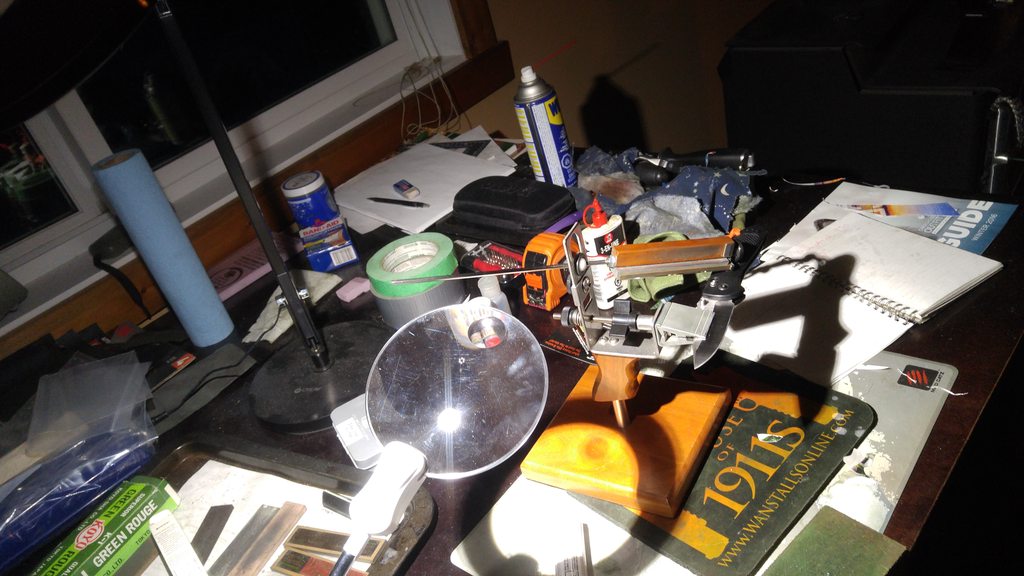
Or one day you will wake up and you got a setup like this*:*

7mnk8mGh.jpg


If you have mild OCD and a bit of time, getting into sharpening is a terrible idea. It's relaxing, it's addictive, it's rewarding and it's cheap!
I am also a reloader (long range shooting), but sharpening is far worse as an activity. There is no end in this rabbit hole, and you can address the potential upgrades and tune up much more easily.

Good luck :)
 
We always do this occasionally. Not to be taken seriously by either side. It is the table pounding that counts. Shoot a volley here a volley there. Keeps the guns from seizing up at least. :)


This


On these


Is easily better than a lot of this. Especially whan one has a stack of edges to do all at once.


I mean just look at the cramped hands and fingers not to mention holding one’s tung just right for all that time. Six plane blades and four or five chisels ?? ? Concentration and finger strength / dexterity has got to break down. As apposed to mindlessly rolling a little roller back and forth after clicking things into place for repeatable work.

Try making a project out of purple heart or bubbinga rather than testing the blades on arm hair and then tell me the free hand is just as good.

Yes I agree though forget about the wet wheels with the leather stroppy wheel thingy and all the “grading of the wheel” from fine to coarse . . . coarse to fine. That’s just to make the manufacturer money.

Just a little roller and a clamp makes a world of diff.

Axes . . . don’t know much about those.

When I want to cut up trees and stuff I use this :

[video=youtube;T5WO9nulOXc]https://www.youtube.com/watch?v=T5WO9nulOXc[/video]

I only use the wet wheel as a finer stone - still very quick. I don't use the rotary strop, finish on a waterstone or a Washboard. The biggest problem is the micro-hollow grind seems to bind more than a flat or slightly convex edge.

I've never used a chisel guide for a benchstone, but they do look like a nice widget to have around, at least to set the initial bevel. After that I'd imagine a good number of freehand touch-ups would be possible before needing to use it again. That's more or less how I do it currently - as they dull I go back to the 4k and 8k a bunch of times. At the end of a project or two if its been used heavily, I'll take it back to the 400 to make sure its squared up and with a nice flat bevel.

I should make a new video of how I approach chisels and irons. I don't think it looks quite as cramped as all that, but admittedly it took me a while to learn how to do them quickly and accurately. That goes back to my earlier statement about studying your hands and the mechanics of how one moves the item to be sharpened. And sure, some of it is just plain stubbornness with a bit of table pounding.

As far as edge quality, taking hair off above the skin is sharp by any standard and the rest is geometry and steel quality (and operator technique). Very little of my woodworking is joinery, so if I have to cut a recess in a bunch of 2x4s that are covered with drywall dust, I also need to be able to quickly bring the edge back. Is all perspective and application I guess.
 
Back
Top