
Got my first strop today and have a few questions....

Joined
Dec 20, 2011
Messages
484
Hi guys I received my first strop today a Stropman HD compact and its pretty sweet.

I have never used a real strop before only a belt. This afternoon I stropped a few knives and created a good bit of metal on the strop. My question is how loaded do you let a strop get before you want to clean it, and how would you go about cleaning a strop? A found a thread on here about cleaning them but it didnt offer much.

Another question I have is that when your stropping do you run the knife on the strop right on the bevel as you would if you were freehand sharpening or do you use a more shallow angle?

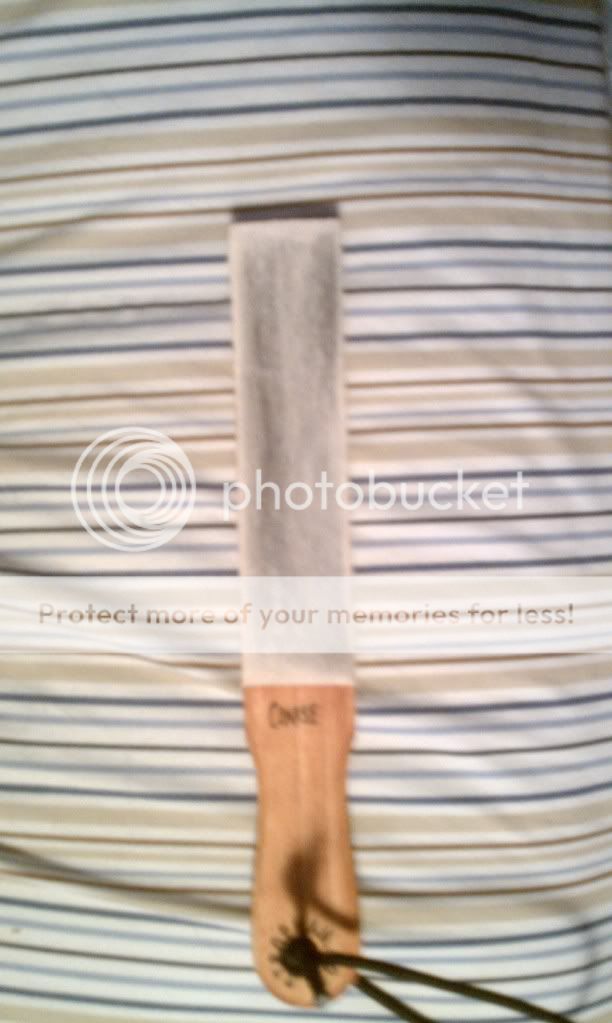
This picture attached is the picture of my strop from just the use this afternoon after stropping 3 or 4 knives. Is this amount of metal normal for the time I've used it? I'm sure it is, I just wouldnt have thought it would take off this much metal.

I really appreciate all the help guys, Im pretty new to knives and I learn SO MUCH from all you veterans. I really enjoy this forum so much!
IMAG0151.jpg
 
Probably loaded with white compound - alumina 1 to 2 microns in size. Alumina is a fast efficient cutter, this strop (or think of it as a 10K stone) will be black soon. I recommend, using balsa for compound >= 1micron, save the leather for green (CrO 0.5 <= wishful thinking) or Red (mono diamonds + dye?).
 
Probably loaded with white compound - alumina 1 to 2 microns in size. Alumina is a fast efficient cutter, this strop (or think of it as a 10K stone) will be black soon. I recommend, using balsa for compound >= 1micron, save the leather for green (CrO 0.5 <= wishful thinking) or Red (mono diamonds + dye?).

Can you explain this a little more, assume I know nothing about stropping compounds. :)
 
You can clean the strop with WD40. Let it dry afterwards then reapply your compound.
 
http://stropman.com/Stropping-compounds-Compound-Choice.htm didn't publish specs - so I repeat what I've read (in the past) in various forums about stick types, they recently added red (a.ka. finest - heck could be CrO/diamonds or (doubtfully CubicBoronNitride)).
For abrasives/compound - this link explains well: https://www.us-products.com/sitehtml/lappingabrs.html

White stick rub/dust/slurry on leather is almost equivalent to a ceramic stone with infused alumina (spyderco stone); however leather is harder to clean.

Green stick(CrO) - many sellers claim 0.5u but that likely the avg size. HandAmerican CrO 0.5u is actually the max particle size.

When Balsa is loaded with steel - chuck it or sand it down, then reload compound.
 
http://stropman.com/Stropping-compounds-Compound-Choice.htm didn't publish specs - so I repeat what I've read (in the past) in various forums about stick types, they recently added red (a.ka. finest - heck could be CrO/diamonds or (doubtfully CubicBoronNitride)).
For abrasives/compound - this link explains well: https://www.us-products.com/sitehtml/lappingabrs.html

White stick rub/dust/slurry on leather is almost equivalent to a ceramic stone with infused alumina (spyderco stone); however leather is harder to clean.

Green stick(CrO) - many sellers claim 0.5u but that likely the avg size. HandAmerican CrO 0.5u is actually the max particle size.

When Balsa is loaded with steel - chuck it or sand it down, then reload compound.

Finer- The fourth red bar as an even finer option (no cut all polish)

The clue on the red compound is in the description above (quoted from the site linked in your post). It doesn't cut, which rules out diamond, CBN, CrO, Alox, Sic (all of which do cut), but polishes only. I'm betting it's iron oxide, a.k.a. 'jeweler's rouge'. Not really hard enough to abrade most knife steels much, if at all. But it can lightly polish using powered buffers. Most 'red' compounds are iron oxide anyway (red is it's natural color), and the quoted description fits that, performance-wise.
 
Hi guys I received my first strop today a Stropman HD compact and its pretty sweet.

I have never used a real strop before only a belt. This afternoon I stropped a few knives and created a good bit of metal on the strop. My question is how loaded do you let a strop get before you want to clean it, and how would you go about cleaning a strop? A found a thread on here about cleaning them but it didnt offer much.

Strops can look mighty 'dirty' and keep right on performing as usual. If you're concerned about too much black stuff (metal) on the strop, just periodically wipe it with a dry paper towel, which will collect most of the loose black stuff from the surface. For the most part, that's all a strop usually needs. If you decide you want to clean it more thoroughly, using a paper towel moistened with WD-40 (don't spray/soak the leather with it) will do a pretty good job. Let it dry out, then re-apply some compound.

Another question I have is that when your stropping do you run the knife on the strop right on the bevel as you would if you were freehand sharpening or do you use a more shallow angle?

This 'sticky' at the top of the Maint forum page is a great visual reference for using proper angle and pressure on a strop:
http://www.bladeforums.com/forums/showthread.php/750008-Stropping-angle-plus-pressure

This picture attached is the picture of my strop from just the use this afternoon after stropping 3 or 4 knives. Is this amount of metal normal for the time I've used it? I'm sure it is, I just wouldnt have thought it would take off this much metal.

I really appreciate all the help guys, Im pretty new to knives and I learn SO MUCH from all you veterans. I really enjoy this forum so much!

IMAG0151.jpg

Depends on the compound. That 'white' compound is likely aluminum oxide, which can definitely remove metal quickly. Streaks like this on your strop look typical for that. Compare it to using Flitz or Simichrome to polish a steel blade, and look at the black stuff left on your polishing rag. Flitz/Simichrome both use the same type of abrasive, perhaps at different grit sizes (aluminum oxide).
 
:thumbup: David - very helpful post! Doh, 'non-cutting + red' would indicate the compound in red-stick is iron-oxide <= a cleaner? probably won't polish due to non-cutting.
 
:thumbup: David - very helpful post! Doh, 'non-cutting + red' would indicate the compound in red-stick is iron-oxide <= a cleaner? probably won't polish due to non-cutting.

'Cleaner' seems a more apt description for the red, at least as it applies to hardened steel. I've tried red compounds for stropping, and haven't seen any difference over using just bare leather alone (and the silicates in the leather are likely harder and better polishers than iron oxide anyway, on steel).
 
Isn't that for a traditional barber type strop and not for a strop on a board. An unsupported strop will flex greatly and conform somewhat to the edge of the blade but it is different when the strop is on a board.

Leather on wood also has similar 'give' to it, especially if the leather is relatively soft or very thick. Compare to stropping on a sponge laying on a countertop. The slightest bit of flex/softness can make the leather wrap around the edge, rounding it off. I think the string model shown in the linked thread accurately describes what the surface of the leather will do, either way. For stropping on either one (barber's or a 'leather hone' hard-backed strop), the same principles apply, with regard to angle & pressure.

Edit:
I'll add, a hanging strop can have somewhat an advantage, in that it's a little harder to compress the leather, when it's free-hanging. I've been using my belt (with green compound) more than my 'hard' strops lately, for this reason. Leather on a hard backing will compress more, if pressure is just slightly heavy, so it's more likely to wrap around the edge itself. The string model in the linked sticky does a great job illustrating that aspect.
 
Last edited:
I won't necessarily disagree with you, I just don't know how much a backed strop will flex under moderate pressure. It certainly will depend on how hard you're pressing. I've seen some people recommend that when stropping just barely let the weight of the knife carry it which shouldn't flex the leather very much but I don't know how effective that is at polishing.
 
I won't necessarily disagree with you, I just don't know how much a backed strop will flex under moderate pressure. It certainly will depend on how hard you're pressing. I've seen some people recommend that when stropping just barely let the weight of the knife carry it which shouldn't flex the leather very much but I don't know how effective that is at polishing.

With PSI of blade weigh per contact surface area (bevel edge) probably will flex balsa 0.1 to 0.2u, horsebutt leather 0.2 to 0.4u(hand waving figures). The up-flex + abrasive size(partially embeded) may effectively round/convex the edge. So, if edge apex at 1u thickness then strop on horsebutt leather with blade-weigh pressure, could yield a micro convex edge quite large angle, also smooth micro serration teeths. So, increase PSI would certainly will round your edge, unless you lower the strop angle (per - stick post string analogy). That said, I enjoy strong arms everything, consequentially I had plenty of rounded dull edges; however my bevel usually mirror polish - better look good than work good, I thought so :p!

I concurs with David's posts.
 
I won't necessarily disagree with you, I just don't know how much a backed strop will flex under moderate pressure. It certainly will depend on how hard you're pressing. I've seen some people recommend that when stropping just barely let the weight of the knife carry it which shouldn't flex the leather very much but I don't know how effective that is at polishing.

Lots of variables. Depends on how hard one is pressing, how soft the backing (leather) is, which is also affected somewhat by the thickness of the leather. Beyond that, the steel is a big factor; some will tolerate heavier pressure on a strop (D2 comes to mind, as I've been working with that today), and some won't tolerate heavy pressure (1095 and the softish steel used in Victorinox SAKs, for example; both will round over very easily, if careless on the strop). Then you throw in the compound, and that's a whole new set of variables.

My own history with stropping started with a 4-sided strop block, with the leather being both relatively soft and thick. Being that I was learning at the time, I didn't fully understand the problems I created for myself, both by stropping too much, and by pressing too hard. Once I started to figure that out, I made some of my own strops with thinner leather on oak, and began to see the difference. I periodically sanded my leather to clean it, so it got progressively thinner over time. And coincidentally, the results also improved. I then gravitated to stropping on balsa wood, which compresses even less, and therefore tolerates heavier pressure (at the correct angle, of course). I've even used the back side of my oak strop block with diamond compound, as I've continually preferred a firmer stropping surface. Now, I'm using the inside (rough side) of my leather belt as a hanging strop, used with some green compound. As I mentioned earlier, it's more difficult to compress the leather on that one, without a firm backing to press against. The net result is that it's easier to lightly 'skim' the blade across the leather, and not worry about it compressing and wrapping itself around the edge. Getting good results this way.

Edited to add:
Regarding the polishing effectiveness at very light pressure, again that depends on the compound (mostly). Stropping with metal polish, like Simichrome or Flitz (both aluminum oxide), can polish very quickly at very light pressure (I've used Simichrome on my strop, occasionally). I'm sure the same could be said for sub-micron diamond compound or silicon carbide as well. Either will cut/abrade steel very easily, so they will polish quickly at very small grit sizes. On bare leather, with very light pressure, most of what's being done is just cleaning up debris from the edge, and perhaps straightening or removing very fine burrs. Not as much actual polishing being done.
 
Last edited:
Back
Top