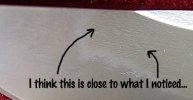
Chiro, I have had the same experience as yourself.
What is happening is you need to remember that the HR1095 is hot rolled (ie.- the "HR"). The steel doesn't come from the mill annealled. The grain you are seeing in the softer regions is sort of semi-hardened steel. I have been told it is like a bainite structure. When etched it produces an interesting texture in the hamon or temper line. You will also see it on some of the Ed Fowler / Bill Burker blades in the transition zones between the multiple quench lines because there is a wide variation in the grain development in that region.
As Nick Wheeler is suggesting, sometimes 1 normalising cycle is not enough to totally remove this effect. It disappears only after multiple normalising cycles. As Nick says, AT LEAST 3. I have found that it also disappears after a single full slow anneal. That does the trick.
I was so attracted to this type of grain for its appearance, that I have been able to partially reproduce it in the past by first
full hardening the blade with a full quench, THEN, applying the clay and making the hamon on the edge portion. The portion above the hamon would still contain portions of the grain. I don't do it any more simply because it is a LOT of trouble and I was having problems with blade warpage. (BTW, I learnt this from Bailey Bradshaw here on the forums, so its not mine...) I am also likely to be wrong in some of my terminology, as I am a very inadequate metallurgist.
Just to be sure, is this the effect you are referring to ? Sorry the link is to a 350kB pic taken some time ago. Jason.
http://www.fototime.com/9B385A1EAD81005/orig.jpg