Grandfather's Jack

Joined
Sep 1, 2014
Messages
42
Hi,

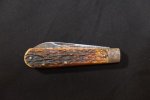
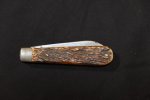
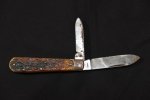
I have this old jack knife that was my grandfather's. Pretty rusty now, and the blades are nicked, but I think I will try to clean it up a bit. Not a full restoration, just a cleanup.

The only mark on it is on the main blade. There is an arrow going through the middle of these letters: V008. The arrow makes it hard to read, it could be V009 or V00S.
Below that is "USA." Closed length is 3 1/2 inches.

There is a definite half stop on each blade. There is rust on the liners, so they are not brass. One bolster is also rusty, so I'm not sure what it was made of.
My grandfather lived from 1868 to 1953, and came to the US in 1885. So it was made after 1885, but probably long before 1953. It would have been purchased in Indiana.

Any clue as to who made it, and when? I know there isn't much to go on.

Any advice on what to use to clean it up and restore it? I thought I would start with a wash and scrub in Ballistol, which has gotten light rust off for me on other projects. Then maybe Simichrome or other metal polish?

Hope the photos show, I haven't uploaded photos before.
 

Attachments

  • 1.jpg
    1.jpg
    24.1 KB · Views: 157
  • 4.jpg
    4.jpg
    35.4 KB · Views: 115
  • 5.jpg
    5.jpg
    33.5 KB · Views: 113
Welcome to the Traditional sub forum...

That's just a GORGEOUS VOOS flintrocker!!! I don't know anything in regards to the maker other then I'm familiar with the brand itself. Maybe made by another company and labeled VOOS:confused:

The covers/scales are BEAUTIFUL:thumbup::thumbup::thumbup:

Many different ways to go about cleaning but my method would consist of HOT water, a mild detergent along with a toothbrush then a good compressed air cleaning to remove ALL moisture then a number of different types of oils could be used for the joints.

Sometimes I'll fold a high grit (1,000-1,500) wet/dry sand paper to fit in between the liners snug like to aide in the removal of rust?

Regardless she's a true keepsake and enjoy enjoy enjoy!!!
 
That's in fantastic shape really. What a great knife. Those scales are awesome. I'd gently get the blades working by flushing with lots of oil. The metal parts i would use a bronze wire brush and oil to carefully scrub the rusted areas. Fine steel wool with oil perhaps. Be very careful around the scales though when using abrasives.

Slow and deliberate is the way to go. I wouldn't personally worry about making it bright and shiney new looking. Just get it working smoothly if possible and get the heavy grime and corrosion off of it. Then enjoy that wonderful keepsake.

Welcome to the Traditional forum and thanks for sharing it. Show us some "after" pics when you're done. :)
 
PLEASE, don't use any kind of sandpaper or abrasive on that knife! :eek:

It's too nice and a family heirloom to ruin by trying to "polish it up" like some I've seen ruined. At first, just try wiping it down with a rag and some oil. Any kind of oil, 3-in-1, WD-40, 30 weight Penzoil. YOu'll be surprised how much rust rubs off on an oily rag. Then, Maybe, just maybe, I'd go with some 0000 steel wool and maybe some Bar Keepers Friend. No sandpaper, no buffing. The fact is, that it's an heirloom from your grandfather, and it has a patina of many many years that tells of his carrying that knife a long way. The more you 'clean it up' the more you will destroy the history ofit.

Gently does it.
 
Exactly right. That's why I like a BRONZE brush (it's like a toothbrush basically), it's softer than the steel so can't scratch or mar it. But it does a great job or taking surface rust off steel. I use it on my guns and it works great. Just use great care around the scales as they can be damaged by anything other than a rag and oils.
 
I like ultra sonic cleaners for stuff like that. A nice bath is soapy water and then 4-6 minutes in a light oil to displace the water. Nice knife!
 
flintrocker,
Your Grandfather's folder on a scale of 1 -10 is a TWENTY, I hope You enjoy it for a long time.
The blades are a perfect combination and the scales are a real dream.
Please be careful not to get Simichrome anywhere near the scales.
Hopefully it won't be too long before someone will give You an answer on the knifes maker.
Please post more photos after a " light "cleanup.
 
flint, I agree with what others have posted above---the reference to sandpaper between the liners on my part was one where I use great caution to simply get rid of the cancerous rust---I don't go crazy that's why I use such a very fine grit. I'll use a matchstick at times and rub the rust with a cleaner of some sort as well.

I cleaned---not full blown restoration but simply cleaned hundreds of knives over the years and I guess when one does it repeatedly one forgets to express the caution needed when going about it.

Again, she's a fabulous knife and as Jeff, aka arizonaman mentioned please post some after shots as well:thumbup:
 
That's a wonderful heirloom. I'd be over the moon if I had a knife like that from my grandfather!

I agree with everyone about going slow and careful. I'd start by just flushing with WD-40 and compressed air. Just keep working the blades, and you'll get a lot of gunk out and stop any rust.

I'd advise caution on using an ultrasonic cleaner. I've used them, but there can be a risk when you have bone scales. If there's any hairline crack (one too small to see easily) the vibrations could do some damage. This is why jewelers have to be careful when cleaning opals, pearls, emeralds- anything that can have internal fissures.
 
Nice VOOS!

You can use a toothpick or something non-marring to clean any gunk on the inside of the knife. The goal, as others have said, is to stop any active rust. I like to use mineral oil on bone like that, but that is up to you.

Amazing connection to your Grandfather!
 
Rust is not meant to be on steel. It is a byproduct of moisture and air. Clean the rust off with 0000 steel wool and take your time doing it. Wash with mild soap and water, blow out the water with an air compressor and oil the joints. That is a nice knife that your grandfather passed on to you and I hope it always brings you fond memories when you carry it.
 
Beautiful VOOS! I echo what has been said - Just a gentle cleaning, no polishing compound or abrasives, no power tools.

Goins lists VOOS USA 1919-1981, and LG4 says 1923 to present (not sure when Bernard wrote that). LG4 says some were USA made (some by Empire) and some were German made. If yours does not say Germany anywhere on it, then it was made in the USA.
 
Beautiful VOOS! I echo what has been said - Just a gentle cleaning, no polishing compound or abrasives, no power tools.

Goins lists VOOS USA 1919-1981, and LG4 says 1923 to present (not sure when Bernard wrote that). LG4 says some were USA made (some by Empire) and some were German made. If yours does not say Germany anywhere on it, then it was made in the USA.

He said it had a USA tang stamp.......
 
Use a rag and some oil to clean it up. Don't polish it too much or it'll lose some of the character of the blade.
 
It is not unheard of to have the USA tang stamp to mean USA based brand, but made elsewhere. I think VOOS USA was the brand name.

That's really interesting. So back then just as now, companies were getting creative about hiding the import country of origin. That reminds me of the Made in China brand "Sheffield", or Boker having a "Solingen" line made in Germany, but the "Germany" line is made elsewhere and assembled in Germany.

That's a beautiful old knife that was obviously cared for. If it were mine, I'd use a 100% cotton cloth and oil to clean it. Maybe a toothbrush and oil for really stubborn red rust. A bamboo skewer works well for cleaning in the knife slot. A drop of lemon oil on the handle if the bone looks dry, but not to much as gobs of oil can soften bone over the years. Good luck and post back photos of the completed project, please!
 
Thank you all for the information and enthusiasm. I am amazed at the information about Voos that came out, and I have a new respect for this old knife. I will try to follow the advice offered. Tonight I started rubbing some oil on the metal parts to begin the cleanup. I can see this will take a while, but I will post a picture when I am done. Thanks again for your help.
 
Back
Top