I've been following the post by Fausto, on getting his first American traditional knife pattern, and I couldn't help but think back to all my encounters with European knife people and what they carried.
I was fortunate in my army career, before it got cut a bit short, to have served on four different continents and working with some very varied culture people. England, Germany, a short TDY stint in Libya at the Wheelus Air force base, Southeast Asia, although I'd like to forget that one, and here in the U.S.
While I was in the engineers, it was the kind of job that had us working closely with the civil engineers in different places. No matter if we were pouring cement for a runway extension, or buildings for a base renovation. Construction guys are the same all over, no matter if the guy over there in muddy work boots and coveralls is a German guy named Klaus, or a Arab guy named Mustaffa. And all working guys the world over pick similar stuff to see them through the day on the job.
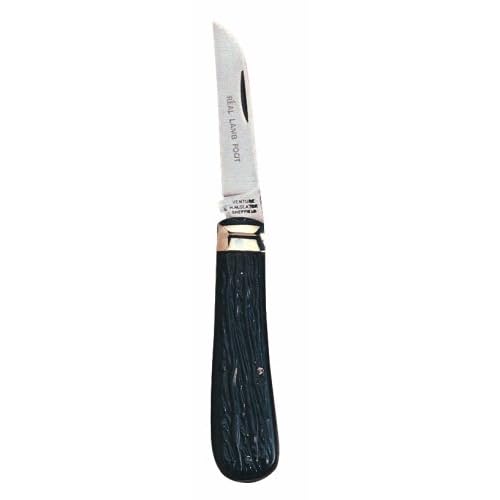
Fausto is looking for his first multi blade American knife. The irony of it makes me think about the fact that I never saw a pocket knife as we would call it, in all my time over seas. In Europe, I saw a lot of old well used wood handled sodbusters like Herters, Kissing Krane, Eye-Brand. Lots of Opinels, Douk-Douks, Mercators, Laguiole's of a few different makes, Nontron, Linder's, and some other brands. All simple single blade folders of various sizes. The only multi-bladed knives I ever saw were the red handle sak's. Except for the German engineers we worked with, they had the alox Victorinox or Wenger soldier models.
I know that Sheffield made all kinds of multiblade pocket knives for the gentleman trade, and for export. But I wonder if the bulk of working men all over the world, use a plain old single blade knife like a soddie. Traveling on four continents gives one a perspective on things. I don't know where all those 4 plus bladed knives from Sheffield went, but I wonder how much was for the American trade and home grown gentry. I have to wonder what did the working stiffs in England do for a knife? Guys like a cab driver in London, a sailor on a merchant ship, or even a soldier shipping off to one of the colonies to keep peace in India or the America's?
I grew up in a country where the two blade jack was king. But in 1963, Buck introduced the 110 folding hunter, and knifedom was never the same since. It seems as if the two and three blade jacks and stockman of my boyhood have been like the buffalo, driven almost to extinction by the new age folders that can be produced much faster and easier. Buck with all their single blade lockblades, Spyderco, Benchmade, Gerber, Cold Steel, and the rest all seem to offer a wide range of single locking blade knives. Many people who see my knives are always a little shocked at how the blades don't lock open. The knife market is so inundated with the new age modern folders that some people don't even know the old ones are still being made. I had one person say to me "Boy, that must be a real oldie. They sure don't make them like that anymore!" It was my Case peanut. He was even surprised Case was still in business. Sure, there are the boutique knife companies like GEC, that turn out beautifully fitted knives with price tags that make you think twice before opening a bag of cement or stripping some wire with it. But in the overall numbers of production, they count for a small fraction of sales in the knife world. The single blade locker is king now, and we're but a minority. Except for sak's.
I guess in Europe things still remained simple, with knives like Opinels and Herters being the choice for the working man who just needs to cut something. I never saw a single stockman, canoe, trapper, or any other of what we call traditional here in the U.S. I can only wonder if it's a case of the grass being greener on the other side of the hill, or just a different culture where knives are looked at in a different way. I've seen few knives as elegant as some of the knives from Corsica or Sardinia, or Italy.Those flame shaped blades are artful and exotic to my eye. But I guess if that's what you're used to, maybe a copperhead or barlow is the exotic one.
I guess greener grass is in the eye of the beholder.
Carl.
I was fortunate in my army career, before it got cut a bit short, to have served on four different continents and working with some very varied culture people. England, Germany, a short TDY stint in Libya at the Wheelus Air force base, Southeast Asia, although I'd like to forget that one, and here in the U.S.
While I was in the engineers, it was the kind of job that had us working closely with the civil engineers in different places. No matter if we were pouring cement for a runway extension, or buildings for a base renovation. Construction guys are the same all over, no matter if the guy over there in muddy work boots and coveralls is a German guy named Klaus, or a Arab guy named Mustaffa. And all working guys the world over pick similar stuff to see them through the day on the job.
Fausto is looking for his first multi blade American knife. The irony of it makes me think about the fact that I never saw a pocket knife as we would call it, in all my time over seas. In Europe, I saw a lot of old well used wood handled sodbusters like Herters, Kissing Krane, Eye-Brand. Lots of Opinels, Douk-Douks, Mercators, Laguiole's of a few different makes, Nontron, Linder's, and some other brands. All simple single blade folders of various sizes. The only multi-bladed knives I ever saw were the red handle sak's. Except for the German engineers we worked with, they had the alox Victorinox or Wenger soldier models.
I know that Sheffield made all kinds of multiblade pocket knives for the gentleman trade, and for export. But I wonder if the bulk of working men all over the world, use a plain old single blade knife like a soddie. Traveling on four continents gives one a perspective on things. I don't know where all those 4 plus bladed knives from Sheffield went, but I wonder how much was for the American trade and home grown gentry. I have to wonder what did the working stiffs in England do for a knife? Guys like a cab driver in London, a sailor on a merchant ship, or even a soldier shipping off to one of the colonies to keep peace in India or the America's?
I grew up in a country where the two blade jack was king. But in 1963, Buck introduced the 110 folding hunter, and knifedom was never the same since. It seems as if the two and three blade jacks and stockman of my boyhood have been like the buffalo, driven almost to extinction by the new age folders that can be produced much faster and easier. Buck with all their single blade lockblades, Spyderco, Benchmade, Gerber, Cold Steel, and the rest all seem to offer a wide range of single locking blade knives. Many people who see my knives are always a little shocked at how the blades don't lock open. The knife market is so inundated with the new age modern folders that some people don't even know the old ones are still being made. I had one person say to me "Boy, that must be a real oldie. They sure don't make them like that anymore!" It was my Case peanut. He was even surprised Case was still in business. Sure, there are the boutique knife companies like GEC, that turn out beautifully fitted knives with price tags that make you think twice before opening a bag of cement or stripping some wire with it. But in the overall numbers of production, they count for a small fraction of sales in the knife world. The single blade locker is king now, and we're but a minority. Except for sak's.
I guess in Europe things still remained simple, with knives like Opinels and Herters being the choice for the working man who just needs to cut something. I never saw a single stockman, canoe, trapper, or any other of what we call traditional here in the U.S. I can only wonder if it's a case of the grass being greener on the other side of the hill, or just a different culture where knives are looked at in a different way. I've seen few knives as elegant as some of the knives from Corsica or Sardinia, or Italy.Those flame shaped blades are artful and exotic to my eye. But I guess if that's what you're used to, maybe a copperhead or barlow is the exotic one.
I guess greener grass is in the eye of the beholder.
Carl.
Last edited: