
Grind Line Problems

Joined
Jun 3, 2016
Messages
14
I'm just starting knife making and I'm having some problems with my grind lines doing what I call a "smiley face". The grind at the plunge line is too high. I can't seem to figure out what I'm doing wrong there (too much pressure, wrong angle, etc. It's worse on my weak side. Any help would be appreciated.
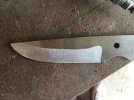
IMG_1062.jpg
 
Too much pressure and too much torque at the plunge line area. Concentrate on putting pressure more towards the tip with your other hand (the one further away from the plunge line) this will grind in distal taper at the same time and fix the issue you've got going on there.

Stay out away from the plunge for the next few passes until you get the rest of the grind caught up to what you've already ground near the plunge line. As you get it dialed in, you can always use light passes and finer grits to even and blend everything together.
 
I'm by no means very experienced, but in my limited experience guide lines have helped me tremendously. I'm not sure if the terminology is correct but it looks like heel of your blade is creeping up towards the spine. I'm not sure if that is in your design, but if not guild lines on the edge will help you prevent that from happening.
 
I'm by no means very experienced, but in my limited experience guide lines have helped me tremendously. I'm not sure if the terminology is correct but it looks like heel of your blade is creeping up towards the spine. I'm not sure if that is in your design, but if not guild lines on the edge will help you prevent that from happening.

Can you clarify what you mean by guide lines?
 
In addition to what John said, make sure you are not pushing the tang away from you as you approach the plunge line. If you use a work rest when grinding draw a line parallel to your platen or contact wheel just in front of your blade, this will help to determine where straight is.
 
Teach yourself to bring the blade to the belt at the tip and just rearward of the tip and grind this area until the :) disappears. Its easy to get into the habit of looking at the blade being ground as "left side bevel" and "right side bevel" Section the bevel up and teach yourself to apply pressure in the areas where you want to remove steel.
The only difference between a skilled grinder and a novice, is control. The ability to remove metal where desired.

Enjoy, Fred
 
Looks like you're pushing the plunge side of the blade into the corner of the belt a little bit. You generally want to keep the pressure even across the whole width of the belt. If you lean the blade to one side of the belt/platen/contact wheel, you'll see more material removed on that side. Using worn belts can sometimes give a similar result if the grit is worn off of one side more than the other.

Fortunately, you can fix this, as you've still got plenty of steel to work with. It just takes practice. Use a fresh belt, and watch where your sparks are going.
 
Teach yourself to bring the blade to the belt at the tip and just rearward of the tip and grind this area until the :) disappears. Its easy to get into the habit of looking at the blade being ground as "left side bevel" and "right side bevel" Section the bevel up and teach yourself to apply pressure in the areas where you want to remove steel.
The only difference between a skilled grinder and a novice, is control. The ability to remove metal where desired.

Enjoy, Fred

Fred said it perfect. You will run into other issues along the way like tips being too fat, one side being ground at a different angle than the other, etc etc. The key to all of these is being able to direct the blade so that it contacts the belt in a way that removes the steel from the area that is in a surplus. For me, it just comes with practice and experience in how grinders work. Keep a conscious effort at all times at the pressure you are putting on the blade as it moves through the belt surface, and how square the blade is in every dimension. What makes a great grinder is the ability to get this right and repeat it exactly the same with every pass.

Just keep at it. Practice makes perfect.
 
It's tempting to push hard against the grinder when grinding. Try using light pressure and watch where the sparks are coming off the belt. It doesn't take much to put too much pressure on just one side of the belt and your grinds won't be even. You want the sparks to come off the middle of belt or at least evenly from both sides.
 
Yeah I'm sure I'm pressing to hard at the plunge line especially because I'm trying to establish the line.
 
Yeah I'm sure I'm pressing to hard at the plunge line especially because I'm trying to establish the line.

Don't do that.

Start about 1/4" ahead of where you want the plunge and do some grinding on the bevel. When you get to the height you want, then gently start where you want the plunge and gently start with a gently sweeping motion take small grinds forward until you get to the original bevel, keep doing this until you get a nice smooth sweeping plunge. You are not trying to get a 90 degree angle at the plunge line, you want a small radius.
 
colour your bevel with a sharpie, and lightly grind,check, grind,check,grind…….. this way you can see where you need to apply different pressure. eventually you'll develop a method that works.
 
Patience helps, just like when you're learning to drive you go slow, when you're learning to grind and having an issue like this you can go to a finer grit and just take your time until you have a better feel for it.
 
Back
Top