Grinding Bevels - Baffled!

Joined
Oct 4, 2011
Messages
1,043
I gave my first try at grinding a knife for the first time yesterday. Learned a few really good things.

I am not that patient, especially when my grinding is not going the way I want. Using a fresh belt was an epiphany moment; I was trying to flatten with a worn belt and it was going absolutely nowhere... Belts actually get worn kind of fast, at least from what I was doing, and from what I could tell.


Now, I got everything good, and then tried to go grind a nice clean bevel. Didn't work the way I imagined, at all. Every time I made a pass, I introduced several new angles. I tried as hard as possible to keep the angle the same, using reference points on the work rest, etc. Tried edge up, edge down. Switching to the other side of the blade I had to go left handed, and it made everything that was already bad worse.

ONE THING that really makes it difficult for me is the tip area. I really change the angle here too much, and then start grinding in burrs eventually, changing the profile and everything of the blade. I'm trying to account for the slight raise in the tip, but every time I go to do so, I account for it too much.

Any tips? I'm going to keep practicing, but I appreciate any input. Thanks!

p.s. I don't have any variable speed options. The grinder just goes fast, and that's it.
 
I'm assuming that you're flat grinding.

Once you get a bevel you like on part of the blade try to go slowly and gently and feel that bevel
against the belt before pressing harder and expanding the area of the bevel until it covers the
whole side of the blade evenly.

General advice is to start with a steeper bevel evenly across the blade then make it shallower in
steps. That is the idea way to do it but what I suggest above can be a useful technique to get
things working again.
 
I too have a grinder with no speed control. It is a steep learning curve but it can be done. Remember, the only controls you have are angle and pressure. Here is how I do it. Not saying its the only way, just how I do it. Mark 2 lines anywhere from .015-.040 apart (depending on the steel type and intended use of the knife) down the edge of the profiled blade. With an old 50 or 60 grit belt I grind a 45 degree bevel down to the scribed lines. This reduces the shearing effect on a new belt when you start grinding bevels. Put on a new belt and start grinding edge up. Make a few light passes until you get a flat on the blade. After you get a flat established use pressure to move the flat up or down. If you need to move it toward the spine apply the blade to the platen until you're sure its flat then apply most of the pressure toward the spine and "walk" the bevel up toward the spine. If you need to "walk" it toward the edge then apply most of the pressure toward the edge. As for the tip, remember to keep the blade flat both vertically and horizontally and the tip will basically take care of itself. Like I said, there is a pretty steep learning curve but you can do it. Remember no matter how bad you mess up a grind it should still make a usable tool for the shop. As long as each blade is better than the last you're making progress. Hope this helps and good luck.

Darrin
 
You might also check out a few of the links in the stickies and others. Salem Straub's site has some good stuff as well: http://www.prometheanknives.com/shop-techniques-3/grinding-tips

The push stick is very helpful. Fred Rowe's bubble jig might help you out as well.

Darrin suggested that I use files to refine mine, and that's helped a lot. Flat grinds are definitely harder to do than you'd think.

The one tip I've found most useful so far is gripping the tang fairly loosely on later passes, so the blade can settle where you need it to grind. That does seem to help keep the angles for changing as much. Keep it up; I'm sure enjoying my learning attempts, and Darrin and others have been very very helpful.
 
On a fixed speed grinder, I've used fine grits to slow things down, like 400 or 600 or 800 grit.


Which grinder are you using ?
 
Last edited:
Got to keep in mind also that it only has to be flat and pretty after the last pass, not the first few. As you get closer to your finished bevel, you have a wider flat area to index against the platen, so it actually gets easier to feel the flat as you go. That said, there is a learning curve and it is technically possible to screw a blade up even when you think you have the hang of it.
 
People keep saying it's harder on a static-speed grinder; What is the benefit of using a variable as it pertains specifically to flat grinds or keeping your angles consistent?
 
Don Nguyen
Frustrating, isn't it? However I think you're right where you should be, considering that this was just your first attempt. I wouldn't be real concerned yet. My first belt grinder was a hand held belt sander (for wood), that I held it in my lap for grinding. This was sooooo much better than using a file that when the bearings burnt out I bought a Sears 2X42. I thought for sure that I would see nice flat, even grinds using it. In a pigs eye! If anything my grinds were WORSE than before. It took a couple of blades to adjust to the new grinder and get back up to my previous level. You have to learn the machine and it takes time for that to happen.

This undefined previous level of grinding skill I mentioned earlier was not very good, maybe a 2 or 3 on a 1 -10 scale and I wasn't seeing any improvement. I bought a bubble jig and figured that NOW I would see the flat grinds going high up on the blade. That didn't happen. In fact I didn't see noticeable improvement until the third or fourth blade. Of course using the bubble to help you find the proper angle is a big thing, I made a few other discoveries along the way.

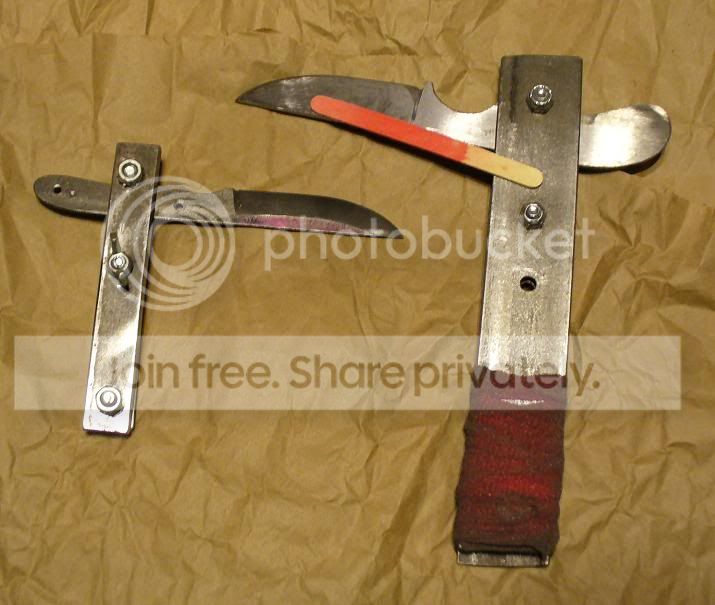
I think it is difficult for me to "feel" the angle of the blade as I ready it to push it onto the grinder. I made a blade holder that sticks out about 6 - 8 inches. This gives me a little more to hold onto and it's also helps me to visually see the angle of the blade in relation to the grinder. The blade holders were supposed to be grinding guides but I use them only as blade holders.

I also realized that I was rushing to make the grinds because I was afraid of getting burned by the steel as it heated up with the grinding. I was using the typical aluminum oxide belts from sears. I used some GOOD belts for the first time this summer and that was a real eye opener. They work so much better at removing steel and don't heat up the blade as quickly. A second thing I did to not fear a hot blade was to try using a push stick. It didn't work out so well for pushing on the blade but it ended up being a place I could place my fingers to push the blade against the belt. Now I don't have to rush and I can be more careful. The Popsicle stick on the large blade holder below is what protects my fingers from the heat.

bladeholders.jpg


I'm also finally developing a soft touch and am better able to find the flat spot as Mr Sanders described. It's really tough when the belt is going a billion miles per hour.

It takes time to learn how to use your tools. What works for me may not work for you. Do what you can with the grinder then finish up with files. You will have saved a ton of time from doing it all with files, and you will see improvement with each blade you grind.

- Paul Meske
 
You make mistakes slower at slower speed. This is not a joke.
Amen


On the Wilton, you can set the platen angle at the angle you want 2 to 3 degrees or so ?
You can nail that down with calculations or trial and error.


Then put a long extension on the toolrest left to right.

Then clamp your stock to some square stock and slide it back and forth on the toolrest.

You can keep the angles consistent this way.

Some call it cheating, but it's all about results.


You can practice on paint sticks or similar wood - keep the same thickness and width.
 
Thanks Dan, that's what I thought the answer would be. A lot more room for error when its not ripping off as much metal so quickly.
 
Back
Top