Grinding direction (does it matter)

Joined
Nov 29, 2011
Messages
1,396
Hey everyone, I am still working on a couple of knife blanks that I got from Gene but am interested in working on my own blade for the next project. Ive got some L6 on the way from the baron. Dont have any capable HT options right now so it will have to get sent off, dont think that should be an issue with this steel to find someone able to HT it properly (I hope).

I have been reading tons of info and have the process down I think, work out a pattern in wood or similar first, mark it out and cut the steel to rough shape. Grind it down to final shape, then grind the blade but leave the sharp edge somewhat thick to keep it from warping during HT. When it comes back dress it up and finish everything.

My question is most of the grinds on the blade portion I see go up and down perpendicular to the knife. For some reason I was thinking that you want any visible marks in the blade to go parallel to the blade overall. Is this true or am I mixing info up on myself. I assume all of this wouldnt matter at all if you go to a highly polished finish anyways.

Thanks for any help,
 
Spine to edge is machine finish.
Ricasso to point is a hand finish.
I prefer the looks of a hand finish.
You can even do both if you like, finish the flats spine to edge end the bevel ricasso to point.
 
Hengelo is correct.

Peters' HT can heat-treat your oil- or air-quenched blades. :thumbup: They specifically list L6.
 
Once past the deep scratches, the direction is not really an issue with HT

Any deep lines or grooves that run from thin to thick ( edge to spine 90° plunge line) or make a sharp angle ( 90° corners at the tang) can be a source for stress riser cracks. That is why we advise against to make any transition a curve instead of an angle, and to sand the blade to at least 220 grit before HT. After HT you can do pretty much what you want as far as cosmetic sanding, but should still avoid any sharp angles along the blade edge and at the ricasso, as these can be the point of failure if the blade gets any lateral stress.
 
After Heat Treating and then final grinding to 240 grit, I will give my blades a hand rubbed finish. This can be accomplished quite easily if you set yourself up for success. Do your best to grind the blade smoothly, and avoid gouges/divots...lots of practice. Once your blade has a nice even grind, the hand rubbing can be done, and if you've created a nice even grind, it will be a mater of an hour till she is looking beautiful.

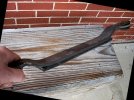
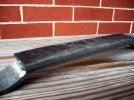
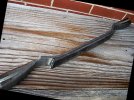
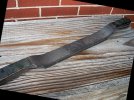
Check out my custom made jig for hand rubbing....DSCN1464.jpgDSCN1463.jpgDSCN1462.jpgDSCN1461.jpg

This "Jig" if you will, is nothing more than a piece of "Poundo Board" available from Tandy Leather...
http://www.tandyleatherfactory.com/en-usd/home/3461-151.aspx

I cut a piece 2" wide and affix it to the metal "Jig" with sticky adhesive. Then I simply use old 2" X 72" belts (also with adhesive) and rub out a finish. I start with 120 grit (1 grit lower than I used on the grinder) and rub all the scratches out. I usually don't have belts higher in grit than 400, so I'll switch to 9" X 11" wet sanding paper and take her up successively through the grits to 1500 or 2500. (I clamp the blade to a board with a wooden template matching the blades profile sandwiched in-between the blade and the board. I also lubricate the blade with Dawn aDish-washing Soap and water mixture....I like to think of this a cleaning out scratches....kinda smells clean to. Don't worry about rust....just make sure its all dried off when you complete the sanding.

When you are finished sanding one side, simply flip the blade and template over, tape the finished side to protect from inevitable scratches, and then rub the other side.

You will be amazed at the results this simple operation can produce. :)

Have Fun,

Bobby
 
Thanks a bunch guys, sorry about the terminology I am new to using the correct terms to describe all the parts of a knive and what not. Just getting into this stuff.

Ill give those guys a try when I get to that point unless I can find someone a little closer to my side of the country. Would love to find some local business that does HT but no luck yet.

That jig and setup you described looks like a great idea. Ive been hand finishing my two knives I am working on with small blocks wrapped in my varing degrees of sandpaper. Takes alot longer though. Looks like with that jig you can set it up and just go to town on the blade.
 
I put a ricasso to point finish on my blades using a 9" tall pyroceram platen and scotchbrite/non woven belts.

No matter how hard I try I get fish hooks with sandpaper. I have given up on handrubbed. I made a sanding base with a hardboard guide to keep my block parallel to the blade but I am still having problems. I would love to finish with the 1000 grit by hand but the fishhooks are bumming me out so I think i will leave the scotchbrite finish. Maybe I need a longer sanding block like bobby shows above.
 
I was hand rubbing all of my blades for a while but for the most part all the customer / potential customers have been preferring/requesting a belt finish. I like the look of belt finish myself too.
 
I was hand rubbing all of my blades for a while but for the most part all the customer / potential customers have been preferring/requesting a belt finish. I like the look of belt finish myself too.

I like the machine finish for knives that are actually being used. I feel bad when a maker spends hours doing a hand sanded finish and then it is ruined in 2 seconds once it is used to actually cut something that marks up the blade.
 
Ernest, I find that fish hooks are from stopping/starting your sanding pass with the paper already on the steel, or changing direction with the paper still on the steel. I don't worry to much about them until I get to my finish grit. Then, once I have the last grit mostly done (no rougher scratches left) I only sand one direction, and I start using a leather-backed sanding bar. It takes a minute to get the 'hooks out, but it's not that hard.

It can be challenging if you start your single-direction passes with the paper on the steel. Lots of times, that paper will get moved just a slight bit sideways as you begin to pull it down the knife, and there's new 'hooks.

I try to either bring the paper down slow and put it on the steel with no wobble, then start accurately, or bring it onto the steel while it's moving in the direction it will be sanding.

Another thing that will happen is you'll get a fish hook pattern one sanding block width away from your plunge, from changing direction repeatedly in the same spot, or starting repeatedly in the same spot. It can help to put one edge of the block down first at the plunge, then with the block moving, bring the other edge down slow to avoid that same spot.

Sorry if this is thread hijack, I figure it's sanding related anyway. With some knives, folders and hollow ground especially, I'll have the flats sanded lengthwise, and the bevels machine finished.
 
No hijack at all Salem, all good info.

Avigil I see your point, I think I am always reverting back to how I maintain my leather working knives. Those are shiny as all heck including the sharpened edge, but those also are used for one thing and thats to cut leather and hopefully not get dropped. I think I will have to change some of my mindset as far as it goes for general purpose knives.
 
Ernest, I find that fish hooks are from stopping/starting your sanding pass with the paper already on the steel, or changing direction with the paper still on the steel. I don't worry to much about them until I get to my finish grit. Then, once I have the last grit mostly done (no rougher scratches left) I only sand one direction, and I start using a leather-backed sanding bar. It takes a minute to get the 'hooks out, but it's not that hard.

It can be challenging if you start your single-direction passes with the paper on the steel. Lots of times, that paper will get moved just a slight bit sideways as you begin to pull it down the knife, and there's new 'hooks.

I try to either bring the paper down slow and put it on the steel with no wobble, then start accurately, or bring it onto the steel while it's moving in the direction it will be sanding.

Another thing that will happen is you'll get a fish hook pattern one sanding block width away from your plunge, from changing direction repeatedly in the same spot, or starting repeatedly in the same spot. It can help to put one edge of the block down first at the plunge, then with the block moving, bring the other edge down slow to avoid that same spot.

Sorry if this is thread hijack, I figure it's sanding related anyway. With some knives, folders and hollow ground especially, I'll have the flats sanded lengthwise, and the bevels machine finished.

My knives are full flat so it is quite easy to put the brushed finish with scotchbrite. I will try Salem's for my 600-1000
finishing passes, particularly going one way. If I start over anymore I'm afraid my knives will actually disappear as they are thin to begin with!
I have found though that if i get hooks with 220/240/280 then my higher grits never take them out effectively. I think they are one sanding block away from each end. I may just go with felt and cork polishing belts to refine the scotchbrite finish a little.

Quint, appreciate the tolerance of this mini hijack.
 
Back
Top