Grit vs grit

Joined
Jun 3, 2012
Messages
397
I’ve known for a long time that grit numbers vary between the US, Europe, and Japan. But I never really bothered to look into the equivalents.

My favorite sandpaper for higher grits, hands down, is Indasa Redline Rhynowet. One of the grits I use the most is P800, which has an aggressive cutting action and leaves a beautiful finish.

That said, according to this chart, P800 is only US 400 grit?! https://www.fine-tools.com/G10019.html

It certainly doesn’t look like a 400 grit finish to me! So what’s the deal?
 
All right; well I may have partially answered my own question. My 3M sandpaper grits are also P (European).
 
Over in the maintenance and tinkering sub forum there's a stickie called Grand Unified Grit Chart that should be of interest.
 
The Europeans also give a different grit value for loose abrasives (F) and sandpaper (P). For example, F500 is equivalent to P1500, despite being basically the same micron size. I assume this is because of the drastically gentler abrasion from loose grit.
 
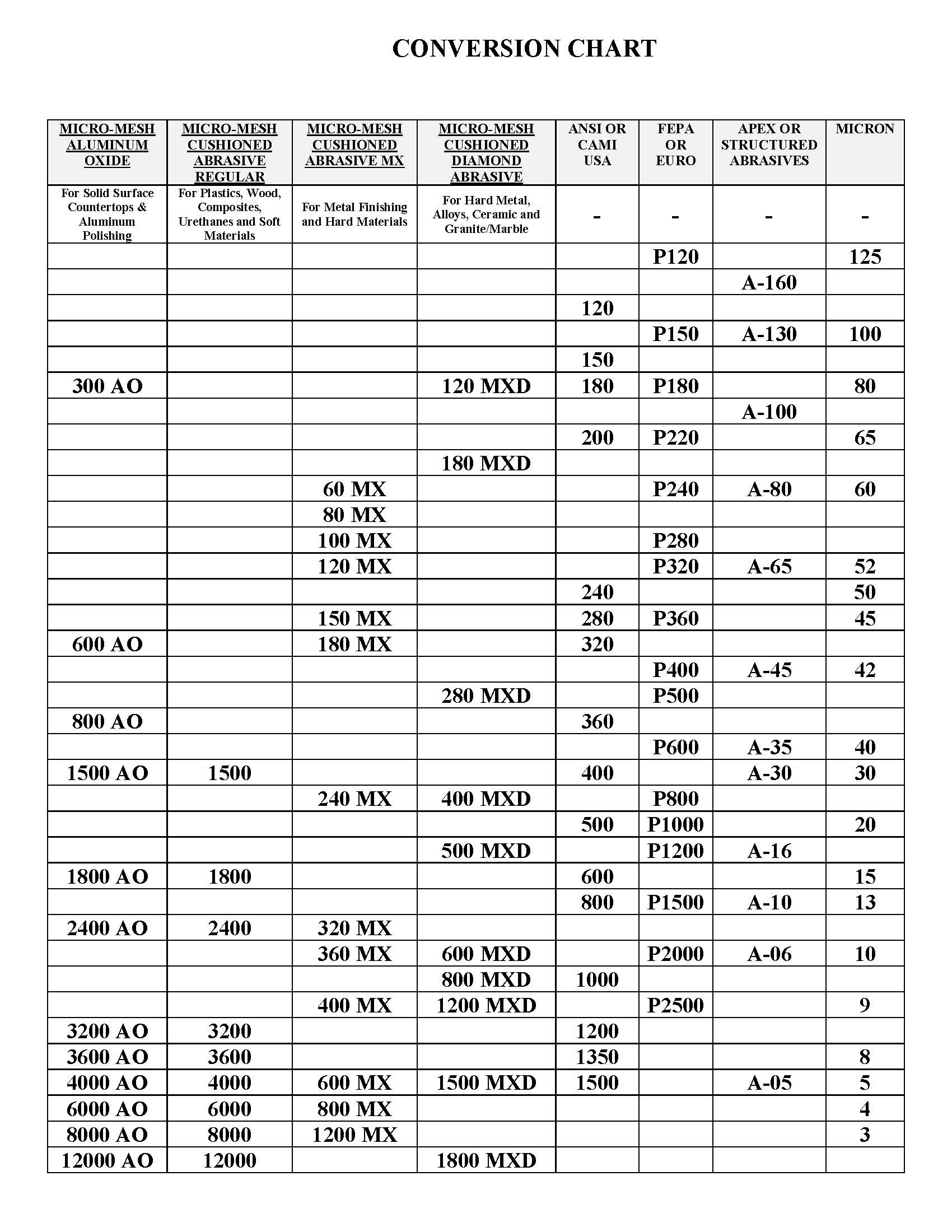
CONVERSION_CHART.jpg
 
Yes, but abrasives are not directly equivalent from type to type. Just because the particle size is the same does not mean they sand the same. Backing, bonding material, coatings, etc, all make a difference. Also, many (most) common abrasive products, like most belts, are not graded very closely. The grit rating is closer to an average than a minimum/maximum. Higher grade abrasives use grti with finer tolerances.
What that means t the average guy is that a cheaper belt at 400 grit may have grit from 300 to 500 in it, while a higher quality product, like gator belts, might have almost no grit coarser than 400 grit. That is part of why they seem to sand so much smoother.
 
Although, with trizact/gator belts you have the Apex/Structured rating. So according to the chart, A-30 is not quite as fine as P-800 paper, which seems about right to me.
 
Back
Top