
Hamon/HT failure,

Joined
Feb 16, 2010
Messages
3,668
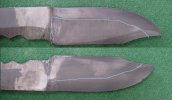
Trying out my one brick forge and thought I'd try for a hamon on a test edge. Just a quick ground bevel on some cheap steel. I mixed up some satanite(Thanks Matt) and painted it over the spine and most of the edge, leaving just the bevel uncovered. I think I need help with decoding what happened. Here's what I think happened, tell me if I'm wrong.
1080 steel, 5 minute soak after the salt started to melt.
Quenched in salt-water,
Tempered for 2 hrs @ 375°,
finished to 220 grit and
2 minutes in FeCl for etch
The blue lines to the spine are where I put a layer of satanite.

1. The ricasso heated and quenched fine. It had no clay on it.
2. The edge and bevels didn't get hot enough? The salt melted and they were a nice medium red.
3. The satanite didn't work and the steel hardened right next to the ricasso above the bevel?
 

Attachments

  • failure.jpg
    failure.jpg
    58.7 KB · Views: 182
Well from my experience, the two obvious things are your steel choice, 1080 is too deep hardening for a traditional "hamon" ( not the same as hardening line) and you quenched in water. Not that water quenching wont work at all for hamon...but with that steel your setting yourself up for failure.

Shawn
 
When using satanite, the refractory can't be so close to the edge in my experience. Especially on steels like 1080/1084, I've noticed that the quench line will show up lower than where the refractory ends.
 
Darn, just hit refresh and lost everything I typed.

I was using brine because on the last attempt at a hamon on 1080, we determined the oil was too slow. No pings or tinks or any bad noises on this, it quenched nicely. A file skates nicely off of everywhere that was red. Sand blasting shows no difference in the material hardness anywhere.

Is the satanite not thick enough? It was painted on with a brush. Further from the edge next time, check.
 
Until you sand it down a bit more, you may not see what is there. If the spine is soft and the edge is hard, there may well be a line somewhere. Sand it to 800-1000 and see what shows up.
 
Is the satanite not thick enough? It was painted on with a brush. Further from the edge next time, check.

If you're asking this question, the clay was too thick ;) You generally don't want more than .100" thickness anyplace. More than that and you actually slow the quench. Also, you want to have a very thin wash of satanite over the whole blade before you put your thicker layer of clay on. This actually SPEEDS the quench over leaving the bevels uncoated (it has to do with adding nucleation sites during the vapor phase IIRC).

Now, with that said, the AISI standard for 1080 calls for 0.60-0.90% Mn which is likely to rain on your hamon parade. The Mn encourages deeper hardening which will result in a more complete quench up under the clay. If you really want to play in with hamon, go with W-1, 1095, or W-2. They are all "shallow" hardening steels that will respond more like you're probably hoping for.

Chasing the hamon is a time and labor intensive thing, and you'll likely have to tune your procedure to your equipment. If you make it to the Fire & Brimstone hammer-in you could probably pick Jesus' brain on this and learn a LOT.

-d
 
I like sandblasting just for a preliminary check of differential hardness, though I did it after grinding to 120X in case there were surface effects that would confuse the issue
 
Stacy, I took off a good layer of 60 grit finish when I finished up to 220. Most of the decarb has been removed on the face of the blade. The spine is hard and the edge is hard. I don't think the satanite kept the spine softer than the edge.

Deker: I wish I could go to fire and brimstone. It's my son's birthday April 2nd, so we are having the party the same weekend as F&B. The satanite was about .03" so I will try a thicker coat on the next test. Even if I don't get a nice hamon, I'd like a softer spine on a knife that I'm working on.
 
Numbers, very interesting read. I'm definitely not putting the satanite on thick enough to have an effect. I'll try again Thursday, going fishing tomorrow.

Does the satanite work as an anti-scale when you coat the whole blade?
 
Numbers, very interesting read. I'm definitely not putting the satanite on thick enough to have an effect. I'll try again Thursday, going fishing tomorrow.
Well that's a first! Usually people put far too much clay on! :D

Does the satanite work as an anti-scale when you coat the whole blade?
Pretty much. The satanite itself can sometimes stick to the steel, but not too often and hot water and a little elbow grease should remove it.

If you leave your thin wash over the whole blade it will help your quench speed too. ;)

-d
 
If you have a steel that might need extra thick clay, there's a very good chance you have the wrong steel.:)

One way around this, is to just heat the edge, with little soak time. But you wont get a very active hamon...
 
Back
Top