Hamon tecniques

Joined
Nov 8, 2000
Messages
1,255
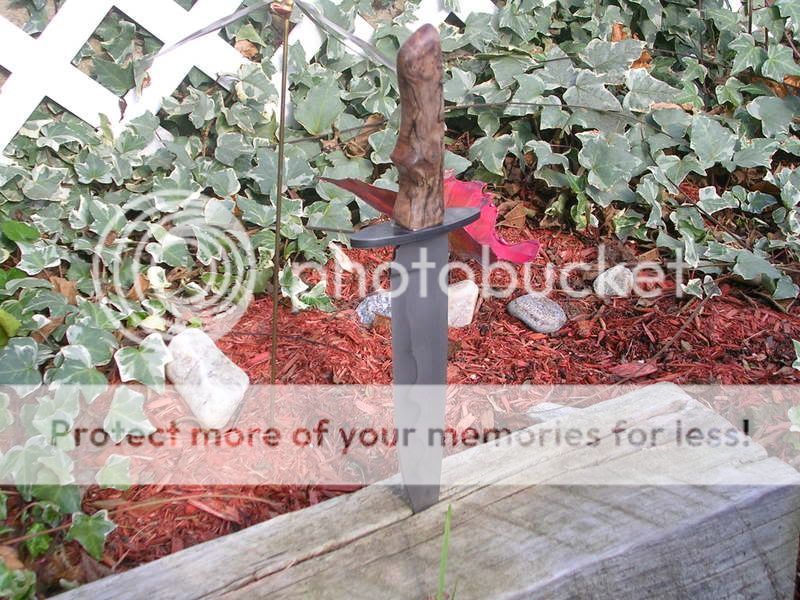
I just finished this bowie and the hamon came out kind of half straight half wavy.When I put on the clay the thickness was pretty consistant all the way back.Does any one have a guess how it came to look this way?Is there more to a hamon than the clay IE:movement in the oil, etc.
I know there is alot to be played with as far as hamons go.Too low on the clay maybe?
The steel is 1095 triple quenched/claycoated(thanks for the burl grasshoppa!!)
If you look close at the crappy pic you can make out the 2nd hamon
claycoat.jpg
[/IMG]
maple2.jpg

maple3.jpg
 
The hamon wont necessarily match the clay. The clay heats up with the blade, then serves to keep heat in the spine long enough that it cant cool fast enough to harden like the edge. So think of the hamon itself like a thunderstorm where a cold and hot front meet. As the blade edge cools, the spine is hot. Youre moving heat, not trying to paint the hamon with clay. So thick clay will push the hamon further down. Thin clay will allow the hamon to creep up. My guess on the straight part is that you quenched the tip faster than that area, and the clay at the back had so much thermal mass that the line ended up straight rather than curved. Just a guess, though! Ive been playing with hamons and ive had a few come out just like that.

This is all how I think about it...someone can correct me if I am wrong here....
 
Thanks doc :cool:

TickTock,thanks for the advice.It's funny how you can get an obsession with something your already obsessed with :eek: I ordered some 1095 after a year of playing with recycled steel,now I'm driven to make some smokin' hamons.

If thermal mass is the key to creating a hamon could I use steel plate instead of clay?Kind of in the shape of what a nice clay coating looks like but in a steel clip-on? sounds pretty stupid but I had to ask :confused:
 
looks good to me :) TRy and let the blade be what it is..not whats in your mind. I have that problem myself:D
 
I think its very cool. Im playing with hamons too when I have time at least. One thing I think I did wrong and maybe you did too, is the clay should match on the opposite side. Know what I mean? If one side has clay and the opposite side has no clay in that same spot I think the heat averages out and affects the line. That may explain the straight sections. But like I say Im no expert on hamons yet.
 
I havent played with hamon, but read quite a bit about it. Some japanese smiths put up a ridge of thicker clay at the point where they want the hamon to end....
 
Explain how you did the triple-quench? The hamon is formed with one quench.Any previous quench lines should be wiped out if the blade is properly soaked at the hold temp.If you did two normal quenches to refine the grain,and one clay quench to establish a hamon,then that would work fine.
Double lines are often formed for the reasons that Bruce stated,or from the interrupted quench. The blade goes in and the edge freezes to martensite. The blade is pulled out and the retained heat runs back down a bit into that area,the subsequent quench crates a second line that is more of a straight quench line than a hamon.The difference between a quench line and a hamon is the structure of the steel in the transition area (the ghostly line you love) . In a true hamon (clay coated) it is troosite;in a quench line (edge quench) it is pearlite.The difference is slight and there will be a mix of structures in most lines anyway.The spine should be fine pearlite in both cases.In a temper line (differential temper) it is a line of demarcation of hardness in the martensite that you see.
Stacy
 
Got some great discussion on this thread.

Indeed, a drawn-back diff. tempered line is different than a clay-quenched line.


Regarding your question...

You didn't mention your quenchant. You need a fast quenchant to make a "paint-on" hamon line - which is entirely feasible. This, to me, seems the most likely culprit.

The closer together the "troughs" of your clay are...the thinner the clay needs to be. The clay retains heat and will "push back" your line. With a fast quenchant (like brine) this is not a problem...but there might be other problems. :D

Also, you didn't tell us how you quenched (vertical, horizontal). I'm guessing vertical?


Regardless...it is an interesting line and seems to get the job done. Sometimes, with hamons, it's a "take what you can get" operation.
 
I forgot to mention the quenchant....peanut oil.I have been getting satisfactory results.
On the triple quench :o well the first time I thought I had it good but it was a bit too soft.(must have looked at it too much before the quench)The second quench was a sure bet :foot: till I fumbled and dropped the blade in the quench.Third time was the charm for me,no special reasoning or voodoo.
I also edge quenched (horizontally) because I thought I read some where that your not supposed to quench the clay.....I must have read every post and link all at once.
Maybe the second line is from a not so steady giddy with enthusiasm hand holding the blade in oil :D I should get a regulator block.I dont have the cojones to quench in brine or water :p
Thanks for the replies and comments
 
If the clay "lifts" off the surface, and allows the quench to penitrate under the clay you can get that look.

If you apply a wash coat of clay, allow this to dry in a plastic tent overnight, then apply a second layer the second day. Apply the second layer above the wash coat line by a 1/4 or 3/8 of an inch following the wash coat contour line. This will give you a lot of complex features along the hamon. Fred
 
One thing too, and I can't tell for sure on your blade, but if you have a healthy distal taper going on the blade may be thicker in the area where the hamon straightened out, so depending on the speed of the quenchant the steel will only harden up to a specific thickness in blade cross section. Peanut oil is a bit slower even than other vegetable oils so I'm thinking along with what everyone else has said that the quench speed was probably borderline to get the hamon up to follow the clay in that area. Definitley heat the oil up if you aren't already. I haven't tried the water quenching yet either and have trouble keeping the clay thin as well!

It's perfectly o.k. and desireable to quench the clay coated portion of the blade however if you are doing multiple quenches after you apply the clay (just to quickly get the blade down below 800 degrees or so, not to form martensite) for grain refinement, the clay may not hold up well until the final quench. Thermal cycling without the quick quenches works well.
 
If the clay "lifts" off the surface, and allows the quench to penitrate under the clay you can get that look.

If you apply a wash coat of clay, allow this to dry in a plastic tent overnight, then apply a second layer the second day. Apply the second layer above the wash coat line by a 1/4 or 3/8 of an inch following the wash coat contour line. This will give you a lot of complex features along the hamon. Fred

Thanks Fred,I just started a small batch of 1095 christmas presents.I'll try that method.
 
Thanks Fred,I just started a small batch of 1095 christmas presents.I'll try that method.


Joe,
Let me know when they're done and I'll send you my address. P.S.
I would like mine similar to that Bowie!:thumbup: :thumbup: I got you a nice GERBER for for Christmas but if you're gonna make mine that's fine too.:D
Matt
 
Back
Top