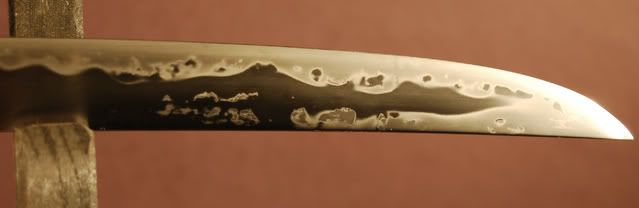
Hamon - what is it exactly?

Joined
Sep 7, 2006
Messages
6,211
Hey guys,

I was showing my daughter some pics of bowies and she remarked on the hamon. I tried explaining it to her (I know it has something to do with the tempering of the blade) but to be honest I don't know exactly what its meant to represent or how it gets there.

Can someone enlighten me as exactly what the hamon is all about?

Also how does it fit in with clay quenching?
 
http://en.wikipedia.org/wiki/Hamon_(swordsmithing)

"The hamon is the transition between the region of harder martensitic steel of the blade edge and the softer pearlitic steel of the back of the sword. This difference in hardness is the objective of the process; the appearance is purely a side effect. However, the aesthetic qualities of the hamon are quite valuable - not only as proof of the differential hardening treatment but also in its own right - and the patterns can be quite complex."
 
I believe that traditionally it's done by putting clay on part of the blade, causing different temps to different parts of the blade. This allows the cutting side to be harder and maintain its sharpness, and the top part to be a little softer to be less likely to crack if it absorbs a blow.
 
Last edited:
You don't need to clay quench to get a hamon, but that method arguably gives you the most control over the end result. With the spine area of the blade coated in clay (more often satanite) prior to quenching (the sudden, rapid cooling which hardens the steel) - that thicker, coated portion of the blade will cool more slowly (and thus not harden as much) as the thinner, uncoated edge. The hamon is a visual artifact of the transition from harder steel at the edge to softer steel at the spine.

Roger
 
This is from a tutorial I wrote a while back

Hamon is a Japanese word used to define the pattern that the hardened edge of a properly made sword makes. A common misconception is that Hamon refers to the hardened area, this is incorrect, the hardened area is known as Yakiba.

In modern knifemaking terms however Hamon has come to define the hardened portion of any knife which displays a differentially hardened edge.

There are many ways to achieve a differentially hardened edge but they all center around the same concept, getting the edge hard while keeping the back soft.

I use Satanite clay to insulate the spine area of my knives, thus preventing the spine from cooling fast enough to form Martensite (hard steel), while allowing the edge to harden. I use Parks #50 metallurgical quenchant with all of my blades but similar results can be achieved with any decent quenchant.
This tutorial assumes that you are using appropriate steel for creating a Hamon, a shallow hardening carbon steel is preferable.
1075, 1095, W1, W2 all do really well, 1084 is a little picky, O1 and 5160 are technically possible but a real bear.
Creating a good Hamon starts in the hammering and shaping phase. It is very important to have an understanding of what each heat is doing to the grain boundaries in your workpiece. If you are doing stock removal you should be pretty well set to go, if not you MUST make sure to properly normalize your work before HT.
 
hamon is what you get when you do a differential heat treat on rostafrei steel :D:D
 
why are the best, and it seems like the most hamons in W2 is it because w2 is a water quenching steel indicated by the W, and thus more suited to to differential hardening
 
why are the best, and it seems like the most hamons in W2 is it because w2 is a water quenching steel indicated by the W, and thus more suited to to differential hardening

not all W2 is created equal,

the specific chemistry has a lot to do with how the finished blade looks, 1084 for instance has enough manganese (causes deeper hardening) that it acts completely differently from 1095

on the surface it would seem that .1% of carbon difference wouldn't be that big of a deal, it's all the other trace elements that work together to change everything.
 
I like fancy hamons like on this sword that I used to own...

jkmountboshi.jpg
 
Fascinating subject indeed.
I've always liked the hamon on the Cloud Cutter.

Cloud-Cutter-Illaa.jpg


Doug
 
why are the best, and it seems like the most hamons in W2 is it because w2 is a water quenching steel indicated by the W, and thus more suited to to differential hardening
more or less, the need for a fast quenchant, like water, means that there is little time to get past the nose of the cooling curve. If you already have a little more trouble getting full martensitic conversion, then it is a little easier to prevent it where you don't want it. The thinner uncoated edge hardens, the thicker coated spine does not. As said, the deep hardening steels work against this, they were designed to, while you may end up with a hamon on an uncoated shallow hardening steel if you don't cool it fast enough.
 
Back
Top