Handle material

Joined
Aug 23, 2010
Messages
59
Why don't more people use Oak for handle material?
I've noticed that most of the suppliers don't carry it? Is there a reason why it doesn't make a good handle material?, or do they not bother to carry it because it's so widely available? I recently re-handled an old knife for someone and it seems to me to be a fairly dense and resilient hardwood. So what's the deal?
 
Last edited:
Years ago I used some oak. I found, however that straight grained walnut and several other woods weren't expensive and finished up to look a lot nicer - to me at least. Frank
 
One problem that occurs is the reaction between the tannins and the steel. Any minute steel shaving or dust particle that gets inbeded in the oak can show up later as a dark spot or a stain.On a darker or dyed wood, that isn't such a problem, but on light oak, it looks bad.
 
Most of the woods used on knife handles are harder, more dense, finer grained, more durable and more interesting than oak. Considering the relatively small amount of wood used on a knife handle, it usually makes sense to splurge (unless a particular piece just calls for oak)
 
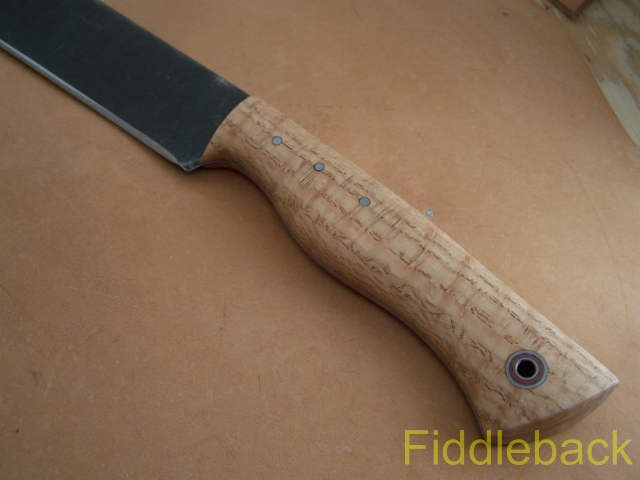
Fiddleback used some quartersawn oak with a run of machetes and others a short while back that looked great.
bsmach105_2078-vi.jpg
 
I like oak.
It does have very large pores, but I don't mind that.
You can catually play with that by filling the pores with material in a contrasting colour.
It combines well with bog oak, becouse the texture is the same, the colour is different.
(like a blond wearing a black hairband)

This is white oak, I beleve that it is a bit lighter then red oak, that I beleave is move common in the US.
I had a table made of oak, I collected the cut off bits. A few good handles worth.
(fire wood is a good source as well)

BTW oak heart wood is very durable

GroteFoto-GZLG33HP.jpg
 
The knife i re-handled was rumored to be well over 100 years old so i wanted to keep it looking old, and since i was doing it for free I used red oak. To make it roughly the same color as the old broken handle I burned it with a torch ( I was watching someone harden a spear tip with fire earlier that day. ha!) and jumped up alot on the grits I used to sand it. I think i went 80 320 600 1200. It was pretty interesting looking. The raised part of the grain was very smooth and shiny while the deeper pars were still fairly rough. It definitely looked old. I wish I would have taken a picture before i returned it to him. The only bad part was that I wasn't careful enough around the tang and burned some of the spacer material and epoxy away. I'm going to keep experimenting with this technique in the future. In theory it should be harder now that it has been burned, but I have no clue how durable it would be in the long run.
 
The knife i re-handled was rumored to be well over 100 years old so i wanted to keep it looking old, and since i was doing it for free I used red oak. To make it roughly the same color as the old broken handle I burned it with a torch ( I was watching someone harden a spear tip with fire earlier that day. ha!) and jumped up alot on the grits I used to sand it. I think i went 80 320 600 1200. It was pretty interesting looking. The raised part of the grain was very smooth and shiny while the deeper pars were still fairly rough. It definitely looked old. I wish I would have taken a picture before i returned it to him. The only bad part was that I wasn't careful enough around the tang and burned some of the spacer material and epoxy away. I'm going to keep experimenting with this technique in the future. In theory it should be harder now that it has been burned, but I have no clue how durable it would be in the long run.

Maybe you should look for an old whisky barrel? I've heard ya'll make that stuff in your neck of the woods!
 
What Stacy said about tannins is word. When peeling oak veneer it gets a bleach bath to prevent dark spot reaction like he describes. Tannins are why bog oak gets it's dark coloring.

White oak is darker than red oak. Wood names come from bark and leaves more than heart wood color. That's because heart wood color varies from region to region depending on soil minerals and other conditions. Market names in the flooring industry are made up according to surface coloring.
 
Maybe you should look for an old whisky barrel? I've heard ya'll make that stuff in your neck of the woods!

:D Ha! Close. The stuff made around here comes in jars!


White oak is darker than red oak. Wood names come from bark and leaves more than heart wood color. That's because heart wood color varies from region to region depending on soil minerals and other conditions. Market names in the flooring industry are made up according to surface coloring.
Today 01:17 PM

I wasn't aware of that! I thought red oak was red and white oak was much lighter in color. Thank you. In that case i have no clue which oak I used.
 
Handle material is mostly personal preference. I don't use oak because of the large pores and general lack of character. I think the same about locust, another fairly common domestic wood. I like darker woods, generally, because I just do. The only other brighter and open grained wood I use regularly is osage orange. My knives are generally smaller than a chef knife, so my scales are what is termed "a small canvas." By the time whatever pins, thong hole tubes, or liners are installed, there better be some figure in the wood to make it all interesting. Just my opinions.
 
River oak makes a nice handle. I found a few piece from a guy the recovered some log that were at the bottom of a river for above 150 years. Fill the pores using a oil finish.

IMG_2335.jpg


IMG_2336.jpg
 
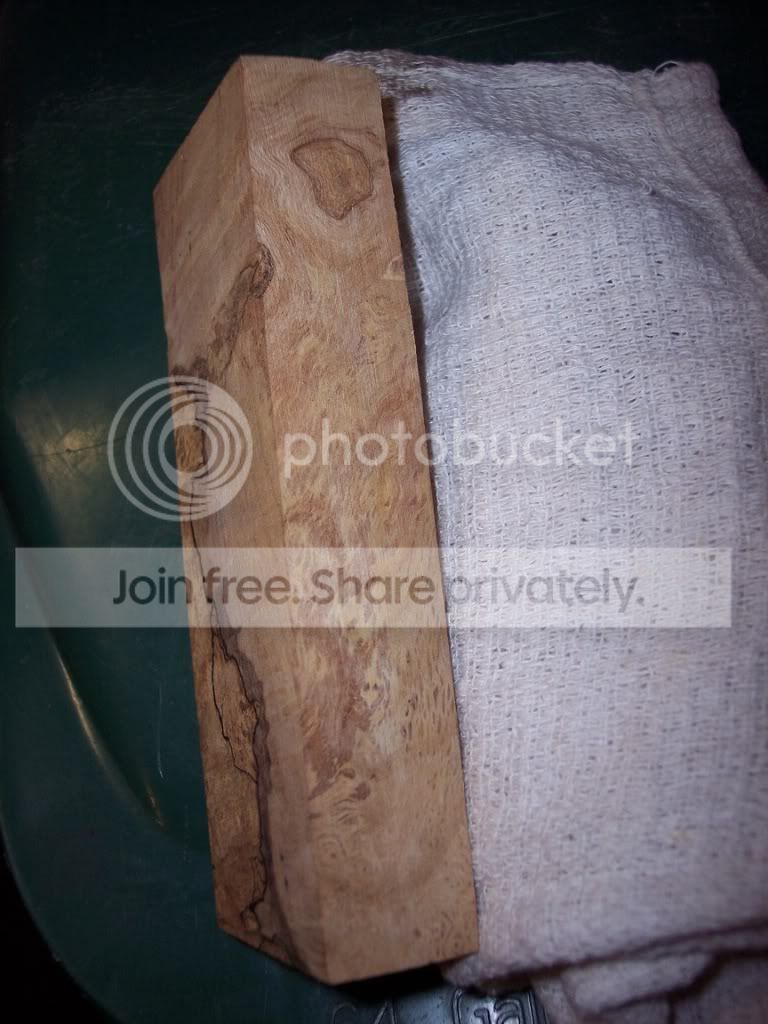
Larry, don't think that's oak at all. No distinct oak med rays and the grain is maple like..not oakish :) Med rays showing in upper right corner of far right piece seems to be maple rays...not oak. Maybe post another photo showing clear grain?
 
Larry,
I think you could very well be right on that, but I'm not sure. I asked specifically on these burls when I bought them and was told it was oak. I thought it looked like maple too, but he sells a lot of spalted maple burl as well, but these he said were oak. I have some other oak burl blocks too, they were cut from the same exact piece, but without any spalting. :o Heres a couple other pics. I tried to get some shots of the grain pattern. The side shots show one of the spalted burl blocks from the very first original pic.


Guess that means I'm stuck with these ugly old blocks.....:p Either way I appreciate your input......


oak012.jpg


oak013.jpg


oak014.jpg
 
Last edited:
Those new photos have oak rays and cells for sure. When you take the new baby out for a stroll you do not want to see folks whispering amongst themselves when glancing your way :)
 
HA HA HA....Well thanks for confirming its oak, its hard to tell sometimes. Better mark those now. ;)

-Larry
 
Back
Top