handle materials

In no particular order.

Zytel - light, more affordable, durable
FRN [fiberglass reinforced nylon] - light, more affordable, durable
G10 - Tough, Grippier, Heavier
Carbon Fiber - Light, strong for it's weight, flashy, different patterns/textures
Titanium - Light compared to steel, "prestigious" cool factor to many, if a frame lock [RIL] has more memory to lock engagement.
Aluminum - light weight, durable
Stainless Steel - heavy, cheaper
Wood - light, nice to look at


I'm sure many will chime in with more and different opinions.
 
FRN-lightweight and fairly grippy, dents instead of shattering on impact, pretty strong but flexy, but feels cheap to some.
G-10-very grippy, strong, but can shatter and tears up pants if too textured
Stainless Steel-strong, but can't be anodized like Ti or Al, slippery and heavy, and shows scratches easily
Titanium-lighter than stainless steel and very strong, preferred for framelocks
Aluminum-lightweight, but scratches easily and is too soft to use in a framelock (compared to Ti and SS)
Carbon fiber-similar to G-10, but looks a little nicer
Micarta-fairly strong composite that is usually either finished smooth or with a canvas texture.
 
If you get into the various bones, stags, pearls, ivories, exotic stone's, etc... it would be a huge list.

Most of the popular ones are already mentioned(unless your looking for slipjoint materials), but I will add...
...G10 is heavy, doesn't grip well unless it has a texture, is VERY tough, and has the best color.
...Micarta (paper, linen, and canvas) is light, grips well wet or dry, tough, not as colorfull. Canvas grips best, then linen, then paper.
...Carbon Fiber, super light, VERY tough, grips fair but when wet or bloody it grips VERY good.
 
What is the difference between G10 and Micarta though?

I thought that G10 was some sort of resin impregnated fiber... which is what I thought Micarta was...

Can someone help me clear that up?
 
What is the difference between G10 and Micarta though?

I thought that G10 was some sort of resin impregnated fiber... which is what I thought Micarta was...

Can someone help me clear that up?

Micarta is a plastic matrix with fiber instead of the resin epoxy matrix that G-10 and Carbon Fiber are. Also, the reinforcement fibers used are different.
 
Stag
Bone
Water Buffalo Horn
Ivory
Mother of Pearl
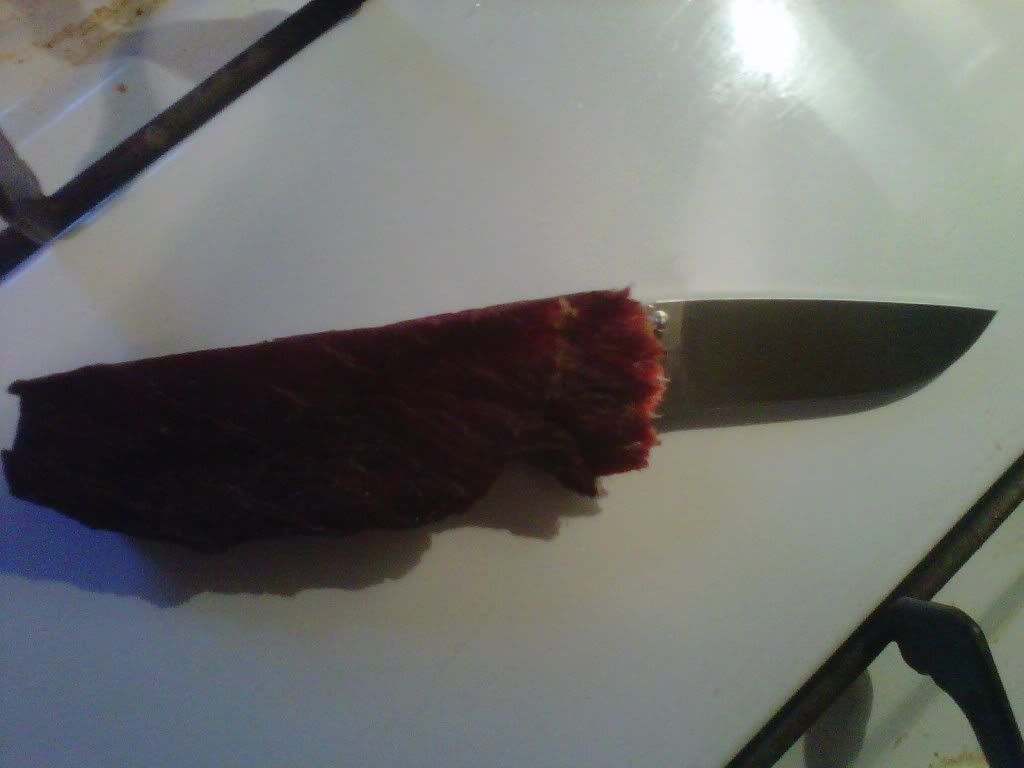
Bacon

Just kidding about the bacon, but how sweet would that be? Mmmm...bacon...
 
JERKYSCALES.jpg


I ran out of bacon, so I did a quick mockup with beef jerky. Meat, it's the most delicious of all handle materials.
 
Have you got a good source for the jerky for handle material? Great idea! Then if you are in a survival situation and things go bad, instead of eating my words I can eat my knife.
Tempted to review the pros and cons of some of the natural materials horn (musk ox Dall sheep goat buffalo etc) antler, bone, ivory (mammoth or fossil walrus hippo tusks) all have down side and up side. Much is a matter of what you want out of a knife and it’s feel-- looks, what you will do with it. Cost is a huge factor. Some materials will not float if near water (stones like jade tiger eye laboradorite) , and some can’t even get wet at all. (mammoth ivory ) Some are about indestructible.( horn) Some will not slip in the hand (antler) some are just rare and cool (musk ox horn- narwal tusk) and some are reputed to have magical properties (7 inch Kodiak grizzly claws makes my hair stand up).
 
Micarta is a plastic matrix with fiber instead of the resin epoxy matrix that G-10 and Carbon Fiber are. Also, the reinforcement fibers used are different.

Thanks for that :).

So you're saying that the fiberglass resin used in micarta is fundamentally different than whatever resin it is that is used in G-10. And that G-10 is basically really fine carbon fiber?
 
Thanks for that :).

So you're saying that the fiberglass resin used in micarta is fundamentally different than whatever resin it is that is used in G-10. And that G-10 is basically really fine carbon fiber?

Almost. Composite materials are made with a fiber and a matrix (the resin or plastic). The two together provide a much stronger material than either alone. But there's a wide variety of fibers and matrices that can be used. Most use an epoxy resin for the matrix, which is hardened and cured at a high temperature. G-10, carbon fiber, and kevlar are all like this. The difference there is the material of the fiber reinforcement used; G-10 uses a glass fiber fabric and CF uses carbon. Micarta, on the other hand, uses a thermosetting plastic (meaning you can't just melt the plastic and reuse it) as the matrix, and there are a few different fibers that can be used with it, like canvas, paper, and linen.
 
Thanks, I appreciate the help figuring this stuff out.

So G-10 uses Glass fibers embedded in epoxy resin, Carbon Fiber uses... carbon... fibers... and epoxy resin (same resin?) And micarta uses a plastic based resin that cannot be melted down, and uses fabrics generally as the fiber.

Last questions:

Can G-10 be melted down?

Also, both G-10 and micarta are basically resistant/impervious to pretty much anything. You might be able to affect the surface with something like a RIT dye, but the rest of it will remain unchanged. Right?
 
Yep, that's right. Epoxy resin by itself isn't a composite, it's just an adhesive. You can't melt down composites and reuse them; even if the matrix was a thermoplastic or something similar, the fibers would make recycling impractical. And yes, composites are quite strong, don't corrode, and resist fatigue very well. Most of the time when they break they fail because of delamination, meaning that the fiber separates from the matrix. If it's made properly, and you don't overload it, that shouldn't be a problem.
 
Traditional canvas micarta is cotton cloth impregnated with phenolic resin, which is thermosetting, which means that it will char rather than melt at high temperatures. Epoxy is also a thermoset resin, and is used to bond the glass fibers in G-10 and the carbon fibers in carbon composite. Nylon is a thermoplastic, used to bond the very short glass fibers in FRN/Zytel. Zytel is simply a DuPont trademark for their FRN. The big advantage to using a thermoplastic resin like nylon is that the handles can be injection molded, a very cost-efficient process when you need to do thousands of handle slabs. Initial tooling costs a lot, but when you do many mold cycles it pays for itself.

Edited to add: Canvas micarta is more permeable than G-10 because the organic fibers can conduct liquids into the material better than the non-permeable glass fibers in G-10 can. The phenolic resins generally withstand higher heat than epoxies, but this depends on the temperature that the epoxy cures at. Both will withstand boiling water just fine, as will FRN.
 
Thanks guys, I've been wondering that for a while... but was either to lazy or to nervous to ask.
 
Back
Top
