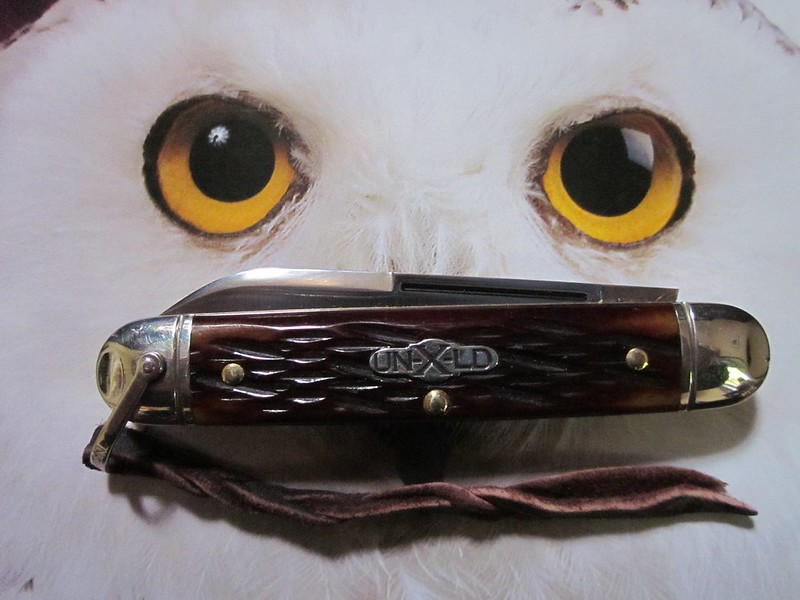
Hardest working White Owl scale material?

Brian.Evans

Registered Member
Joined
Aug 20, 2011
Messages
3,267
Ok gents. Our wedding anniversary is coming up and I'd like to start dropping hints. However, I'm at a loss as to what scale material to decide. I know I don't want the jigged red bone, or any of the acrylics. I'm planning on this being my "go to" knife. I already carry my daughters yeller peanut, but I use my other knife for most everyday uses, to save on her knife's wear.

I need a material that isn't going to get overly hurt if it gets dropped or kept in a pocket while working in the shop or on an accident scene. I want something that is going to last a long time.

As always, opinions welcome. Thanks.
 
Ebony. One of THE most durable woods.

If you don't want jigged bone or acrylics...then your choice is limited to stag, woods or horn. I'd steer clear of the latter if it's toughness you're after.

Thanks, Will
 
Didn't think of ebony.
I think would wood stand up to being dropped

better than bone or stag antler.It will dent but not crack or chip

Acrylics probably toughest but thats off the menu.
imo.
What if it was boney looking stuff in acrylic?
 
Another vote for ebony. Most GEC knives I own or have owned have been ebony and I think it's pretty hard to beat.
 
One more vote for Ebony. It ages beautifully as well as being tough as nails.
 
if you think about it a while, everyday run of the mill kitchen knives that have been dropped and abused by being soaked in water and washed everyday for years on end mostly have wooden handles. Ebony is among the woods used. I go with wood without hesitation. I bought a Green River knife blank over 20 years ago and put ebony scales on the handle. My wife uses it in the kitchen in the garden and washes it regularly and it's still a beautiful go-to knife.
 
While I have a White Owl in autumn jogged bone, I'd sure love that Snakewood tool!
 
I was leaning towards ebony for the very reasons you all mention. I've seen a lot of older knives in ebony and they all look like they've held up well. As long as it's deep, dark ebony, I think I'd like it.
 
Oh dang, I just saw that GEC has a Northfield in autumn jigged bone. Now that's a sharp knife!
 
Yup.

682211-bal-autumn-gold-fixed1[1].jpg


7113109713_441517e710_c.jpg


;)

~ P.
 
Snakewood: Average Dry Weight (?) : 81 lbs/ft3 (1300 kg/m3) | Janka Hardness (?) : 3800lbf (16903 N) | Specific Gravity (?) : 1.30).

Gaboon Ebony: Average Dry Weight (?) : 63 lbs/ft3 (1000 kg/m3) | Janka Hardness (?) : 3220lbf (14323 N) | Specific Gravity (?) : 1.03).

While both woods are extremely dense and tough, as you can see from the numbers, Snakewood is harder than ebony, but not as dense. Both have the potential to crack if allowed to dry out over time, but that's easy to avoid. Both make excellent go-too natural knife scales
 
I've heard :rolleyes: that snakewood is very prone to shrinkage and cracking if not properly dried. I have not heard any negatives about ebony. I think I would be inclined to go with the ebony.
 
How long has Snakewood been used ? and How long has Ebony been used.
I've got an old English made penknife with Ebony scales that are superb but the blade is almost gone.I call it the lock pick.
 
How long has Snakewood been used ? and How long has Ebony been used.
I've got an old English made penknife with Ebony scales that are superb but the blade is almost gone.I call it the lock pick.

Don't have dates, but considering that ebony can be obtained in Africa vs. New World for snakewood, my guess is that ebony has been used longer.


http://www.exoticwood.biz/snakewood.htm
Snakewood is an incredibly beautiful wood which originates mostly in Suriname, South America. The specific gravity is around 1.2, making it one of the worlds hardest woods. The part sold as snakewood is really the heartwood of the larger tree. This wood is usually felled with axes and carried on the backs of hard working natives over streams and through snake infested jungle areas. Each tree felled is monitored, and the government has developed a strict permit process to control harvesting. Much of the wood has inferior or no figure, but the small amount that has attractive figure is exported. We sell only figured pieces that have high density of figure unless specifically marked otherwise. All snakewood has at least minute hairline cracks. We take the extra step of soaking some pieces in cyanoacrylate to minimize or eliminate any cracking. Fortunately, if cracks do occur, they can be hidden completely if caught early. We do not recommend attempting to dry snakewood, as this almost always leads to cracking. Being dense, the water content is already very low. To be successful, always have superglue and hardener on hand, cover the piece with plastic completely when not working on it, and seal it completely with a finish that does not allow moisture transmission. Needless to say, the wood should never be allowed to get overly heated or left in direct sunlight.

http://canequest.com/ebony_wood.asp.
Ebony Wood

Ebony is a dense and heavy wood used for making a variety of items including musical instruments such as bagpipes, violin pegs, chessmen, buttons, handles for cutlery, and of course stick shafts and handles, for which a strong wood is a necessity. Ebony is one of the most difficult woods to carve given its hardness, and traditionally only master carvers were given the opportunity. Ebony trees are relatively small, and are found in the tropical rainforests of Africa, India, Ceylon, Malaysia, and Indonesia. The bark of ebony is tan and generally light in color, and the outer wood is a soft white. It is the inner portion of the tree that is fine-grained, dense, dark colored, strong and heavy, and has been prized for centuries.

Known for its jet-black color, ebony varies from deep black to dark red, with a variety of rich dark shades. Heartwood may display dramatic and irregular striping of bright brown, gray or greenish black on a deep black background. It is genetics that determines the shade, along with moisture, mineral content of the soil, and age/growth rate of the tree. Generally, the darker ebony is found at higher altitudes and from older trees. Ebony with more red tones has its origin at lower altitudes and from soil with greater iron content. Ebony is a scarce and costly wood.

Macassar Ebony
Special mention must be made of Macassar ebony, native to the Celebes Islands of Indonesia. It is an exceptionally beautiful hazel-brown black-striped wood, and is important in the production of canes and used for the most expensive shafts.

Ebonized woods
If purchasing a stick described as having an ebony shaft, examine it closely. Ebonized wood is an imitation of real ebony, inexpensive wood that has been stained black, and is identifiable by its grain, mottling or lighter weight.
 
Back
Top