
-
The BladeForums.com 2024 Traditional Knife is available! Price is $250 ea (shipped within CONUS).
Order here: https://www.bladeforums.com/help/2024-traditional/
You are using an out of date browser. It may not display this or other websites correctly.
You should upgrade or use an alternative browser.
You should upgrade or use an alternative browser.
Hartsook Neck Knife PE S30V
- Thread starter psy-ops
- Start date

- Joined
- Nov 30, 2006
- Messages
- 1,087
Depends on what you mean by useful. It is the size of a pen knife so if you just want to cut string or open small packages yeah its useful any thing more than that I would be doubtful. Be advised it is also very thin I wrapped mine with 550 paracord so it would be easier to control and grip.
I really like mine, but I rarely carry it. It was super sharp out of the box. I wish it were a tiny bit bigger. I find that a paracord lanyard with knots tied at the right distance allow you obtain a better hold. I wear my BK11 as a belt knife and this as a neck knife.
I have so many knives that it is hard to get them into the rotation. I do not regrete this sub $20 purchase at all.
I have so many knives that it is hard to get them into the rotation. I do not regrete this sub $20 purchase at all.

- Joined
- Mar 22, 2006
- Messages
- 5,944
ag russell woodswalker...not the best steel AUS-8 flat grind 10 bucks with out the sheath 20 with a leather one and 30 with a kydex it's a great little knife for the $$ great for fuzz sticks and food and game prep 2&1/2 inch blade really handy with the kydex neck rig.
- Joined
- Feb 22, 2006
- Messages
- 64
My Gossman PSK is about that size and I love it. I use it more than any other knife when I am in the bush. Although I wouldn't get one in S30V, I also use mine as a striker for my fire steel.

- Joined
- Mar 21, 2006
- Messages
- 10,040
ag russell woodswalker...not the best steel AUS-8 flat grind 10 bucks with out the sheath 20 with a leather one and 30 with a kydex it's a great little knife for the $$ great for fuzz sticks and food and game prep 2&1/2 inch blade really handy with the kydex neck rig.
i don't have any experience with the hartsook necker, though i've heard lots of good things about it....
i do however have an a.g.russell woodswalker.. it is a great little knife.. especially for the $$$.... i love it..... mine is a modded version from scott tanguay:thumbup: it is very handy and holds a great edge.....:thumbup:

- Joined
- Aug 3, 2004
- Messages
- 971
The Hartsook is a good backup for light cutting and even last resort self defense (I'd only go for soft points with it though), but if you were planning on a backup that'd be easier to handle I'd go with the WW. I love the hartsook but I think it's place is in a city/SD environment not the bush.
- Joined
- Nov 29, 2005
- Messages
- 887
There was a lengthy thread (latest post at this point was about May 2) which I started on a similar subject, title beginning "Tiny fixed-blades . . . ", in which the Hartsook received a lot of favorable testimonials. One poster here referred to it as the aboriginal stone flake blade for our times. I have a Hartsook now, and am impressed with how it fills its niche. It's tiny, very flat, and the paracord loop really does just about give you double the grip that you'd otherwise get with just the tiny, thin handle. It's a clever idea. I wouldn't deliberately set out on a camping trip with that as my only blade, and I REALLY wouldn't want to count on anything with a grip that tiny for any fighting context, where the knife is likely to be the point of intersection between two adrenalin-charged 180-pound guys; I doubt it'd be easy to maintain a grip under use-as-weapon circumstances. The real niche for this knife is not as a weapon, I think, but as a knife that can fit where you ordinarily couldn't fit a knife, and thus one you could keep accessible for survival emergencies which would otherwise deprive you of the use of any knife whatsoever. It'll just about fit diagonally in a standard-sized wallet; a hat with a pocket in the brim will accommodate it without your even knowing it's there. You could certainly dress out a deer with it, with a little patience, though there's not enough blade that you'll likely be batonning it through anything. The shortness of the blade makes it take a little getting used to, as I find that I've often run out of blade and am trying to cut with the choil when I'm experimenting with using it to break down boxes--again, a potential problem with a fighting knife, but that's not really what this is.
The Woodswalker is also a great knife, but quite different: it's got a very-respectable-sized handle, comparatively, which gives you simultaneously much better control and more comfort than the Hartsook, and a package that's 4 or 5 times as thick as the Hartsook, if not more.
The Woodswalker is also a great knife, but quite different: it's got a very-respectable-sized handle, comparatively, which gives you simultaneously much better control and more comfort than the Hartsook, and a package that's 4 or 5 times as thick as the Hartsook, if not more.

- Joined
- Dec 22, 2006
- Messages
- 2,194
I have a Hartsook and it is an ultralight, compact knife. The stone flake and sharp claw analogies are right on. The idea is to have a sharp little tool handy for cutting tasks. It can hang around your kneck with a whistle, firesteel, compass and LED microlight for a bare bones PSK. I would add a larger knife for backcountry travel.
Small knives are for light work-- cooking, trimming line, repairing clothing, etc. I wouldn't plan on using a Hartsook for self defense, but if that's all you have, I guess you need to use all the resources available.
The AG Russell Woodswalker is a good buy, and as Return of the JD said, a very different knife-- minimal, but not as ultra minimal as the Hartsook. Either knife will serve you well for small cutting chores.
Getting down to the core of the matter, we're talking about selecting a knife. The question is, what do you want to accomplish? What tasks do you want this tool to perform? For survival use, the general drift has been towards a trio of tools-- small blade, medium blade, and a larger tool for cutting firewood and shelter making. A small neck knife is a useful part of a trio like that.
There are lots of reasons for buying knives--- as tools, collecting, or just because it's cool. Nothing wrong with any of that, but when it comes to survival, you want to be able to accomplish what your training or reading have taught you to do: make a fire, build a shelter and gather food-- the tools can do the job or they can't.
Small knives are for light work-- cooking, trimming line, repairing clothing, etc. I wouldn't plan on using a Hartsook for self defense, but if that's all you have, I guess you need to use all the resources available.
The AG Russell Woodswalker is a good buy, and as Return of the JD said, a very different knife-- minimal, but not as ultra minimal as the Hartsook. Either knife will serve you well for small cutting chores.
Getting down to the core of the matter, we're talking about selecting a knife. The question is, what do you want to accomplish? What tasks do you want this tool to perform? For survival use, the general drift has been towards a trio of tools-- small blade, medium blade, and a larger tool for cutting firewood and shelter making. A small neck knife is a useful part of a trio like that.
There are lots of reasons for buying knives--- as tools, collecting, or just because it's cool. Nothing wrong with any of that, but when it comes to survival, you want to be able to accomplish what your training or reading have taught you to do: make a fire, build a shelter and gather food-- the tools can do the job or they can't.

- Joined
- Nov 7, 1999
- Messages
- 6,651
Hey Guys..
The Hartsook would make an Awesome Hat Knife.. Very light....
I have a small,,actually Very small stainless damascus knife on the side of my Hat, with a matching mini ferro rod, one on each side of my Tilly hat in concealex sheaths.
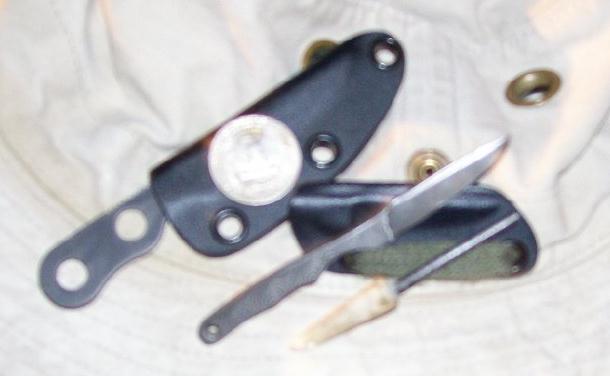
The Hartsook would in my opinion make an awesome knife for the side of a Tilly hat..
ttyle
Eric
O/ST
The Hartsook would make an Awesome Hat Knife.. Very light....
I have a small,,actually Very small stainless damascus knife on the side of my Hat, with a matching mini ferro rod, one on each side of my Tilly hat in concealex sheaths.
The Hartsook would in my opinion make an awesome knife for the side of a Tilly hat..
ttyle
Eric
O/ST
By useful I meant, carving fuzz sticks, possible last ditch SD, general all around small knife stuff.
Is there another neck knife that has a 4 inch handle and a 2-3 inch blade made of good steel in the $20 range?
Thanks for responses
Chris
I have one. It's REALLY small and thin, like a sharpened nail file. I use it when fishing for cutting line and such. I'm sure I could make fuzz sticks with it. SD? Maybe if you get attacked by a rabid squirrel or something, but not against a person - the handle is too small to hold onto for a hard thrust and the blade too short to reach anything vital. It's a very nice knife, but it is a lot smaller than I expected.


- Joined
- Sep 27, 1999
- Messages
- 3,164
Those pictures are so informative. Thanks for posting them. Actually the woodswalker was more of what I had in mind.
I appreciate the input. I seem to remember Benchmade having a smaller skeletonized neck knife but I have not been able to find it. It was around $30.
Definitely, after all the posts and now pictures the Hartsook was not what I was looking for.
I appreciate the input. I seem to remember Benchmade having a smaller skeletonized neck knife but I have not been able to find it. It was around $30.
Definitely, after all the posts and now pictures the Hartsook was not what I was looking for.
- Joined
- Nov 29, 2005
- Messages
- 887
Two more thoughts on Hartsooks. (1) The Hartsook itself is about 2 millimeters thick. That's it. The scabbard for it is about 4 millimeters thick (except for the bulging loop they put at the tip--something one might want to saw off, if thinness of scabbard is preferable over having a projecting loop to make the scabbard lie flat when it's hanging from a neck lanyard.) This thinness is the chief distinguishing characteristic of both the Hartsook and the Hartsook/scabbard system (well, that plus the tiny-handle-plus-paracord-loop-adding-up-to-not-so-tiny-handle arrangement). The Hartsook is thus vanishingly thin and light. This makes for portability, and a real ability to keep it available in situations where you'd ordinarily not be able to keep a knife. I mean, you could use it as a bookmark. You could reinforce a hatband into a sheath and carry it there. Stuff like that.
One thing that means is that when you're holding it, a lot of your grip is probably going to be with your thumb on the top of this 2mm blade, and your index finger on the bottom--so your thumb and index finger are about one centimeter apart from each other, if your index finger is in the choil. Your hold on the knife comes from pressure between thumb and index finger, with your middle finger assisting farther back on the handle, your ring finger and pinky inside the paracord loop and applying a little stabilizing tension (and your ring finger maybe pressing a little on the back of the steel handle.) Basically, most of your grip is pressure between thumb and forefinger.
Because you're pressing on the top and bottom of a piece of steel that's about 1 cm tall and 2mm thick, there is going to be a tendency for the blade to flip sideways if your thumb and index finger aren't pressing directly toward each other, or if there's some kind of force from the side. No big deal, but with a knife this thin, it's just going to be easy for the knife to flip so that instead of the edge going straight down, suddenly the edge will be pointing to, say, the right. Keeping this from happening means applying some pressure between thumb and forefinger--more than you'd have to apply to cut with a knife with the usual much-thicker handle.
This has two effects: first, it might be somewhat tiring to cut with this thing for a very long time. Second, if you were actually trying to use this as some kind of weapon, you might find it hard to apply lots of striking force without the blade turning so that you're suddenly trying to cut with the flat of the blade. You're not going to lose the knife under this situation if you've got your ring finger and pinky through the loop, but it's not conducive to the kind of stable grip that one would want in a fight. Again, this just supports my evaluation of this knife as a great backup survival tool to make sure you've got a cutting edge wherever your car/plane/boat/pogo stick happens to break down, but if you're going to fight a mugger or mountain lion, you're probably better off with a brick or a large rock.
2. If you didn't feel like spending $20, or you wanted to go more the high-carbon-non-stainless route, you could make a very similar knife out of an Ontario/Old Hickory/Tru-Edge paring knife, by removing the wooden handle and selectively removing a little stock with a Dremel tool, to make a choil, shorten and maybe round the handle, possibly work in a Hartsook-style paracord loop, and maybe jimp the spine a bit where desired. (Like another commentator, I'd probably add more jimping on the spine than the Hartsook has, so that you'd have one continuous jimped section of spine, instead of two sections of jimping separated by a smooth portion.)
One thing that means is that when you're holding it, a lot of your grip is probably going to be with your thumb on the top of this 2mm blade, and your index finger on the bottom--so your thumb and index finger are about one centimeter apart from each other, if your index finger is in the choil. Your hold on the knife comes from pressure between thumb and index finger, with your middle finger assisting farther back on the handle, your ring finger and pinky inside the paracord loop and applying a little stabilizing tension (and your ring finger maybe pressing a little on the back of the steel handle.) Basically, most of your grip is pressure between thumb and forefinger.
Because you're pressing on the top and bottom of a piece of steel that's about 1 cm tall and 2mm thick, there is going to be a tendency for the blade to flip sideways if your thumb and index finger aren't pressing directly toward each other, or if there's some kind of force from the side. No big deal, but with a knife this thin, it's just going to be easy for the knife to flip so that instead of the edge going straight down, suddenly the edge will be pointing to, say, the right. Keeping this from happening means applying some pressure between thumb and forefinger--more than you'd have to apply to cut with a knife with the usual much-thicker handle.
This has two effects: first, it might be somewhat tiring to cut with this thing for a very long time. Second, if you were actually trying to use this as some kind of weapon, you might find it hard to apply lots of striking force without the blade turning so that you're suddenly trying to cut with the flat of the blade. You're not going to lose the knife under this situation if you've got your ring finger and pinky through the loop, but it's not conducive to the kind of stable grip that one would want in a fight. Again, this just supports my evaluation of this knife as a great backup survival tool to make sure you've got a cutting edge wherever your car/plane/boat/pogo stick happens to break down, but if you're going to fight a mugger or mountain lion, you're probably better off with a brick or a large rock.
2. If you didn't feel like spending $20, or you wanted to go more the high-carbon-non-stainless route, you could make a very similar knife out of an Ontario/Old Hickory/Tru-Edge paring knife, by removing the wooden handle and selectively removing a little stock with a Dremel tool, to make a choil, shorten and maybe round the handle, possibly work in a Hartsook-style paracord loop, and maybe jimp the spine a bit where desired. (Like another commentator, I'd probably add more jimping on the spine than the Hartsook has, so that you'd have one continuous jimped section of spine, instead of two sections of jimping separated by a smooth portion.)
- Joined
- Dec 22, 2006
- Messages
- 2,194
.... (Like another commentator, I'd probably add more jimping on the spine than the Hartsook has, so that you'd have one continuous jimped section of spine, instead of two sections of jimping separated by a smooth portion.)
Agreed on the gap in the jimping-- my thumb lands in the smooth spot and I can't figure out why Buck did that-- shoulda just jimped the whole thing.
I've never thought of the knife as a heavy pressure cutter or self defense option. I bought it with small slicing, peeling, trimming line and the like.
It wouldn't be too hard to build scales for one and extend it a bit. It begs for all kinds of sheath options as is. Just a simple Kydex envelope would be good for me. A take-off on the Woodswalker pocket sheath would be interesting--- I bet you could make one that would go in your watch pocket. A horizontal belt sheath would be very cool.