Having Problems with getting a mirror polish😭

Joined
Nov 17, 2025
Messages
15
IMG_9438.jpg
IMG_9436.jpg
IMG_9440.jpg
IMG-9443.jpg
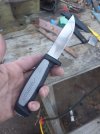
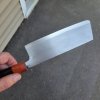
I’ve been trying to get a mirror polish with my dc4 and cc4 and I don’t know what I’m doing wrong. I have spent hours trying different methods and trying to make a clean mirror finish. And I find the strop gives it a blurry finish.

Any tips and advice would be much appreciated!

 
The two Fallkniven hones (DC4, CC4) by themselves won't be nearly enough for mirror polishing, as you're seeing. Fallkniven describes the CC4 as a very fine stone that's used primarily for 'polishing the edge'. But that's kind of misleading, as it can't polish away the heavy scratches left by the DC4 - there's too wide a grit gap between the two hones. If the edge were already polished, or nearly so from the factory, then that CC4 might be adequate to maintain it.

Mirror polishing needs to be done with a very tight grit progression in many stages, starting with something coarse enough to start refining the scratch patterns on the steel, and then, step-by-step, incrementing finer up through very fine grit. 'Polished' is when the scratches eventually become too fine to see with the naked eye. It's more easily done using a progression of wet/dry silicon carbide (SiC) sandpaper used on a very firm or hard backing like wood, glass or stone. The sandpaper can be found in a wide range of grit sizes.

Begin with something in the 220-400 range to start reducing the size of the scratches seen in your photos. Use linear passes (one direction only) on the sandpaper to make a uniform scratch pattern that you can easily see. With each grit step, change the direction of the sanding passes by 90 degrees, so the new scratch pattern can completely erase the previous grit's scratches. Progress through 400 > 600 > 800 > 1000 > 1200 > 1500 > 2000 and beyond. Most steels will start to show a hazy mirror up around 800-1000 grit or so, with a clearer mirror showing up past 2000/3000 grit. Then follow that using a strop with a polishing compound like white rouge (aluminum oxide), Simichrome or Flitz (both also aluminum oxide), or a progression of diamond compounds down to 3 microns or finer will work.

The above is ONE WAY to go about it. Doing it with stones is also possible - experts can do it using a progression of water stones up through very, very fine grit. Having the quality stones to accomplish that is very expensive though, and it takes real expertise to do it well.

Polishing blades to a near-perfect mirror is a LONG learning curve. So, a lot of patience will be needed to figure out what works, in terms of the gear used and technique. Practice on an inexpensive blade with a flat grind, like a kitchen knife, to get a feel for what works, before trying it with a more expensive knife. Regarding your knife (Mora?) shown in the pictures, some of Mora's blades are in laminated steel, with a layer of softer but tougher (less brittle) stainless steel on the exterior, and a harder but less tough (more brittle) steel sandwiched between the softer stainless, for the cutting edge itself. If sanding those blades, you'll risk sanding through the softer exterior steel. That potentially could reduce the strength of the blade - the laminated structure is what makes the knife less prone to breakage in hard use. So, make sure you know if yours is a laminated blade, before getting too aggressive with sanding.

I'll also add, if it's a laminated blade, the softer exterior steel will scratch very easily in use. So, after all the work to polish it, you might consider whether it's worth it or not. And even if it's not laminated, a polished blade will still get scuffed up pretty quickly if it's used much anyway. The sandpaper could still be useful for applying a simple satin finish to the blade, using a single grit like 220, 320 or 400, which emulates a lot of factory brushed satin finishes very well and would be much easier to maintain.
 
Last edited:
I'm so, so sorry if this sounds rude because I don't mean to be, but that's very much not how that works.

The above post details the process very well. I would add, tape your sandpaper to something dead flat like a piece of glass or micarta, start at 400 grit or so. Don't use the Harbor Freight sandpaper!

Totally unrelated, but here's my flat ground Mora Robust!

20251214_162020.jpg
 
I'll add another suggestion here...

You can 'strop' the blade's edge bevel on medium-to-high grit SiC sandpaper, such as something in the 320-600 range, which will leave a clean & uniform satin finish on the bevels. Following that, a strop made of denim glued over a hard surface (wood, for example) and used with white rouge (aluminum oxide) stick compound works very fast to produce an acceptably polished bevel. I suggest this, because I used to polish blades this way. A denim strop will take and hold a very dense application of the stick compound. The compound is fine, made for polishing stainless steels, but it's also very aggressive and fast working for tasks like this. Lay the wide bevel flush to the strop. Don't press too hard to prevent rounding of the apex.

I used paint-stirring sticks found at the big box home stores for strops like this. Use some spray adhesive on the back side of the denim, laid flat. Then press the stick to the denim and clamp it all in place. Give it a few hours to dry & cure, then trim the edges away. Then 'crayon' the stick compound onto the denim. You'll see how well the denim takes the compound, much better than leather will. I included photos of a couple of blades I did this way below, after thinning the edge grinds on each. I think I used a Fine Norton India stone for the first (Case Sod Buster Jr. in 420HC steel), to create the new edge, following on the strop described above. In the 2nd, I convexed the modified spey blade (reground to a spearpoint tip) on a Buck 301, also 420HC, using diamond hones (DMT Coarse & Fine), then followed on the same strop as I described above. The aggressive strop provides a means to somewhat 'cheat' the tight grit progression I described earlier. It won't make a true, PERFECT mirror finish. But it otherwise leaves it looking pretty good, especially for blades that actually get used for real work.
gIarv1n.jpg

1GrqVSI.jpg
 
Last edited:
Thanks guys for the responses, very helpful!
So pretty much I use sandpaper on a hard surface with a very tight grit progression? I want to get it right on my mora robust before I try on my fallkniven a1.so can sharpening stones even make a mirror polish? Any more advice would be greatly appreciated!

Yeah, just use a tight progression of sandpaper and make sure you erase all of the scratches from previous grits. You can get away with roughly doubling your grits (400, 800, 1500, etc) but I would recommend using every grit as a beginner.

And some sharpening stones can, particularly very fine Japanese waterstones, from my understanding.
 
I'm going to be the odd man out and say you can get "close enough" to a mirror polish with this progression: DC4 ceramic side (use dish soap to form a kind of slurry) - spyderco fine - spyderco ultra fine - strop with compound/diamond spray. For my spyderco "ultra fine" I just purchased a fine pocket stone and lapped one side of it with an old diamond stone to create the ultra fine, so a single pocket stone becomes two grits.

The dc4 ceramic side will do most of the heavy lifting (it's a great grit for refining scratch pattern) but sharpening in a circular motion seemed to help me the most.

While not a perfect mirror, it's pretty close and super practical.
 
Speaking to secondary bevel mirror finish: i suppose the same could apply to primary/scandi if you adapt your media. As mentioned above: a dead flat surface is imperative the entire way to maintain uniform scratch.

Tight grit progression essential. I use diamond stones and step up from 220,320,600. leather strop and diamond emulsion 1500,4000. Then leather becomes useless from here forward because the surface is too spongy and uniform scratch pattern is impossible for me after 4k on leather. I then switch to a glass lapping stone + emulsion and go 8k, 15k, 25k, 50, 100k, then finally 200k.

I played around for probably 6 months before I got my first ā€œmirrorā€ without grit contamination.

Essentially you’re doing what you’re supposed to do: play with the process and enjoy every step of learning. Try not to get frustrated. When you get in the groove it’s really satisfying. I am foregoing a lot of nuances here.

Hope this was a little helpful
-John
 
I just bought some wet and dry sandpaper in 800, 1200, 2000 and 3000 is that enough for a mirror polish?
Yes, unless you have some scratches already that would take too long to get out with the 800, and assuming you are as patient and perfectionistic about not advancing to the next grit as people are telling you that you should be.

This will get you something I'd call a mirror, but there are people more picky about that than I am. If it's not mirror enough for you, the 3M Trizact 5000, which is backed with foam, can work wonders. FWIW, it's also great at removing the yellow from old car headlights.

Just know that the pickier you are about what qualifies as a mirror, the more exponentially hard a job you are taking on.
 
I just bought some wet and dry sandpaper in 800, 1200, 2000 and 3000 is that enough for a mirror polish?
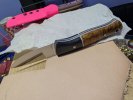
3K is getting there, but a bright reflective finish will light up a few steps up the progression. Your 3K paper will leave a smooth surface with a scratch pattern invisible to most eyes, but it will still have a gray, overcast look.

The good news is, if you get a clean 3K finish you have done most of the hard work. One or two more grits and it will clear up a lot. 3K is about 6-7 microns, one or two more grits and you will be glad you went a little further.

Lapping film is more costly than sandpaper, but good lapping film makes this job a lot quicker, and a glass platen keeps the film off the apex. This cheap D2 shined right up after a ten-minute polish job on SC lapping film, and it still cut like it did before the polishing began.

cFxXUuY.jpg
 
I just bought some wet and dry sandpaper in 800, 1200, 2000 and 3000 is that enough for a mirror polish?
:thumbsup:
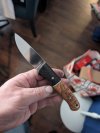
Make the very most of the 800 starting out, to completely remove the coarse scratches shown in your photos. The 800 will wear quickly and its grit will break down to something finer, which slows its working speed. Ideally, starting with something like 320-400 would be more effective for cleaning up the heavy scratches in that first step. If that's done well, then the progression through 800 > 1200 > 2000 > 3000 will produce much more pleasing results. Anything beyond 2000 is usually where I've used a strop with polishing compound to finish up.
 
Last edited:
I went through a good bit of hand sanding recently, on 64 HRC Magnacut. Changing the grit direction does help a lot since just going the same direction will hide and cover a lot of the deep scratches, until you get to a fine enough grit they look like claw marks in the steel and you need to go back down again. Even changing directions early on and then doing length wise after 800 or so will help a lot. You can also do 45 degrees if it's easier. Make sure you spend enough time at each grit removing the previous scratches, too.

Took a long time, but I am happy with this hand rub finish on Magnacut:
600302276_10103131686068210_3003733656278708527_n.jpg

Looks a bit different at different angles, but looks nice!
601969406_10103131685574200_7744370894858599643_n.jpg

It's not a mirror finish, but its a nice one!

Get some 3/8" thick Micarta or G10 Scales and a Dura Gold SIC sandpaper assortment (120-3000) and some WD40. The Micarta or G10 will give you a hard backer to use; I use the edges to concentrate the force in a smaller area. The corners help getting into the plunge cuts, too. I put some leather on one side to give a softer backer, which helps at the finer grits especially. You will get little j hooks and start/stop marks, but don't worry about those. I use those to tell me when I am done with the next grit. IE when the 400 grit takes out the J hooks from the 220 grit, I know I am just about ready to move on to the 600 grit! The WD40 helps the paper from clogging up as quickly. Some people also use a hard rubber piece like an eraser.

I have a 2x2" square piece of wood that I clamp the knife down to and clamp that to a work table so I don't have to hold the knife. This lets me get straight pulls easier and to be able to put more force onto it, too, which makes a difference! Putting pressure, especially with the lower grits, will make them work quicker, but will leave deeper scratches to remove, so I lighten up the pressure as I get to the finer grits.

Another finish you can do is using SIC powder like for rock polishing. 220, 500 and 1200 are available and you make a slurry with the grit and some mineral oil and use some leather and fine SIC sandpaper (500-1500 usually) to use as a finger stone with the slurry on it to sand the blade. It will give a more matte finish to the steel, but it may look nice on a laminated blade. This helps get into any uneven grinds on the blade. It makes a faux kasumi type finish, so it's nice for laminated blades like Japanese kitchen knives with a Kasumi finish where the soft cladding is a darker matte grey and the edge of hard steel is more polished. The leather/power slurry and sandpaper gets into the ripples so the area doesn't have to be perfectly flat ground.

This is on an edge quenched blade with the faux kasumi finish:
20230530_112915.jpg
 
Why do you think it's important to have a mirror polished edge? There is no benefit to it.
A good synthetic ruby stone can mirror polish.
 
Back
Top