Can you heat treat with a torch? I have a bernzomatic torch, can you heat treat the blade with it? I know you need to get it red hot, non magnetic and let it slowly cool. Then for the blade edge you heat it up red hot, just the edge, then quench it in oil or similar, I heard that vegetable oil is the way to go. After this is done you heat up the back to straw color then either quench it or let it cool slowly(I forget which). I don't have a forge yet, that is why I am wondering if I could use a torch for this. I need to get past the heat treat to finish this knife, it is my first one. Any help would be greatly appreciated I want to finish this knife for next weekend.

-
The BladeForums.com 2024 Traditional Knife is available! Price is $250 ea (shipped within CONUS).
Order here: https://www.bladeforums.com/help/2024-traditional/
You are using an out of date browser. It may not display this or other websites correctly.
You should upgrade or use an alternative browser.
You should upgrade or use an alternative browser.
Heat treating with a torch?
- Thread starter jmar595
- Start date
- Status
- Not open for further replies.

Stacy E. Apelt - Bladesmith
ilmarinen - MODERATOR
Moderator
Knifemaker / Craftsman / Service Provider
- Joined
- Aug 20, 2004
- Messages
- 38,235
I'm going to go out on a limb and guess you have no idea what you are doing.
STOP before you mess up a blade (minor problem) or hurt yourself (bigger problem). You need to read a book or two on knifemaking and heat treating. The worst words I ever hear form people is "I Heard" this or that. READ it, STUDY it, and LEARN it before you DO it. Forums and the INTERNET are great, but they are not a replacement for reading.
Sorry to blast you, but you need to slow down. Filling out your profile will help us understand where you are and how much life experience you have.
Stacy
STOP before you mess up a blade (minor problem) or hurt yourself (bigger problem). You need to read a book or two on knifemaking and heat treating. The worst words I ever hear form people is "I Heard" this or that. READ it, STUDY it, and LEARN it before you DO it. Forums and the INTERNET are great, but they are not a replacement for reading.
Sorry to blast you, but you need to slow down. Filling out your profile will help us understand where you are and how much life experience you have.
Stacy

- Joined
- Nov 29, 2005
- Messages
- 475
You've got some critical points there wrong. My tutorial isn't super great, but it may help you start.
I recomend Wayne Goddard's $50 dollar knife shop.
http://www.bladeforums.com/forums/showthread.php?t=461906
happy knife making!
I recomend Wayne Goddard's $50 dollar knife shop.
http://www.bladeforums.com/forums/showthread.php?t=461906
happy knife making!
- Joined
- Jan 20, 2004
- Messages
- 1,526
jmar595, a couple weeks ago, I did exactly what you proposed doing. Here's my experience.
I do have a forge, but am currently out of propane, so I went ahead and heated a test knife with a Bernzomatic. I was using 1095 steel with a stock thickness of 1/8". The knife I heated was thinner than that, though. It was a 3" blade, 6.75" OAL.
With that little Bernzomatic, I could get a small segment of the steel non-magnetic, but I could never get the entire edge sufficiently and thoroughly hot. I heated the knife and quenched it twice. At times, the knife was secured in a vice, which may have acted as a heatsink. For the second heating, though, I held the knife with a pair of forge tongs and heated the blade on both sides with the torch. Doing this, I could get the whole blade edge red, maybe even non-magnetic, but it was not a satisfactory heat.
After heating/quenching, I tempered the knife once for 1.5 hours at 375*F then put an edge on it. The edge became quite sharp, but it bent without returning when flexed on a brass rod. I then bent the blade in a vice. It bent somewhat easily to beyond 90*. I then straightened the knife and bent it again, finally able to snap it.
Upon inspection, the steel's grain was uneven - a fine grain on the perimeter, but a chunky, coarse grain on the inside.
My heat-treating with a Bernzomatic showed me that the little torch simply doesn't get hot enough to heat even thin (3/32") knives thoroughly. It also showed me that 1095, even with a thin cross-section, is a shallow-hardening steel. An oxy-acetylene torch would probably work well, once one has practiced with it.
Hope this gives you a bit of insight, jmar.
I do have a forge, but am currently out of propane, so I went ahead and heated a test knife with a Bernzomatic. I was using 1095 steel with a stock thickness of 1/8". The knife I heated was thinner than that, though. It was a 3" blade, 6.75" OAL.
With that little Bernzomatic, I could get a small segment of the steel non-magnetic, but I could never get the entire edge sufficiently and thoroughly hot. I heated the knife and quenched it twice. At times, the knife was secured in a vice, which may have acted as a heatsink. For the second heating, though, I held the knife with a pair of forge tongs and heated the blade on both sides with the torch. Doing this, I could get the whole blade edge red, maybe even non-magnetic, but it was not a satisfactory heat.
After heating/quenching, I tempered the knife once for 1.5 hours at 375*F then put an edge on it. The edge became quite sharp, but it bent without returning when flexed on a brass rod. I then bent the blade in a vice. It bent somewhat easily to beyond 90*. I then straightened the knife and bent it again, finally able to snap it.
Upon inspection, the steel's grain was uneven - a fine grain on the perimeter, but a chunky, coarse grain on the inside.
My heat-treating with a Bernzomatic showed me that the little torch simply doesn't get hot enough to heat even thin (3/32") knives thoroughly. It also showed me that 1095, even with a thin cross-section, is a shallow-hardening steel. An oxy-acetylene torch would probably work well, once one has practiced with it.
Hope this gives you a bit of insight, jmar.
You can, but you need to build a forge. I use a Bernzomatic torch for my mini forge.
Also do some research into the process.
You need to understand each process and why and what it does.
It's not difficult, but there are many critical factors. It's not just about heating the steel to nonmagnetic.
Also do some research into the process.
You need to understand each process and why and what it does.
It's not difficult, but there are many critical factors. It's not just about heating the steel to nonmagnetic.
- Joined
- Nov 29, 2005
- Messages
- 475
I highly recomend reading posts, about heat treatment info, hardening and tempering, etc... by Kevin R. Cashen.

I agree pretty much with what physh said. I am not sure where but I know there are threads here regarding making a single firebrick forge. Its simple and will help you get a more consistent and higher heat on your blade for HT. Also one single firebrick wont break the bank so its worth while. Like stacy said, try and understand exactly what is happening within the metal structure before you do heat treats. This will also help you solve potential problems that may occur.
Lang
Lang

- Joined
- Feb 17, 2007
- Messages
- 3,375
As a guy who used to harden my knives with a torch here is my take. Unless it is very small blade a simple propane/butane torch will not get it. Next with a oxy/act you can easily reach temperature of non magnetic. Usually the steels harding point is a bit higher. The real rub comes in when you know that to do the best harding even for a simple steel you should have some soak time. A simple steel like 1080/84 or 1095 should stay at temp for about 10 minutes. Once the steel is over non magnetic all you have is its color when using as torch. If you over heat you will cause the steel's grain to grow and it will not be as tough even after the temper. Trying to keep the blade in that range evenly along the whole blade length for anywhere near 10 minutes is very hard. I would move the torch keep it farther away only pass it over the blade when I thought the color was dropping etc. Then after a few minutes I would quench. At the time I used ATF. Yes they got hard and you could get them razor sharp. No, they were not the best that they could have been. I bought a old pottery kiln off Craigs list for a $80 bucks and cut 4" hole in the lid. I got a thermo couple and controller and a SCR off ebay for a bit over $100, Now I place my blanks on a piece of stainless wire and hang them in the kiln with a fire brick over the hole. Now I know that my blades are getting a 10 minute soak at the correct temperature. Then I lift out each blank on its wire and plunge it into an old pressure cooker full of Parks fast quench oil. Now I know that part is right. I have redone a toaster oven to my satisfaction and I have an accurate temp probe in it to verify my temps when I temper them to 400 degrees for 2 hours cool and then give them 2 more hours at 400. Yes, I got good hard blades that would sharpen and work with a torch. After reading and learning and realizing the most important thing about a knife is its HT, I am at a point where I KNOW that that part of the job is approaching its maximum.
That said I recommend a furnace or a forge (I will recommend a pyrometer). Also torch or forge I will also say it is best if you run a bit rich. With a oxy/act run a bit of tail on your blue flame and give your forge a bit more fuel than it needs, This will help make sure the majority of oxygen if used in combustion and not used to leech carbon from you blade. Less scale and decarbonation
As it is your first knife and all and you will proably keep it. It would not hurt you to have the experience of doing the hardening with an oxy/act torch and temper it with a kitchen oven checked with a candy thermometer. I see you are a airplane mech., so I assume you have access to a oxy/act torch. If you would rather I will do a real hardening for you if you mail me the blank and include return postage,
ALSO WHAT STEEL is the blank????????????
That said I recommend a furnace or a forge (I will recommend a pyrometer). Also torch or forge I will also say it is best if you run a bit rich. With a oxy/act run a bit of tail on your blue flame and give your forge a bit more fuel than it needs, This will help make sure the majority of oxygen if used in combustion and not used to leech carbon from you blade. Less scale and decarbonation
As it is your first knife and all and you will proably keep it. It would not hurt you to have the experience of doing the hardening with an oxy/act torch and temper it with a kitchen oven checked with a candy thermometer. I see you are a airplane mech., so I assume you have access to a oxy/act torch. If you would rather I will do a real hardening for you if you mail me the blank and include return postage,
ALSO WHAT STEEL is the blank????????????
- Joined
- Sep 9, 2003
- Messages
- 2,361
I am in another round of testing right now dealing with soak times and much lower than recommended temperature ranges and some surprises have come from it but much of my previous suspicions have been well confirmed.
Bladesmithing was born in times of very simple steels, indeed early steel development was a result of techniques used in smithing, the problem is that bladesmithing is an ancient craft that has been introduced to modern alloys and has not adjusted or compensated for that fact. A forge is primitive enough when using modern alloys but a torch is even more removed from optimum equipment for them, in fact it is about as primitive as it gets when you consider that a good campfire would heat more evenly and with a better atmosphere.
However I am not going to rain on your parade entirely but instead point out that if you are dealing with that level of simplicity it would be wise to match your steel to it. Any carbide forming elements are best avoided and excess carbon or iron (ferrite) that you will not be able to deal with efficiently. All this would bring you to a simple steel like one of the 10XX in the range of .70% to .85% Carbon. So your best shot at decent results would be 1070, 1080 or 1084, many other steels would have carbides and other properties that just would not be properly utilized with a 30 second soak at an unknown temperature with a torch. What many have done in the past is to compensate by using unorthodox methods to segregate the carbide they cannot properly manipulate in order to make micro-saw blade instead of a knife edge and thus get results that satisfy them, but much of industry does the opposite of.
P.S. Thank you for the vote of confidence Blue Dragon, but my name alone on information is not nearly as important as having it verifiable, make sense and be backed up with sound facts. There is loads of such information out there, just not as much in knifemaking unfortunately , there is a whole lot of veiled advertising, but not much real information.
Bladesmithing was born in times of very simple steels, indeed early steel development was a result of techniques used in smithing, the problem is that bladesmithing is an ancient craft that has been introduced to modern alloys and has not adjusted or compensated for that fact. A forge is primitive enough when using modern alloys but a torch is even more removed from optimum equipment for them, in fact it is about as primitive as it gets when you consider that a good campfire would heat more evenly and with a better atmosphere.
However I am not going to rain on your parade entirely but instead point out that if you are dealing with that level of simplicity it would be wise to match your steel to it. Any carbide forming elements are best avoided and excess carbon or iron (ferrite) that you will not be able to deal with efficiently. All this would bring you to a simple steel like one of the 10XX in the range of .70% to .85% Carbon. So your best shot at decent results would be 1070, 1080 or 1084, many other steels would have carbides and other properties that just would not be properly utilized with a 30 second soak at an unknown temperature with a torch. What many have done in the past is to compensate by using unorthodox methods to segregate the carbide they cannot properly manipulate in order to make micro-saw blade instead of a knife edge and thus get results that satisfy them, but much of industry does the opposite of.
P.S. Thank you for the vote of confidence Blue Dragon, but my name alone on information is not nearly as important as having it verifiable, make sense and be backed up with sound facts. There is loads of such information out there, just not as much in knifemaking unfortunately
, there is a whole lot of veiled advertising, but not much real information.i tried to use a torch to just anneal a blade and while it worked ok it wasnt great, i couldnt really get it fully red even with a make shift forge of fire bricks around it with very minimal space
it you really really really want to HT now you can resort to charcoal (briquets are supposedly bad bad bad but the first knife i did i used briquets and its has a good strong edge still (its a very small knife so its just used for cutting not much harsh abuse, natural charcoal is better and you can basically just take hard wood and burn it down to embers and use that)
a friend uses an oxy/aceteline torch to make knives (makes very few and far between) but he also doesnt know a lot of the small differences that make a huge difference and doesnt understand a lot of metallurgy so his tips and techniques some times are bad
-matt
it you really really really want to HT now you can resort to charcoal (briquets are supposedly bad bad bad but the first knife i did i used briquets and its has a good strong edge still (its a very small knife so its just used for cutting not much harsh abuse, natural charcoal is better and you can basically just take hard wood and burn it down to embers and use that)
a friend uses an oxy/aceteline torch to make knives (makes very few and far between) but he also doesnt know a lot of the small differences that make a huge difference and doesnt understand a lot of metallurgy so his tips and techniques some times are bad
-matt
- Joined
- Jan 16, 2006
- Messages
- 1,246
I have used two MAPP gas torches to HT 2 to 2 1/4" blades for my frontier folders. By placing the blade in the center of the converging flames the heat is equal. I would not try to HT any blades bigger then that.
For little blades it's just not worth firing up the forge for.
For little blades it's just not worth firing up the forge for.

- Joined
- Jun 2, 2007
- Messages
- 1,354
i think your better off using a small barbeque grill and a hair dryer! Torches are simply not very effective in heat treating a blade that you want evenly hard throughout. Obviously there are guys out there that have done it that way with over 100+ or 1000+ blades, but they have so much practice in doing it that if it's your first blade and you don't wanna screw it up because it look you forever to file, grind, etc, then try to barbeque pit method and some kind of blow dryer set on low that will shoot air from the bottom. Kinda sounds a bit scary, but with some kind of piping it shouldn't be dangerous. Also try some hardwood charcoal and not briquette or however you spell it. Those get hotter in my opinion...alot may disagree....or just build a forge! There's a ton of guys on here that build everything they use and they are the kind of guys that are more than happy to share information with anyone!
If you're just screwing around and don't really care about that knife blank you just made (hopefully you have ground/filed in the bevels already) otherwise forget it if you think you're gonna file it in by hand after heat treat. You can quench in warm vegetable oil. Use a cheap toaster oven and temper. When you're actually done with the torch part and quench part, take a new file and try to file the edge. if it bites in, you didn't get it hot enough or quench it fast enough, but if the blade skips over and cannot bite, then you've got something there. not saying it will be perfect, but atleast this blade will hold an edge somewhat after you temper it. 400 degrees for 1 hour (2 or 3 times) cool to room temperature between temperings. Or send it out to have it heat treated by one of these guys on here that do that particular steel everyday! good luck!
If you're just screwing around and don't really care about that knife blank you just made (hopefully you have ground/filed in the bevels already) otherwise forget it if you think you're gonna file it in by hand after heat treat. You can quench in warm vegetable oil. Use a cheap toaster oven and temper. When you're actually done with the torch part and quench part, take a new file and try to file the edge. if it bites in, you didn't get it hot enough or quench it fast enough, but if the blade skips over and cannot bite, then you've got something there. not saying it will be perfect, but atleast this blade will hold an edge somewhat after you temper it. 400 degrees for 1 hour (2 or 3 times) cool to room temperature between temperings. Or send it out to have it heat treated by one of these guys on here that do that particular steel everyday! good luck!
I think I will go with the charcoal forge. I don't want to mess this blade up, but I want to finish it for this weekend. I need to finish the heat treat so I can solder on the bolster. I don't have access to oxy acety, wish I did though. I will try with a simple charcoal forge for this one, and I am looking at building a gas forge and a charcoal one (little better than the one I will use for this one). I did a search on forge building and they are relatively inexpensive and easy to make. May take a little time that's all. I really like making knives, even though it has taken me so long to do this first one.
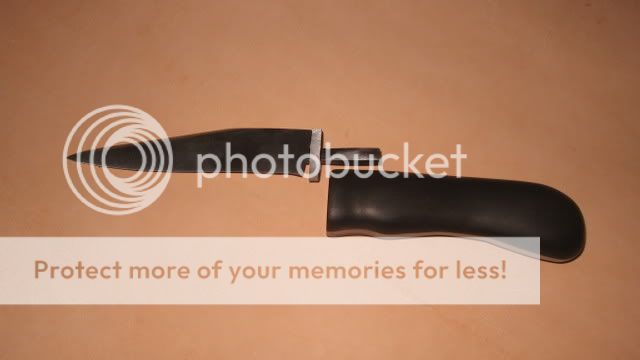
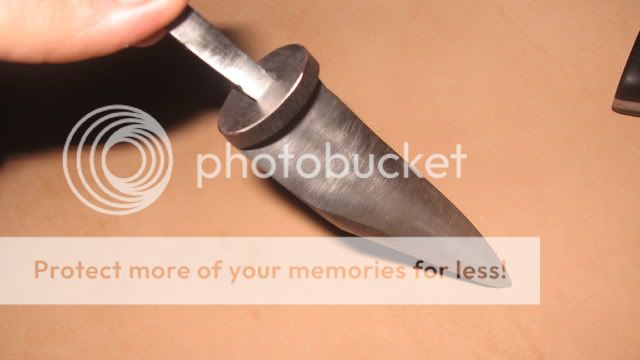
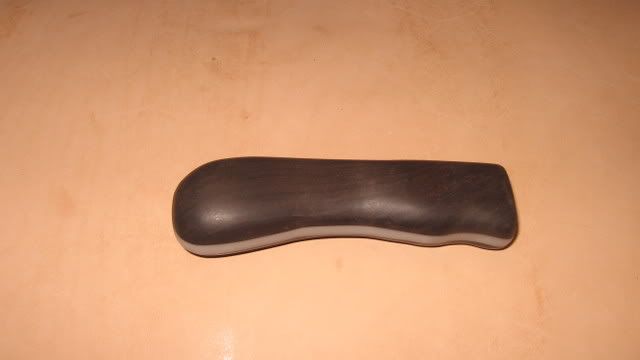
that is a really interesting shape especially for a first blade, not bad, just different (i do like).
that are those, rose wood handles?
for my "forge" i took 4 basic building bricks with the holes all in them and made a rectangle with them on the ground (one their sides so the holes went in-out of the rectangle). then i out fire bricks above them in the same fasion, placed more fire bricks to cover up the top and made a very small hole to have a draft to keep everything burring well. i used briquettes but hard wood or real charcoal would have been better, got them going real will with a lot of lighter fluid and let it burn for about 30 mins. used a little hand bellows from my fire place and pumped air through the holes every few mins. i got the blade up to a nice bright orange and kept it there for 10-15 then, i also had placed a piece of scrap about the same size as the blade (maybe a little smaller) and heated it the same, dropped that in the oil (it was a very small blade and i used a large bread pan (one of the foil one) to quench in so the scrap heated it well). pulled the blade out, quick into the oil, stoped bubbling and smoking, got it out, right into preheated oven to temper.
i had to do this 2 times, because the first blade i did got warped a little and i tried to straighten it but snapped it... and i needed to put it into my portfolio for school so i was kinda screwed, got the second one ok though
-matt
that are those, rose wood handles?
for my "forge" i took 4 basic building bricks with the holes all in them and made a rectangle with them on the ground (one their sides so the holes went in-out of the rectangle). then i out fire bricks above them in the same fasion, placed more fire bricks to cover up the top and made a very small hole to have a draft to keep everything burring well. i used briquettes but hard wood or real charcoal would have been better, got them going real will with a lot of lighter fluid and let it burn for about 30 mins. used a little hand bellows from my fire place and pumped air through the holes every few mins. i got the blade up to a nice bright orange and kept it there for 10-15 then, i also had placed a piece of scrap about the same size as the blade (maybe a little smaller) and heated it the same, dropped that in the oil (it was a very small blade and i used a large bread pan (one of the foil one) to quench in so the scrap heated it well). pulled the blade out, quick into the oil, stoped bubbling and smoking, got it out, right into preheated oven to temper.
i had to do this 2 times, because the first blade i did got warped a little and i tried to straighten it but snapped it... and i needed to put it into my portfolio for school so i was kinda screwed, got the second one ok though
-matt
Stacy E. Apelt - Bladesmith
ilmarinen - MODERATOR
Moderator
Knifemaker / Craftsman / Service Provider
- Joined
- Aug 20, 2004
- Messages
- 38,235
Just a comment, but the tang should be at least twice as long as it is on that blade. You can weld on an extension with a MIG welder easily if you have access to one.
The reason that it is too short is that it may split the handle when cutting down hard on something. The blade is about four times the length of the tang ,so the force at the end of the tang is four times as great. Epoxy it in well and it should be OK for a first knife. Make the next one longer.
Stacy
The reason that it is too short is that it may split the handle when cutting down hard on something. The blade is about four times the length of the tang ,so the force at the end of the tang is four times as great. Epoxy it in well and it should be OK for a first knife. Make the next one longer.
Stacy
The handle is black african wood and teflonin the middle. Yes, the tang is very short. I need a longer bit to go into the handle more. I do not have access to a welder, wish I did. I destroyed the ricasso on this blade, learned a lot on this one. Still a lot more to learn though.
- Status
- Not open for further replies.